
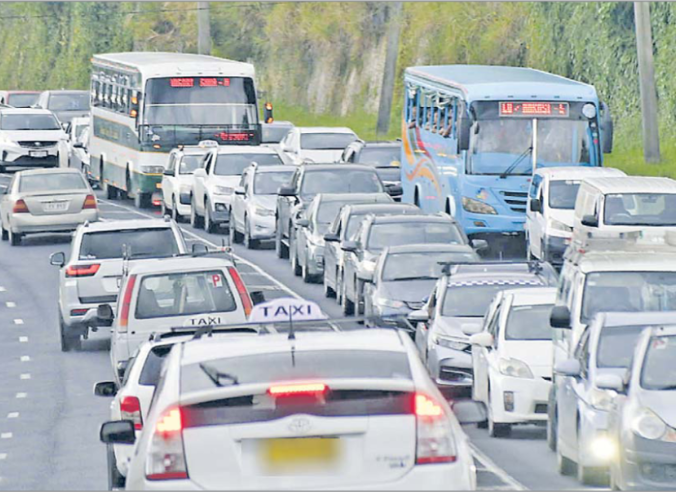
Commuters are venting their frustration on social media over continued delays in addressing traffic congestion along the Suva–Nausori corridor.
One user said their vote in the next general election would depend on what concrete solutions a politician can deliver to ease the long-standing traffic problem.
“Traffic will determine who I vote for,” the commenter wrote, adding that leaders must prioritise practical changes rather than promises.
Another claimed that despite plans formulated with the Land Transport Authority, little progress was seen on the ground.
Daily travellers also shared the personal toll of congestion. One commuter said traffic has been a major issue in Fiji for years, with many spending hours on the road, particularly those relying on taxis.
“It’s tiring, costly and affects everyone’s day-to-day life,” the post read.
A regular commuter travelling from Nausori to Suva said travel times have significantly worsened.
“What used to take less time now takes hours because of traffic congestion,” the commuter shared.
Many online users are now calling for urgent and lasting solutions to improve traffic flow and reduce daily commuting stress.
Peak-hour traffic leaves workers exhausted
BY the time the sun rises over Suva, Aminiasi Tudrau has already been on the road for hours – exhausted, hungry and stuck in traffic that barely moves.
The early morning commuter from Naduria Village in Rewa says the once-manageable Suva– Nausori corridor has turned into a daily nightmare, with travel times nearly tripling since the new school term began.
“Last year around mid-year up to December, the traffic was not that bad,” he said.
“But compared to this year when school started, we can feel there’s a huge difference.”
Mr Tudrau boards the 5.30am government workers’ bus each morning bound for the Government Buildings in Suva.
Previously, he would arrive at work by 6.10am or 6.20am. Now,
he reaches the office around 8.30am – nearly three hours after leaving Nausori.
Traffic begins building from Koronivia, with the stretch to Nakasi taking up to two hours due to multiple junctions and intersections feeding into the main road.
“Sometimes the traffic is not literally moving. It just stops,” he said.
The delays are not just inconvenient – they are taking a personal toll. Waking at 4am often means skipping breakfast.
By the time commuters reach Suva, many are drenched in sweat and battling fatigue.
“We bathe properly before we leave home, but when we’re stuck in traffic and the sun comes up, the heat affects us. We end up sweating and feeling sleepy.
“We try to stop ourselves from sleeping inside the bus. It’s embarrassing.”
Mr Tudrau believes rising vehicle numbers, traffic light timing and road infrastructure gaps are fuelling the congestion.
He is urging authorities to review traffic management, road expansion and even school transport arrangements.
“Most parents prefer dropping their children to school, even when school buses are available.
“If students used school buses directly and parents went straight to work, maybe it could reduce congestion during that peak time.
“Right now, traffic congestion along the corridor is a big issue in Fiji. Something needs to be done.”
Lecturer calls for strategic planning
AS traffic congestion worsens along the Suva–Nausori corridor, University of the South Pacific lecturer Rajendra Prasad is calling for long-term planning and practical infrastructure improvements rather than restricting vehicle ownership.
“Instead of saying let’s restrict the number of vehicles, that goes against the basic rights of people,” he said while urging authorities to fix structural issues.
“Increasing number of vehicles is also a sign of development happening in the country.”
Mr Prasad, who commutes daily from Nakasi to Suva, stressed that rising vehicle numbers reflected growing middle-class purchasing power and should be anticipated through strategic planning.
“We used to have national development plans for the next 10 years.
“I believe that is missing now. We are trying to apply Band-Aid solutions by solving today’s problem without worrying about the future.”
He urged agencies such as the Bureau of Statistics to project trends in income growth and vehicle ownership to guide infrastructure development over the next 10 to 20 years.
Mr Prasad pointed to immediate fixes, including proper road maintenance, completing roadworks thoroughly, and scheduling maintenance during off-peak hours.
“Roadworks should be done when traffic is minimal, not during peak hours,” he said, highlighting Ratu Dovi Rd as a missed opportunity where fourlane sections narrow unnecessarily.
While acknowledging ideas like staggered school hours, he cautioned that solutions required careful planning.
“Every solution has pros and cons. It’s not a small matter to just change hours.”
He noted the lack of co-ordination among agencies such as the Fiji Roads Authority, Water Authority of Fiji, Telecom Fiji and Energy Fiji Ltd.\
“The increasing number of vehicles is not going to stop. In the meantime, we can at least fix the immediate infrastructure problems properly and once and for all.”
Practical, forward-looking solutions, he believes, are key to easing commuter stress and managing Fiji’s urban growth.

