
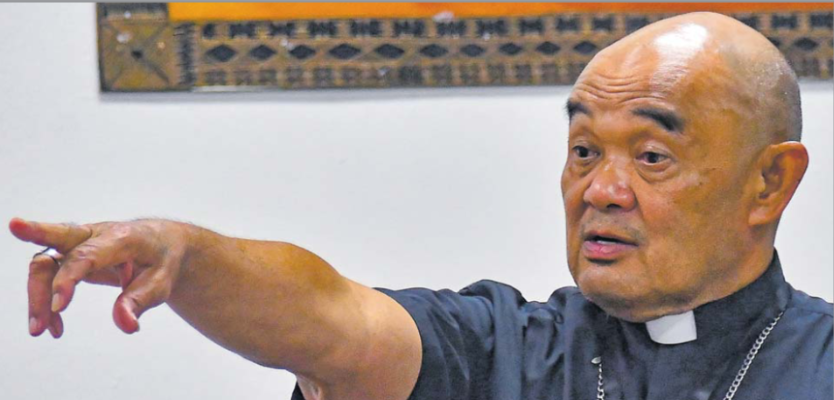
Archbishop Peter Loy Chong has called for a united response from Fiji’s Christian, Hindu, and Muslim communities to tackle the country’s growing drug problem.
Speaking on renewed efforts to address substance abuse, the Archbishop said faith groups represented a powerful force for prevention and social change.
He acknowledged that past collaboration between churches, the police and traditional leaders had been weak, but said renewed efforts were now underway.
The Fiji Council of Churches, which includes 13 Christian denominations, provides a foundation for stronger cooperation, Archbishop Loy Chong said.
He added that expanding collaboration to include Fiji’s Hindu and Muslim communities would cover 98 per cent of the population, creating a united front.
The Catholic Church plans three youth seminars on drug prevention this Lent in Suva, the Western Division, and the Northern Division.
The Fiji Council of Churches, working with the police, will engage other religious groups to develop a shared approach focused on prevention, compassion, and community engagement.
“Tackling the drug crisis requires cooperation across faith groups, communities, and state agencies,” Archbishop Loy Chong said.
“Real progress depends on moving beyond dialogue to action at village and community levels.”
‘Need for more rehab centres’
THE Catholic Church in Fiji has joined the chorus of calls urging Government to urgently invest in more rehabilitation centres.
The church urged communities to respond to drug addiction with compassion rather than expulsion as it could push young people into more dangerous situation.
Archbishop Peter Loy Chong said the church supported prevention and care but could not meet rehabilitation needs alone.
“Churches don’t have the money to build a rehab, and that’s why the Government needs to invest in rehab,” he said.
“Right now, there is only one rehab that is undersourced and under-staffed.”
He added that recovery must also begin early in schools.
“It is necessary to have counsellors in schools.
They are part of the rehab process.”
He stressed that treatment must be matched with a change in community attitudes.
“Somebody who is addicted to drugs is really crying out. He’s crying out for recognition, crying out for love, crying out for belonging.”
He warned that harsh responses only deepen harm.
“If your language is too judgmental, if you are overly strict and find no space for people with drug addiction then that’s not a good language to give to these young people.”
He rejected calls to remove addicts from villages.
“What we are hearing some villagers say, we’ll expel them from the village.
No, that’s not a good language to give to these young people.
“They need love and understanding. They are not a problem on their own, there are other things that cause this problem.”
Archbishop Loy Chong said real progress required rehabilitation, counselling, and compassion working together to help people recover and protect communities.
Vulnerable children at risk
FIJI is at risk of prioritising economic partnerships and labour mobility schemes while failing to protect its most vulnerable children, Associate Professor Jose Santos of the Pacific Regional Security Hub has warned.
Speaking at the National Pastoral Response to Drugs workshop, Mr Santos questioned the hidden social cost of overseas employment and close regional ties.
“You look at the seasonal workers; it’s the best thing for the economy. Yes, but when parents go away to work overseas, who’s looking after the children,” he asked.
He said many children were left in the care of relatives already affected by drug addiction.
“If they’re addicted to drugs, what do you think they’re going to do? They’re going to use the children to make money to pay for their drugs.”
Mr Santos linked these vulnerabilities to the growing presence of foreign sexual offenders in the Pacific.
“We have people coming from Australia, New Zealand, America for what they call pedophile holidays in the Pacific.
“They come to the region because they know there is no strong protection for children and families under economic duress.”
He warned the Pacific lags other regions in safeguarding children.
“In Australia, people on the sex offenders list are banned from travelling to Southeast Asia. If you come to the Pacific, you don’t get stopped. Easy takings.”
Mr Santos questioned why governments moved swiftly to protect trade interests but failed to show the same urgency for child protection.
“You protect Southeast Asia because of trade, and you don’t protect the Pacific because of vuvale. You like using that word.”
Drugs linked to broken families, moral decline, says Archbishop
THE rise of drug problems in Fiji is closely tied to broken families and moral decline, Archbishop Peter Loy Chong has warned.
“We discussed what we are seeing happening on the ground, but we also pushed the discussion to what is causing what’s happening … to understand the root causes of the problem,” he said.
“Two areas stand out very clearly: the breakdown of families, and the spiritual crisis or moral decay.
These are where the church should be involved.”
While law enforcement, health services, and economic factors play a role, Archbishop Loy Chong said the church had unique resources to support families and restore values.
“On the ground, nobody can deny the church has a very important role in addressing the drug problem and helping people with addiction.”
Prevention programs, he said, must focus on strengthening families, supporting couples, and preparing youths for life and marriage, core measures that could reduce the risks driving young people toward drugs and build resilient communities.

