
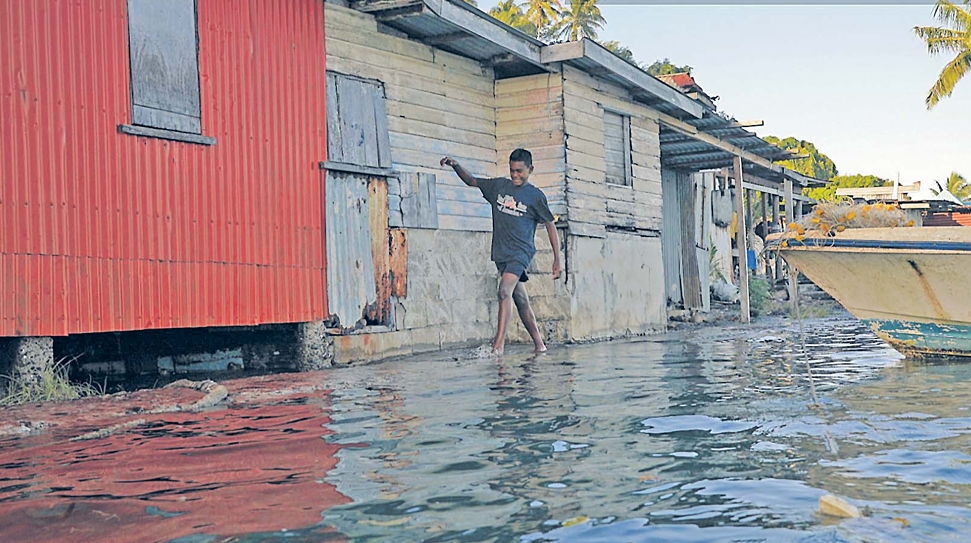
THE Ministry of Environment and Climate Change is strengthening its push for community-led climate action through the Climate Catalytic Fund (CCF), aimed at supporting those most vulnerable to climate impacts.
Permanent secretary Dr Sivendra Michael said the fund represented more than just financial support.
He said the Climate Catalytic Fund “has become more than a financing mechanism — it stands as a practical commitment to community-centred solutions that empower those living with climate risk every day to act with their own knowledge, priorities and experience.”
Fund focused on frontline communities
Dr Michael said the CCF targeted community-led actions particularly in areas facing heightened displacement risks.
“It recognises that communities understand their risks better than anyone,” Dr Michael said.
“What they often lack is not ideas, but the technical pathway to turn those ideas into fundable, eligible projects. That is the gap this Fund is designed to close.”
Ba and Macuata first in line
In its first funding cycle, the ministry has focused on Ba and Macuata, the two provinces identified through the Risk Index for Climate Displacement (RICD).
Each province will receive up to $US25,000, with individual projects ranging from $US5000 to $US25,000.
The funding is targeted at practical, quick-impact and locally led adaptation actions.
Dr Michael said consultations showed communities in both provinces were determined to adapt and reduce the risk of displacement.
“The RICD allows us to be precise. It helps us identify where the risks are highest, where displacement pressures are emerging, and where small, early interventions can make a significant difference before those risks escalate into emergencies.”
Blending science with lived experience
Dr Michael said the RICD tool combines scientific data on hazards, exposure and vulnerability with insights gathered directly from communities.
“The result is investments that are evidence-based, but equally grounded in the lived realities of the people experiencing those risks.
“As stewards of our Blue Pacific, we carry a responsibility to protect our lands, our waters and our people. This decade demands that we move from plans to implementation at scale.”
Helping communities stay, not relocate
While acknowledging progress, Dr Michael said there was still much more work to be done.
“The Fund supports communities at risk of displacement who are choosing to remain where they are. That means supporting practical measures that reduce vulnerability now.”
He said the CCF would support practical adaptation initiatives.
“This includes strengthening flood-prone areas, improving drainage, reinforcing coastal and riverine protection, supporting resilient livelihoods, and scaling nature-based solutions such as mangrove and reef restoration that protect both people and ecosystems.”
NDC 3.0 sets direction for next decade
Dr Michael said Fiji’s NDC 3.0, launched in late 2025, provides the national roadmap for climate action over the next 10 years.
“A Costed Implementation Plan is now being developed to translate these policy commitments into practical action.”
He said this would create a pipeline of projects aligned to NDC targets across sectors.
Millions mobilised through climate finance
Reflecting on the ministry’s achievements, Dr Michael said the start of the year had been a time for reflection.
“In 2025, Fiji mobilised $US142.7million in climate finance.
“This is not funding implemented by the Ministry alone — it is delivered through sectoral ministries such as Public Works, Energy, Agriculture and Waterways.
“Our role is to unlock and coordinate access to these resources across government so that climate action is integrated into national development.”
He said an Adaptation Fund allocation of $US5.7million was awarded for Nature Based Seawalls Project implemented by the Pacific Community and executed by the Ministry of Agriculture and Waterways.
Quick grants remove funding barriers
Dr Michael said the CCF’s quick-grant approach was designed to avoid long and complex processes.
“These are quick grants. They do not take one to two years to prepare.
“Within weeks, communities can develop proposals and access funding between $US5000 and $US25,000 for practical action.”
Support already reaching communities
He also highlighted funding already delivered under the Communities Climate Adaptation Fund.
“Through the Communities Climate Adaptation Fund under the Global Climate Mobility Centre, up to USD$100,000 has already been awarded to Macuata-i-wai, Narata and Vuniniudrovu, which are now in implementation.”
Expanding access across sectors
Dr Michael said the Ministry’s climate finance strategy now looks across government, communities, NGOs and the private sector.
“The Climate Finance Team works with the Project Development Unit to identify which funds can be accessed by government, which can go directly to communities, and which are designed for the private sector.”
He noted that some funds were restricted.
“For example, the Subnational Capital Fund under the GCF is only accessible to the private sector, not to communities or NGOs.”
Building community capacity
Dr Michael said the Ministry was now actively supporting communities to access funding.
“As I said in my remarks, this is our responsibility. We cannot advertise funding and expect communities to navigate complex criteria on their own.
“There are many eligible communities in Ba and Macuata. The reason applications are often few is not lack of need, but lack of proposal-writing capacity.”
He said the Ministry’s Project Development Unit was stepping in to close that gap.
“Our Project Development Unit has made it clear that we will work directly with communities to help them prepare proposals that meet the criteria and are eligible for funding.”

