
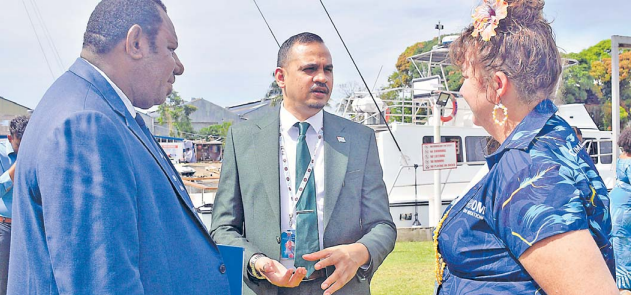
THE Ministry of Environment and Climate Change continues to work closely across sectors and with its partners to mobilise resources that support communities most vulnerable to climate impacts.
While making an opening remarks at the Climate Catalytic Fund (CCF) Fiji Symposium at the Royal Suva Yacht Club in Suva, permanent secretary for Ministry of Environment and Climate Change Dr Sivendra Michael said the Climate Catalytic Fund had become more than a financing mechanism but stands as a symbol of an unwavering commitment to practical, community-centered solutions that operate to empower those on the frontlines to act with local knowledge, creativity and purpose.
“The CCF targets community-led actions particularly in areas facing heightened displacement risks,” Mr Michael said.
“It recognises the need for flexible, locally-driven support, allowing communities to design and implement solutions that truly reflect their realities and priorities.”
He said in this first cycle, they were focusing on Ba and Macuata, the two provinces identified through the Risk Index for Climate Displacement (RICD).
Each province will receive up to $US25,000. Individual projects can range from $US5000 to $25,000, with funding focussed on practical, quick-impact, and locally led adaptation actions.
Mr Michael said from their consultations across climate-impacted communities, they understood that several communities in Macuata and Ba were determined to adapt and avert or minimise displacement.
“Here, the RICD plays a key role, helping us identify high-risk areas, allocate resources wisely, and give communities space to test practical solutions before risks escalate into crises.”
Mr Michael said the tool combines scientific data on hazards, exposure and vulnerability with insights directly from the communities.
“The result is investments that are not only evidence-based but as much grounded in the lived experiences of those who need the support most.
“We are reminded that as stewards of our Blue Pacific, we carry a profound responsibility to safeguard our lands and our oceans for future generations.
“This decade demands such innovation and calls for bold action, and unwavering commitment to scaled-up implementation.”
Mr Michael said Fiji had made progress, but there was still much more to do.
“By building on what we have and leveraging strong partnerships, we can create greater opportunities for more of our communities to thrive.
“The fund supports communities at risk of displacement opting to stay in place.
“It will consider practical adaptation activities such as retrofitting coastal or riverine infrastructure, strengthening flood-prone areas, or supporting resilient livelihoods.
“Complementary initiatives such as nature-based seawalls, reef and mangrove restoration further scale community-led adaptation and safeguard ecosystems.”
He said Fiji’s NDC 3.0, launched in late 2025 sets our climate action plans for the next 10 years, and recognised that adaptation and resilience were central to our development.
“A Costed Implementation Plan is being developed to translate these policy commitments into practice, tuning strategies into action, and hope into tangible results.
“A pipeline of projects is expected, informed by the NDC indicator targets across key sectors.”

