
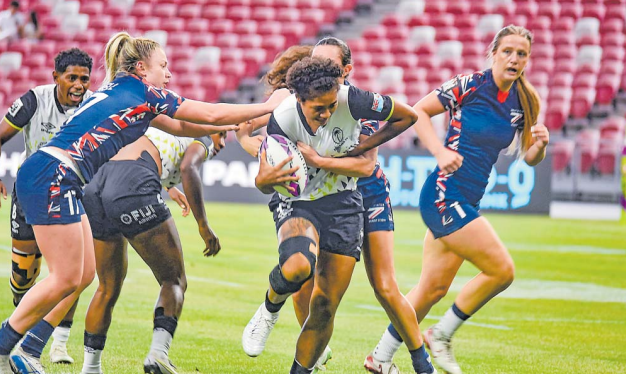
The euphoric celebrations for our Fiji Airways men’s 7s team, masters of the heart-stopping comeback, often drown out a more urgent and uncomfortable national conversation. While our men pull victory from the jaws of defeat, our Fijiana 7s team’s recurring struggles present a paradox: How can a nation so rich in rugby magic consistently field a women’s side that seems strategically and structurally left behind? A fan’s raw plea to integrate Fijiana XVs talent isn’t mere criticism; it is a spotlight on a systemic failure that betrays our rugby ethos.
The hollow echo of holistic development
THE Fijian Rugby Union (FRU) is not without a vision on paper. Its Annual Report 2023 speaks eloquently of a “holistic view of development” and a Development Unit committed to “challenging gender norms.” Yet, this philosophy seems to dissolve before it reaches the pinnacle of the women’s game. The contrast is stark. The men’s program benefits from a deep, integrated system where talent flow between 15s and 7s is managed and expected. The women’s program operates in fragmented silos. We celebrate the Fijiana Drua’s success in Super W and the growth of local Marama competitions, but treat these as ends in themselves, not as vital feeders for a world-class 7s engine.
This fragmentation creates a devastating talent drain. As highlighted by World Rugby’s own analysis, the professionalisation of women’s 15s has led to an “exodus” of Pasifika 7s stars to overseas clubs. Where is the proactive, Fijian-designed system to manage this transition, or better yet, to create a dual-pathway that allows players to serve both formats, as Aotearoa does so effectively? Instead, we see a reactive scramble, with the 7s program often looking depleted, while the FRU’s own rhetoric of “wholesome rugby work” rings hollow.
The Aotearoa Blueprint: Integration as a choice, not chance
Aotearoa’s dominance is no accident. It is the product of deliberate design, where Black Ferns 15s and Black Ferns 7s are two pillars of a single, high-performance entity. Their system identifies athletes and consciously develops their skills across the codes, understanding that the power and set-piece prowess of 15s can be electrifyingly channelled into the 7s arena. Their recent record-extending triumphs are a direct result of this synergy.
In Fiji, we possess all the raw components for a similar model: the national Fijiana XVs, the professional Fijiana Drua, and vibrant domestic competitions. Yet, we lack the strategic wiring to connect them. The call to see bigger, faster, more experienced athletes from the 15s set-up in the 7s team is a call for this very integration. It is a demand to stop treating the two formats as rival constituencies and to start viewing them as a united front in the battle for global rugby supremacy. When our coaches speak of 15s players slotting into 7s as a promising discovery, it reveals how far we are from a streamlined system.
The cost of neglect: A dispiriting message to a generation
The consequences of this neglect extend far beyond the scoreboard. Every time our Fijiana 7s take the field with less than the best-possible preparation and player pool, it sends a damaging message. It tells every young girl in our villages and towns that her pathway to the highest level of our national game is second-tier, an afterthought. This directly undermines the FRU’s own grassroots goals, such as the “Get Into Rugby” program, which successfully introduces thousands of girls to the sport. What is the point of lighting a spark at the grassroots if we show them there is no fully-fuelled rocket to the top?
True “whole-person development” cannot stop at the introductory level. It must extend to the pinnacle of performance. It requires giving our best female athletes the same structured pathway, the same quality of coaching, and the same expectation of excellence that we afford our men.
A call for authentic revolution: From words to action
The solution requires more than just hope; it demands concerted, strategic action. The FRU must move from vague philosophy to concrete, high-performance planning.
First, it must formalise the 15s-to-7s pipeline. This means co-ordinated scheduling, shared high performance resources, and a selection policy that actively identifies and develops dual-code athletes. Second, it must invest in specialised 7s talent identification within the wider women’s ecosystem, scouting not just for speed, but for the rugby IQ and physicality that 15s players can bring. Finally, it must apply the same ingenuity, passion, and urgency to building the women’s 7s legacy as it does to maintaining the men’s dynasty.
Our men’s team has shown that with belief, unity, and relentless effort, any deficit can be overcome. The FRU now faces its own deficit — one of strategy, equity, and will. The fans are not merely asking for a few wins; they are demanding that the Fijiana 7s be treated with the seriousness befitting our nation’s rugby soul. The talent is in our islands, the blueprint is in plain sight, and the time for excuses is over. For the sake of our national pride and the dreams of every Fijian girl, Fijian Rugby must execute its most important comeback yet.
RO NAULU MATAITINI is a keen follower and supporter of Fiji Rugby and a regular contributor to this newspaper. The views expresed herein are his own.

