
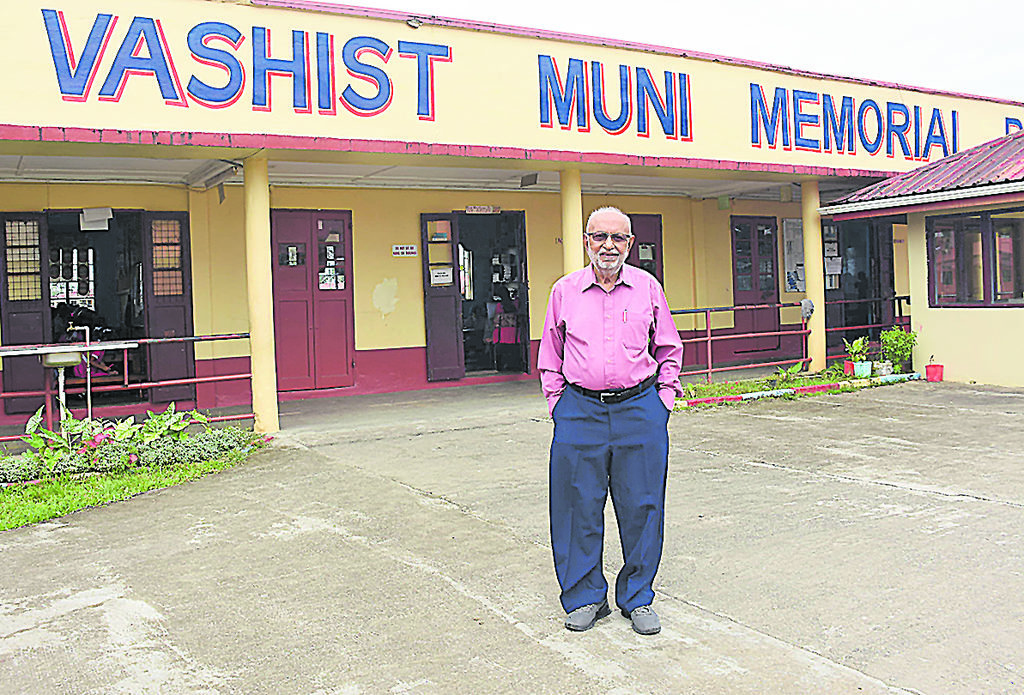
FOR a small town like Navua, you don’t often stop to think about where your school came from.
How often do you have a school founded by a single man — a figure spoken of in hushed, almost legendary terms, whose stories are still told long after he was gone,?
For more than a century, this school has shaped generations, from the children of indentured labourers to today’s diverse student body — Vashist Muni Memorial School.
Last year the school celebrated its 100th-year anniversary, where many realised the school they’ve been going to (Vashist) and their parents went to, was a living monument of history.
And it all started with one man — Sadhu Vashist Muni.
The man who planted the seed
Sadhu Vashist Muni was a Hindu missionary born in Banaras, India, in 1888.
Clad in a simple orange robe and protected by his signature light pink umbrella, he arrived in Fiji in May 1920 with a mission that reached far beyond religion.
According to accounts, he spoke both English and Hindi fluently, and was welcomed by Indo-Fijians who saw in him something extraordinary — a leader, a teacher, and to some, even the reincarnation of Lord Vishnu.
He came with a vision to educate the children of indentured labourers and to uplift a community through knowledge, dignity and justice.
Remarkably, within the same month of arriving in Fiji, he established what would become Vashist Muni Memorial Primary School. He encouraged language preservation, cultural pride, and self-determination. But his work was not to last long; in March 1921 he was deported back to India under colonial suspicion. Even so, stories of his courage and spiritual charisma have never faded.
Founding the school: from Ashram to institution
Recalling history, Vijay Maharaj, now aged 89 and one of the few remaining alumni from the early years, says the origin of the institution was something “long overdue to come to light.”
When the school first opened in 1920 as Vashist Muni Ashram, it taught only vernacular language to 17 boys. The first classrooms stood where the Navua Police bure exists today.
After Sadhu Muni’s departure, Pundit Bhagauti Prasad Sharma arrived from India to lead the school forward. In 1923 the school received official registration from the Fiji Education Department under the name Navua Indian Vernacular School.
Details become sparse for the next two decades, as records were poorly maintained, a loss Maharaj laments deeply. But when he first joined as a student in 1943, Master Ram Sundar was the head teacher who tirelessly guided the school towards primary registration and the name Navua Indian School.
Governed by a committee elected annually by parents, the school community fund-raised and built structures through sheer effort, including holding Ram Leela cultural events that remain a tradition to this day.
By 1967, these efforts led to the establishment of Navua High School, and by 1971 the primary and high schools came under a single parent body called Vashist Muni Institute Navua.
In March 1983, in a move to honor the visionary founder, the primary school was officially rechristened Vashist Muni Memorial Primary School, the “Memorial” added because another school in Tavua already bore the founder’s name.
As one commentator later wrote, the name anchors the institution’s identity as a leading Hindu faith-based educational hub built on sacrifice and heritage.
At the heart of the campus sits a Saraswati temple, fulfilling Sadhu Muni’s wish to keep culture and learning intertwined, while annual Ram Leela performances retell the epic of Lord Rama, a tradition over a century old.
Growing Up in Navua
For Vijay Maharaj, school in 1943 was far from easy.
“When I enrolled in Class One, we didn’t even have a classroom for newcomers,” he recalls.
“The committee rented makeshift tin and wooden buildings scattered around Navua town, and later repurposed other old structures for classrooms as the school expanded.”
He said space was scarce; a nearby senior citizens’ home stood in the middle of the compound until its residents were relocated in 1945. Then, that building too became classrooms under the committee’s direction.
As you can imagine life at that time wasn’t only about schooling. Fiji was in the grip of World War II fears, soldiers with rifles patrolled the streets, rumours of air raids spread, and children hid in caves when the sound of planes came overhead.
Yet despite the fear and chaos of war, the children persevered.
Mr Maharaj credits his education and the sacrifices of his parents and community, for giving him a future he could never have imagined.
He went on to teach, trained in Kavanagasau and Natabua, and eventually became a head teacher in multiple schools. Even after migrating to Australia in 2008, he remained deeply connected to his alma mater, serving as chairperson of the school’s trustees for over a decade.
A thriving centre of learning and community
A century after its founding, Vashist Muni Memorial Primary School has grown into one of Fiji’s largest primary schools.
With over 1017 students, 30 teachers, and a vibrant multicultural community, it is a far cry from the 17-boy vernacular class of 1920. Kindergarten alone has more than 120 children.
Once a school only for Indo-Fijians, it has now become a multiracial hub of education and activity, hosting awards days, sports competitions and religious and secular events.
It also serves as a cyclone evacuation centre for the wider Navua community, strengthening its role as a place of safety and service.
The school stands today as both an educational institution and a historical symbol deeply tied to Fiji’s Indo-Fijian heritage.
The enduring impact of Sadhu Vashist Muni
Sadhu Muni’s time in Fiji may have been brief, but his influence was profound.
In 1921 he led a peaceful strike among sugar cane workers demanding fairer wages and justice for imprisoned leaders, a movement that continued for months after his deportation and led to concessions from the Colonial Sugar Refining Company, reshaping labour activism in the islands.
Although he spent only a short time here, the schools he founded still bear his name, including in Tavua and Navua, as lasting reminders of his vision.
Even from afar, Sadhu Muni continued to speak for justice, urging former indentured labourers not to return to Fiji until conditions changed.
His legacy endures not just in bricks and mortar, but in the lives of those educated in his schools, and in the proud affirmation of culture, language and community he championed.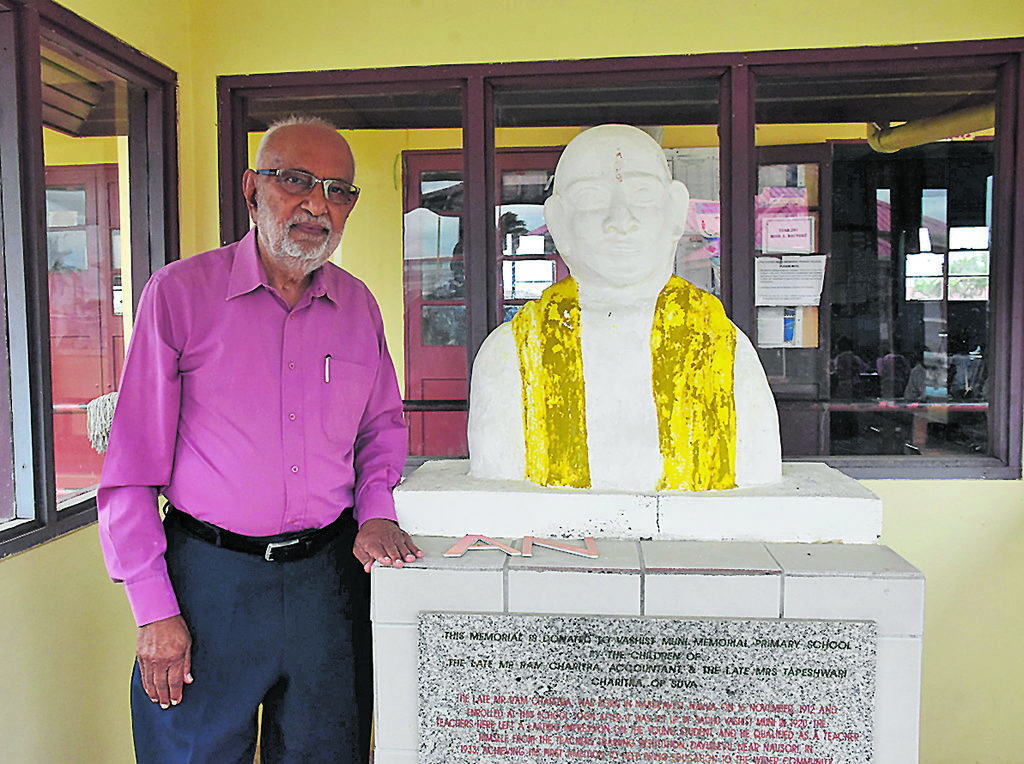
Former student Vijay Maharaj with the monument of the late Sadhu Vashist Muni at the school in Navua. Picture: KATA KOLI
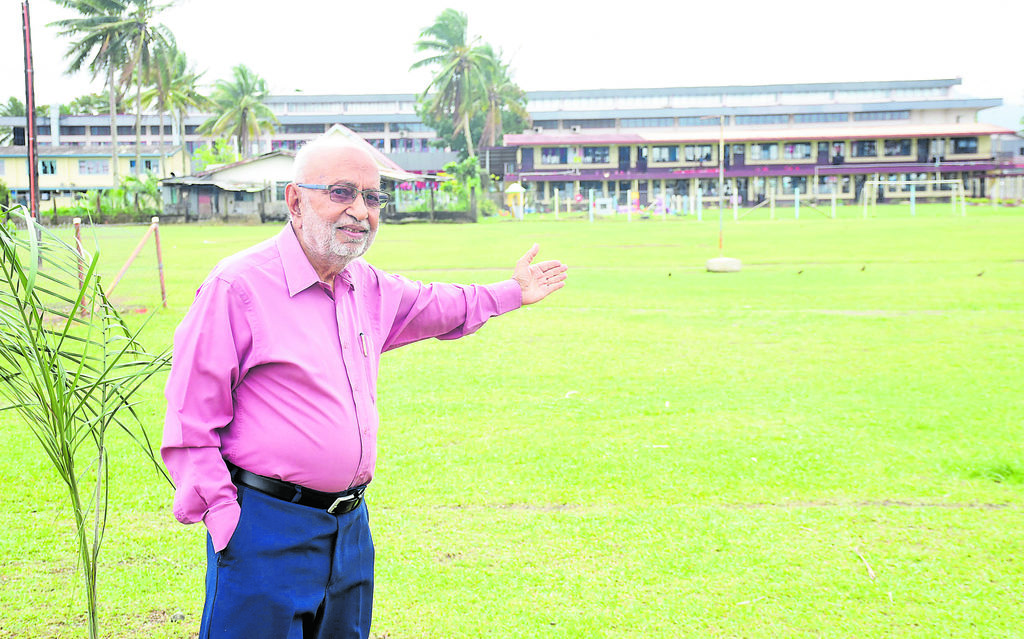
Vashist Muni Memorial School former student Vijay Maharaj points at the location where the Old People’s Home was located in the centre of the main school compound. Picture: KATA KOLI

