
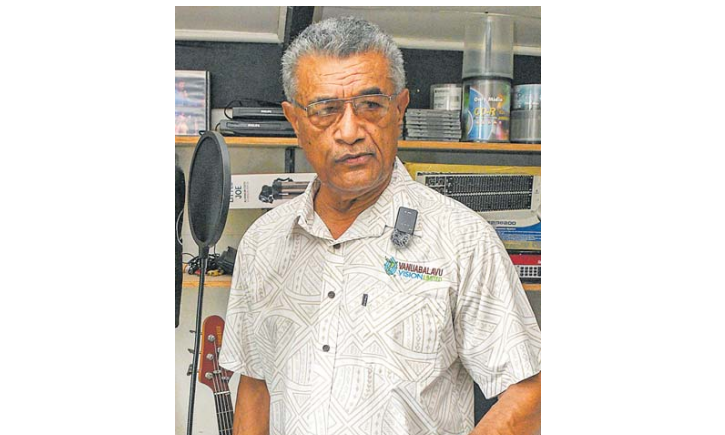
For more than five decades, music icon Saimoni Vuatalevu has been a constant and reassuring presence in Fiji’s musical landscape.
He has been composer, performer and cultural voice whose songs have crossed generations, ethnic lines and social divides.
Now in his later years, the veteran singer and composer shows no sign of slowing down.
Instead, as Fiji steps into 2026, Vuatalevu remains deeply engaged, in music, in community leadership and in the enduring belief that songs should do more than entertain.
Speaking to The Sunday Times, Vuatalevu reflected on a quiet New Year spent surrounded by family, children and grandchildren, a calm beginning after what he described as a demanding but rewarding 2025.
Since retiring from government service in 2007, he has devoted himself fully to music, while also taking on leadership responsibilities within his village community in Suva. As chairman of both the village community and its investment arm, his days are filled with meetings and planning.
Yet music, he says, remains inseparable from who he is.
“It’s a talent you’re born with,” he said.
“You continue until the Almighty says that’s enough”
Songs that tell Fiji’s story
Vuatalevu began composing in the late 1970s, becoming more serious about songwriting by the mid-1980s.
Since then, his catalogue has grown into a body of work that many consider foundational to modern Fijian music.
Songs such as Tucake Mai, Viti Noqu Parataisi and Tukuni remain widely known and sung today, appealing to listeners young and old.
Unlike many contemporary releases, his music rarely centres solely on romance.
Instead, his compositions reflect everyday life, cultural memory and national identity.
One song, Dreu Tu Na Maqo recalls the simple childhood ritual of waking early during mango season, only to discover that fruit bats had beaten everyone to the harvest.
Another promotes healthy living, while others speak of unity in a multi-ethnic Fiji.
“I don’t compose the way many people do nowadays,” he said.
“I always try to maintain quality which is the theme behind the song, the lyrics, the tempo and the melody. You have to bring all those elements together.”
For Mr Vuatalevu, quality is not defined by trends and popularity, but by meaning and by whether a song can speak to people across cultures.
Bridging cultures through music
One of the most distinctive aspects of Vuatalevu’s career has been his willingness to perform in multiple languages, including Hindi, which has earned him admiration from audiences across Fiji’s communities.
He said he enjoys singing in different languages, particularly when the melody is strong and the message resonates.
When he performs Hindi songs, he often sees audiences respond with appreciation, recognising music’s power to bring people together.
“These are the kinds of things that unite us,” he said.
“If the melody is good and the theme is meaningful, I’ll sing it”
It is this inclusive approach that has helped cement his place as not just a musician, but a cultural bridge-builder.
Advice for the next generation
As a veteran artist who has seen the industry evolve, Vuatalevu is keenly aware of both the opportunities and challenges facing young musicians today.
While acknowledging the popularity of love songs, he encouraged emerging composers to broaden their focus and consider writing music that reflects the social issues confronting Fiji particularly those affecting young people.
“Drugs are a big problem,” he said.
“I hope composers will start writing about the problems we’re facing and how we can tackle them, especially to help our younger generation”
He believes music can be a powerful tool for education and awareness, especially when it reaches audiences that formal messages often fail to engage.
At the same time, he warned that talent alone is not enough. Discipline, respect and attitude, he said, are recurring challenges within the music industry.
“I’ve been playing music since 1969,” he said.
“The biggest challenge has always been discipline. There are many talented musicians, but without discipline, it’s difficult to go far”
He believes young artists should take time to learn from those who came before them, rather than dismissing experience in favour of quick success.
Music as a force for good
Despite the challenges, Mr Vuatalevu remains optimistic about the role of music in society.
He believes it can uplift communities, shape attitudes and help guide younger generations towards a better future.
“Music changes the atmosphere,” he said.
“It brings happiness to families, youth, schools and communities. When people listen, it can create awareness and bring people together”
He also emphasised the importance of understanding copyright and protecting creative work, pointing to the role of the Fiji Performing Rights Association (FPRA) in ensuring composers receive fair recognition and royalties.
As he continues to compose, record from his home studio, and perform, Mr Vuatalevu remains guided by the same principles that have shaped his career from the beginning, the most important being that music should always be a force for good.

