
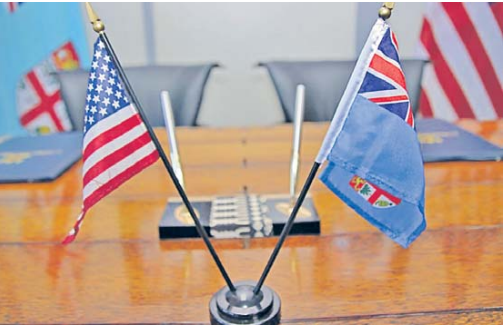
The recent inclusion of Fiji on a list of nations facing US visa restrictions has ignited a firestorm of anxiety and anger across our social media and in our homes. The issue touches the very fabric of our nation: our families, our economy, and our identity. To navigate this crisis, we must move beyond heated rhetoric and confront the full, complex picture with clarity and compassion. This is not a story with a single villain or victim, but a multi-layered challenge demanding understanding from all sides.
The Trigger: A US policy rooted in sovereignty
THE immediate cause is a longstanding US law (Section 243(d) of the Immigration and Nationality Act) that allows visa sanctions on countries deemed uncooperative in accepting citizens ordered deported. This is not a random “ban,” but a specific enforcement tool. The United States, like any sovereign nation, asserts its fundamental right to control its borders and uphold its immigration laws. The Trump administration’s application of this tool is a direct, if blunt, response to a systemic, decades-old national issue: an estimated 11 million undocumented persons within the US, many of whom initially entered legally and overstayed visas.
The Fijian Government’s unenviable position: Accountability vs. advocacy
Prime Minister Rabuka’s blunt stance-that overstayers “brought this upon themselves”has drawn fierce criticism. Yet, legally, it is a defensible hardline on accountability. A government must uphold the integrity of its passport and international agreements. Failure to co-operate with deportation orders risks severe collateral damage, including the loss of visa-free travel for all Fijians. His position underscores a non-negotiable principle: Visa conditions are a legal contract.
However, true leadership requires more than stating hard truths. The government’s duty is dual: To enforce accountability; and to advocate fiercely for its citizens. The current stance risks appearing to abandon our people. A more strategic approach would marry the hardline on the principle of lawfulness with a soft-power diplomatic surge, lobbying Washington for exemptions for essential workers like caregivers and nurses, and urgently preparing a national reintegration plan for returnees.
The diaspora divided: A spectrum of circumstances
We must abandon the monolithic view of “the diaspora.” Their situations are profoundly different, and a just discussion acknowledges this spectrum:
m For those who overstayed: Their choice, however motivated by powerful economic necessity and love for family, was a conscious breach of contract. They have contributed immensely through labour and taxes, often in essential jobs Americans do not fill. While their economic role is undeniable, they have lived with the ever-present risk of this outcome. Their plight evokes deep sympathy, but it exists within a framework of personal responsibility.
m For legal residents, Green Card holders, and citizens: This group is justifiably alarmed and frustrated. They have played by the rules, often at great cost and over many years. They fear being stigmatised, and they worry for family and community members. Their lawful status and contributions must be explicitly acknowledged and protected; they are the model, not the problem.
m For future migrants and families at home: They watch in terror. Families dependent on remittances – funds that “build homes and pay school fees,” face financial collapse. Aspiring migrants see a door slamming shut. For them, this is not about abstract law; it is about the death of hope and a direct threat to survival.
The core conflict: Competing truths This crisis is a collision of two powerful, valid truths:
-The legal-sovereign truth: Nations must enforce their laws. Chronic non-enforcement erodes the system and encourages further illegality.
-The human-economic truth: Global inequality drives migration. Wealthier nations benefit enormously from the labour of migrants from poorer nations, often within a system that offers no viable, long-term legal pathways for such essential work.
To champion only one truth is to be wilfully blind. The suffering of families is real. The principle of lawful migration is also real.
The moral dimension in a world of realpolitik
The Pope’s call for compassion is not a call for lawlessness. It is a reminder that policies should be measured by their impact on human dignity. A policy that disrupts millions of lives and destabilises economies without offering a constructive alternative is questionable in its effectiveness and morality. The “bridge” he advocates for could be the bridge of a bilateral labour agreement, a structure that respects both the rule of law and the dignity of work.
The path forward: From blame to constructive solutions
Punitive enforcement alone solves nothing. It will harm US industries reliant on this workforce and devastate Fijian families. The solution lies in replacing a broken model with smart, humane co-operation.
For the United States: It must couple enforcement with expanded legal pathways and smart diplomacy. A solely punitive approach ignores the structural realities of its own economy, which relies on immigrant labour in key sectors. The solution lies in transforming an irregular flow into a managed, legal stream. This means:
1. Negotiating bilateral labour agreements: Specifically, with countries like Fiji, creating channels for temporary workers in identified shortage areas most notably healthcare (caregivers, nurses) security services and seasonal agriculture. This protects US interests by ensuring a documented, vetted workforce while granting migrant workers legal protections and dignity.
2. Creating a path to regularisation for essential workers: Designing a stringent, one-time program that allows long-term, tax-paying, law-abiding undocumented individuals, particularly those in caregiving, construction, and service roles vital to communities, to earn legal status. This resolves the human dilemma humanely and brings a shadow economy into the light.
3. Reforming visa systems to reflect economic needs: Acknowledging that for many from developing nations, the gap between temporary visas and permanent residency is an insurmountable chasm. Reforms should include more permanent residency options tied to essential occupations and clearer pathways from temporary work permits to stability.
By pairing the justified defense of its borders with these proactive measures, the US would demonstrate global leadership. It would uphold the rule of law not just through force, but through fairness, recognising that the labour of migrants is not a threat to its security but a pillar of its economy and a testament to its founding spirit of opportunity. This approach secures borders, stabilises industries, and aligns American action with its stated values of justice and pragmatic problem-solving.
Continuing the path forward: Concrete steps and moral imperatives
To move from crisis to resolution, all parties must transition from reactive emotion to proactive, structured engagement. The following steps outline a potential roadmap for accountability, compassion, and sustainable reform.
1. An urgent call for tripartite dialogue
The current standoff requires immediate, high-level dialogue involving three key entities: The US Department of Homeland Security/State Department, the Fijian Ministry of Foreign Affairs, and a selected, non-partisan delegation representing the Fijian diaspora (including legal residents, community elders, and business leaders). The goal of this dialogue would be to:
-Clarify the specific cause: Determine the exact parameters that led to Fiji’s inclusion, is it a specific number of final deportation orders, and if so, can they be expedited or resolved? Transparency is the first step toward a solution.
-Establish a “Priority Worker” exemption: Advocate for the formal recognition of Fijian caregivers, nurses, and aged-care workers as essential to the US healthcare infrastructure. A temporary moratorium on deportations in these sectors while a new visa category is negotiated would be a critical humanitarian pause.
-Create a pilot bilateral agreement: Use this crisis as the impetus to draft a first-of-its-kind Fiji-US Seasonal or Caregiver Work Agreement, with clear pathways for legal entry, monitored working conditions, and guaranteed repatriation.
2. A national reintegration strategy for Fiji (Beyond ad-hoc plans)
The Fijian government must publicly announce a detailed, funded national strategy titled “Veitalanoa Ni Vanua” (Healing the Land/People) or similar. This cannot be vague promises; it must be a concrete plan with budget allocations, involving NGOs, the private sector, and provincial councils. Its pillars should be:
-Immediate humanitarian reception: For those deported, a dignified arrival process with crisis counselling, temporary accommodation, and family mediation services.
-Skills assessment & fast-track employment: A dedicated unit to translate overseas experience (e.g., in healthcare, construction, hospitality) into local qualifications and job placements, with tax incentives for businesses that hire returnees.
-Entrepreneurship catalysis: A dedicated remittance-to-business loan fund, offering matched savings and business training for returnees and their families wishing to invest in small enterprises, turning lost remittances into local job creation.
3. A Truth and Reconciliation process within the diaspora
The diaspora community itself has a role in healing and reform. Community leaders, church groups, and the Fiji-US Business Council should initiate forums that:
-Acknowledge the full narrative: Celebrate the immense contributions of the community while openly discussing the long-term societal and personal costs of the “overstay strategy” – the fear, the family separation, the exploitation in shadow economies.
-Mentor the next generation: Successful green card holders and citizens must actively mentor new arrivals and students on legal strategy, insisting that preserving Fiji’s good name is a collective duty.
-Establish a legal defence fund: Pool resources to provide legitimate, accredited legal counsel for those with the strongest cases for asylum or regularisation, moving people away from exploitative “consultants.”
4. A clear message for future generations
To every young Fijian dreaming of opportunities abroad, the message must be recalibrated: “Your ambition is honoured, but your pathway must be honourable.” The Ministry of Education and NGOs must integrate migration literacy into school curricula and community workshops, covering:
-The stark realities and legal dangers of visa overstay.
-The legitimate pathways: student visas, skilled worker categories, and the detailed requirements for seasonal work programs in countries like Australia and New Zealand as alternatives.
-The concept of “circular migration” – going, learning, earning, and returning to build Fiji as a model of patriotism.
Final reflection: Choosing legacy over politics
This moment is a defining test of character for both nations. Will the United States choose a legacy of ruthless enforcement, or one of pragmatic, humane leadership that secures its workforce while upholding justice? Will Fiji choose a legacy of blame, or one of fierce, sophisticated advocacy that stands by its people—both their dreams and their responsibilities?
The remittances are not just dollars; they are packets of hope. The laws are not just text; they are frameworks for order. We must honour both. The solution lies not in walls of division, but in bridges of structured mercy – a system that is legal, orderly, and recognises our shared humanity and economic interdependence.
Let this crisis, therefore, be the painful birth of a new chapter. Let it forge a Fiji that is a smarter advocate on the world stage, a diaspora that is both empowered and law-abiding, and a partnership with America that is based on mutual respect and clear rules. Our shared future depends on the courage to build that bridge, together.
SEVECI TORA is the former Acting CEO of Post Fiji. He currently serves on the Board of Post Fiji Ltd and the Board of Trustees for FENC Fiji Ltd. He is a keen reader and regular letter writer. The views expressed here are his own and do not reflect the views of this newspaper or the position of any organisation he is associated with.

