
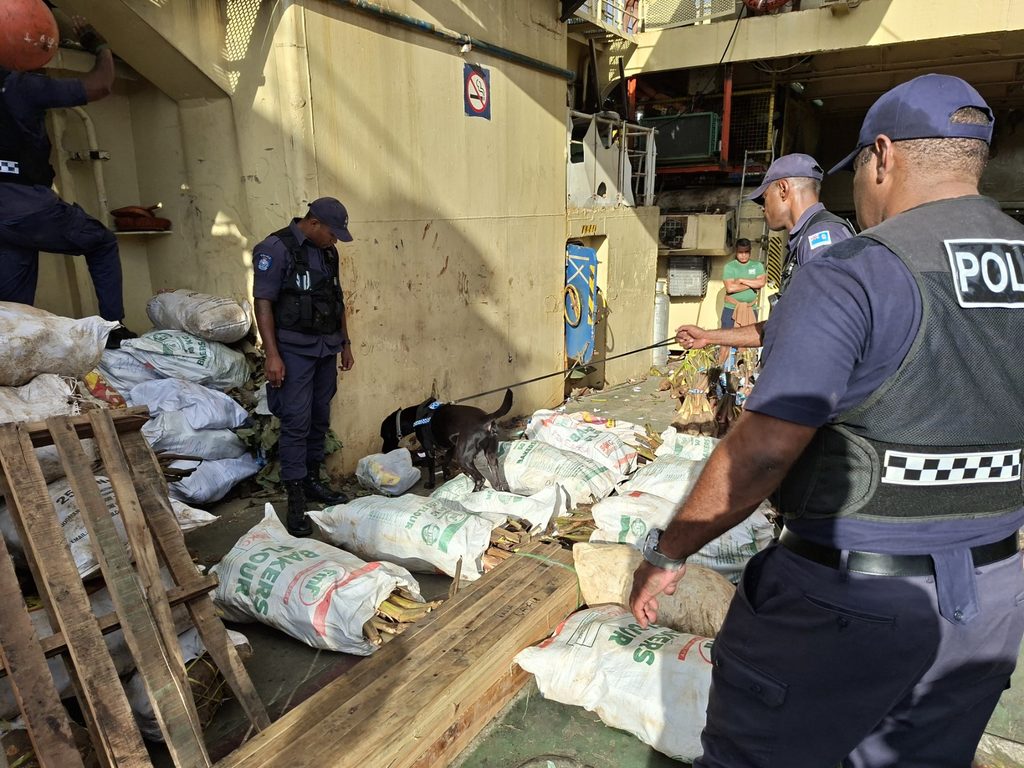
It is encouraging to see the Fiji Police Force focused on what it must do in the fight against illicit drugs.
That is as it should be.
We have trained men and women in blue whose duty is to stand up, be counted, and do the very best they can in confronting a problem that threatens families, communities and the future of our young people.
We note that a senior police detective will travel to Australia to interview a former Criminal Investigations Department officer who has made allegations on social media about drug dealers in Fiji.
Police Commissioner Rusiate Tudravu has confirmed that final arrangements are being made.
This shows a willingness to pursue every lead and to test every claim, no matter how uncomfortable or politically sensitive it may be. That is a positive step.
We are also encouraged by the support shown to police by traditional leaders in Sabeto, Nadi and Vatia, Tavua.
Their efforts to establish village rules and awareness programs to work alongside law enforcement in protecting the vanua demonstrate that the fight against drugs is not just a police responsibility.
It is a national one.
It is important that communities and the police stand together in the fight against drug dealers.
All of this points to a force that understands it must be proactive and vigilant. It must be seen to be acting decisively and lawfully. Public confidence depends on results and on visible effort and integrity.
However, while we commend the direction being taken, we must also hold the force to scrutiny over its handling of public communication following last week’s raid on a home in Samabula, Suva.
Police confirmed yesterday that no drugs were found at the residence of a Member of Parliament.
A police team had conducted a search as part of an investigation, and a suspect related to a family member had been arrested earlier in Wainadoi and was present during the search.
The operation, police later clarified, was for the retrieval of documents. No drugs were discovered. Investigations continue.
The issue is not the investigation itself. Police have a duty to act on information and to follow due process wherever it leads.
The concern lies in the delay and lack of clarity in communicating what had actually transpired.
In the absence of timely information, speculation filled the vacuum. Social media erupted. The Member of Parliament was subjected to intense and, in many cases, ruthless attacks.
Reputations were dragged through the mud. By the time clarification came, much of the damage had already been done.
So what took so long? Why was there no immediate effort to set the record straight? Who was responsible for the dissemination, or lack, of accurate information?
These questions inevitably fall on the force’s communications team and its senior leadership. They bear ultimate responsibility for ensuring that accurate, verified information reaches the public in a timely manner.
Clarity is not a luxury. It is an obligation. In a climate where misinformation spreads at lightning speed, silence can be costly.
We understand that not every detail of an investigation can be made public.
Operational sensitivities must be respected. But there is a difference between protecting an investigation and allowing damaging speculation to spiral unchecked.
With our renewed commitment to freedom of expression, opinions will flow freely.
People will jump to conclusions and, at times, make wild or baseless allegations. That is the reality of the digital age. It makes the role of official communication even more critical.
As mainstream media sought answers and received little, frustration mounted. Waiting in silence is not a communications strategy.
If the Fiji Police Force is to lead effectively in the fight against drugs, it must match operational strength with transparent and timely communication.
Public trust is hard won and easily lost. In this battle, integrity, accountability and openness are as vital as enforcement itself.
This should be a lesson for the force. Decisive action must always be accompanied by decisive communication.

