
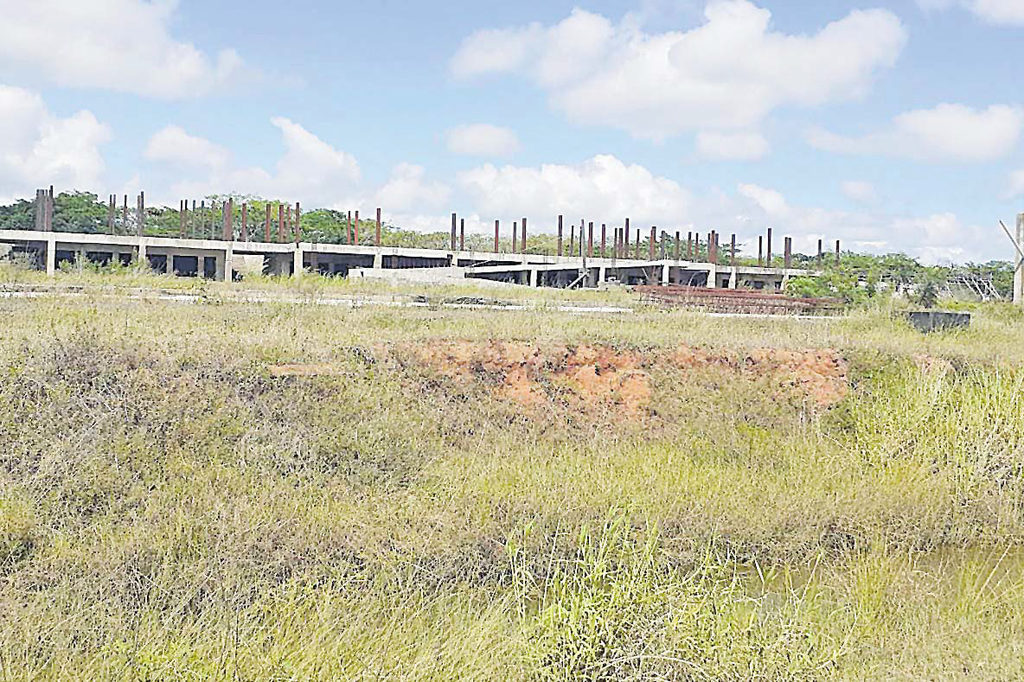
It will cost the Fiji National University about $3million to demolish the unfinished concrete building that has stood silently at Naiyaca in Labasa for more than a decade.
For vice-chancellor Professor Unaisi Nabobo-Baba, the building is not just an abandoned construction site but a costly inheritance.
One that greeted her when she took office in 2023 and immediately demanded scrutiny, explanation, and accountability.
“The campus site has been under construction for the past 15 years,” she said.
“I came into office in 2023, and from that point, we spent one full year trying to understand what had happened previously, because the Government and everyone else were looking for records related to this.
$12m down the drain
Prof Nabobo-Baba said they looked into financial records and technical reports of a project that had absorbed millions of dollars in public funds, yet there was zero deliverance.
“We conducted a full year of thorough investigations, reviewing whatever records were available. We then submitted these findings to the (Parliamentary) Standing Committee.”
By the time the university reported to Parliament, the picture that emerged was stark.
About $12m had already been utilised, but the result was an unfinished, unusable structure that could neither host students nor be safely occupied.
“When we reported to Parliament, we explained that when we came in during 2023, what we inherited was an unfinished building.”
She said qualified architects and engineers were engaged to assess the structure, and their findings were sobering.
Building unusable
“The building, they advised, could not be used in its current state.”
While it was not entirely unsafe, she said, certain areas, particularly the middle section, were classified as red zones under occupational health and safety standards.
“As a result, we set it aside. If we were to demolish it now, it would cost approximately $3million, so we have cordoned it off.”
Occupational health and safety regulations prevent staff and students from entering the structure.
Rather than pouring millions more into demolition, the university made a strategic decision to focus on building the campus itself, starting with facilities that could immediately serve students and staff.
Plans to rebuild
“We then decided to focus on building the campus.”
One of the first steps was to stop paying rent for external facilities, a cost that had quietly drained university resources for years.
“We stopped paying around $300,000 in rent each year for the building we use in Labasa. By saving that amount, we will be able to start constructing the campus.”
Apart from this, the university has saved funds to rebuild the campus.
“We will later seek government support.”
What stands today at the Naiyaca site is a traditional bure that has been completed, along with three classrooms.
“What you see today is an attempt to complete the bure.
“Currently, the largest class in Labasa has about 60 students, which is our biggest lecture size. At times they will be able to use the bure for their classes.’
Additional classrooms are already in the pipeline.
“We also have three classrooms on that side. By 2026, we are hoping to complete more classrooms on the other side.”
Future plans
Some of the buildings under development are originally designed for a different purpose altogether, such as future bed-and-breakfast accommodation that could generate income for the university.
For now, however, the immediate need is teaching space.
“We plan to invest in these buildings. In the future, these six classrooms can be converted into BnBs, because by 2027, the rest of the campus is expected to be completed.”
This phased approach, she said, reflects a broader philosophy of fiscal responsibility and long-term planning.
“That is our official position. When we arrived, we saw a dilapidated building. We were told to seek expert advice, and we did.”
While the old structure remains unusable for now, she has not ruled out its future potential.
“Once we complete the campus, and with the assistance of experts, we believe we may be able to rehabilitate the old building, as it still has potential.
Ideas for its future use range from an exhibition centre for culture and arts, to an extension of the university library, but all of that, she stressed, would depend on funding and technical advice.
“At the moment, to save costs, we believe it is a better use of funds to focus on building the campus first and then revisit the old structure later,” she said.
Financial toll
The financial toll of the delay, she said, has been enormous.
She said rental costs alone have continued to rise over the years, quietly siphoning funds away from infrastructure and student services.
“For example, between 2016 and 2020, rent was around $20,000 per month.”
For her, it’s better for the funds to be used to build property for FNU rather than being spent solely on rent.
“I believe in responsible use of resources. We are from Fiji, and I would rather see the $240,000, almost a quarter of a million dollars, used to build property for FNU rather than being spent solely on rent.”
That figure, she said, does not even include recurrent costs such as electricity and maintenance.
Build to own
Building the university’s own infrastructure, she said, would ultimately benefit not only FNU but the people it serves.
“If we can generate revenue in the future, we could offer scholarships. However, our main focus remains our students.”
Any savings, she said, should be redirected back to student facilities, including lounges and learning spaces, rather than disappearing into overhead costs.
“We want government funding to be directed toward initiatives that truly serve our people,” she said.
She said the university was also aligning its long-term strategy with national development priorities.
“As vice-chancellor, I was present at the launch of the Na Vualiku program and over the next 10 years, we will closely align ourselves with that agenda.”
The urgency to complete the Naiyaca campus, she added, goes beyond bricks and buildings.
“The quicker we complete this development, with your support and the support of partners in Labasa, Suva and around the world, the sooner we can deliver results for our people.
Vanua Levu waits
For the people of Macuata and Vanua Levu, the delays have been a source of frustration and disappointment, a sentiment powerfully articulated by Tui Macuata Ratu Wiliame Katonivere.
The Fiji National University Labasa Campus, meant to be completed seven years ago, remains largely unfinished more than 15 years after the idea was first conceived.
Ratu Wiliame said discussions on establishing a national university campus in the North began as early as 2008.
He said this after surveys revealed that a significant number of university students studying in Viti Levu were originally from Vanua Levu.
In 2013, under his leadership, land at Naiyaca was gifted to the institution in good faith and with great hope.
“We were told the campus would be completed by 2018,” he said.
A ground-breaking ceremony, he said, was held that same year, which was attended by then education minister Filipe Bole.
Unfulfilled promises
He said assurances were given that construction would take three to five years, but those time-lines were never met.
“There was confidence, there were speeches, and there were promises, but those promises were never delivered.”
Instead, he said, the project faced delay after delay, year after year, with little visible progress.
“The dreams we planted seemed to be at risk of wilting,” he said.
The incomplete structures, he said, have become a symbol of neglect and poor planning, raising serious questions about accountability and commitment to the Northern Division.
“The partially built structures at Naiyaca stood quiet and empty, a constant reminder of an unfulfilled promise. Our people wondered if the campus would ever be completed.”
While the coronavirus pandemic further disrupted development, he stressed that delays and inaction had plagued the project long before the global health crisis.
“The coronavirus pandemic further derailed plans. It was a difficult time. It felt like our dream for a Northern campus had been put on hold indefinitely.”
No accountability
Behind the scenes, an audit later revealed deep-rooted problems.
It found a lack of feasibility studies, tender irregularities, governance failures and contract issues that ultimately led to the project’s abandonment.
The university terminated the contract of the initial builder in 2020 and, in 2021, won a court case allowing it to encash a $2 million bond.
In 2024, the matter was referred to the Fiji Independent Commission Against Corruption for investigation into potential corruption and mismanagement.
However, to date, no individuals have been publicly charged in relation to the abandoned FNU Naiyaca campus project.

