
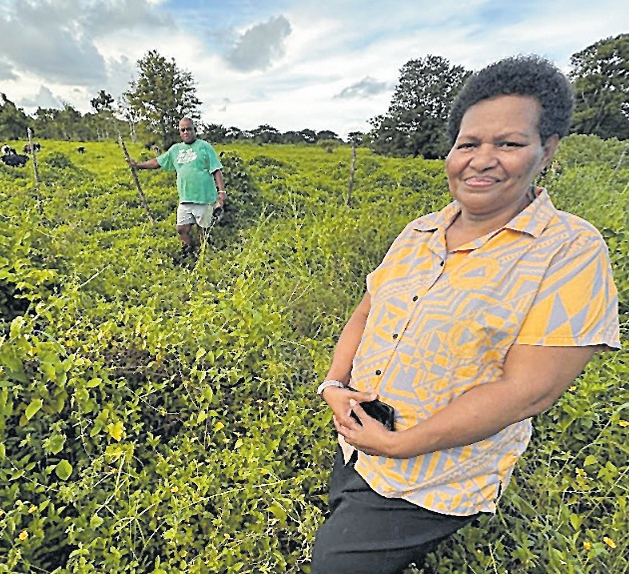
FOR Elesi Mila and her husband Aleveo Basaga of Navunisole Village in Tailevu, farming has always been a way of life. Their livelihood depended largely on kava and a small mix of crops, but for years their work on the land felt more like a routine than a shared vision.
Today, couples like Elesi and Aleveo are quietly reimagining what it means to farm as a family. Across rural Fiji, in village halls and on kitchen floors, whole households, men, women and young people, are coming together to talk openly about their goals, workloads and futures.
Driving this shift is Family Farm Teams (FFT), a practical, family–centred approach supported by the Australia and New Zealand–funded Pacific Horticultural and Agricultural Market Access Plus (PHAMA Plus) program. Developed by the University of Canberra with the Australian Centre for International Agricultural Research (ACIAR), FFT uses talanoa–based learning to recognise the farm as a family business. With shared decision–making, nutrition and resilience at its core, the approach is helping households move from subsistence to more resilient, semi–commercial farming.
Elesi and Aleveo Basaga say the training came at the right time. Before FFT, their income relied heavily on kava and a few crops. Today, their farm looks very different.
They now run a small cattle operation, raise poultry for eggs and meat, and grow vegetables for both sale and household use.
“FFT really opened our minds,” Aleveo says. “We’re no longer depending only on cassava, taro or yaqona. We’re planning together and working as a team.”
That focus on teamwork is deliberate. Across Fiji, women play an important role in agriculture but often have limited say over how income is used or farm decisions. FFT tackles this directly, embedding gender equality into practical planning. As families talk openly about workloads, finances and goals, roles begin to shift.
For Elesi Mila, FFT strengthened shared decision-making, something often overlooked in local farming enterprises.
“We deal with the farm together now. It lightens the load and makes planning for the future much clearer,” she says.
Nutrition is a key part of the FFT story. Despite fertile land, Fiji imports much of its food, and diets heavy in processed products have contributed to rising rates of non-communicable diseases. FFT encourages families to establish ‘kitchen gardens’ close to home, growing a variety of vegetables for daily meals. Families report spending less on store-bought food, eating better, and freeing up time and money for education and savings.
The approach is also reshaping how institutions work with farmers. The Tutu Rural Training Centre in Taveuni has embedded FFT as a core component of its training for young men, couples, and women, making FFT a foundational requirement for its programs, recognising that financial literacy and contract farming are effective only when families are aligned and plan together.
Australia’s support through PHAMA Plus has been central to scaling this change. By investing in people, skills, and systems rather than one-off inputs, the program is helping to embed long-term resilience across Fiji’s agriculture sector. More than 1,000 households across Fiji and the Pacific have already participated in FFT training, with early results showing lasting behavioural and economic change.
For trainers like Miriama Tikoibaravi at the Tutu, FFT has been transformative not just for farmers but also for those supporting them.
“When everyone, men, women and children, works toward shared goals, the results are far more successful,” she says. Now an FFT trainer, Miriama is helping families see farming as a pathway to dignity, stability and opportunity.
FFT offers a powerful example of partnership in action, one that respects local knowledge, strengthens families, and invests in a shared future. One family farm plan at a time!

