
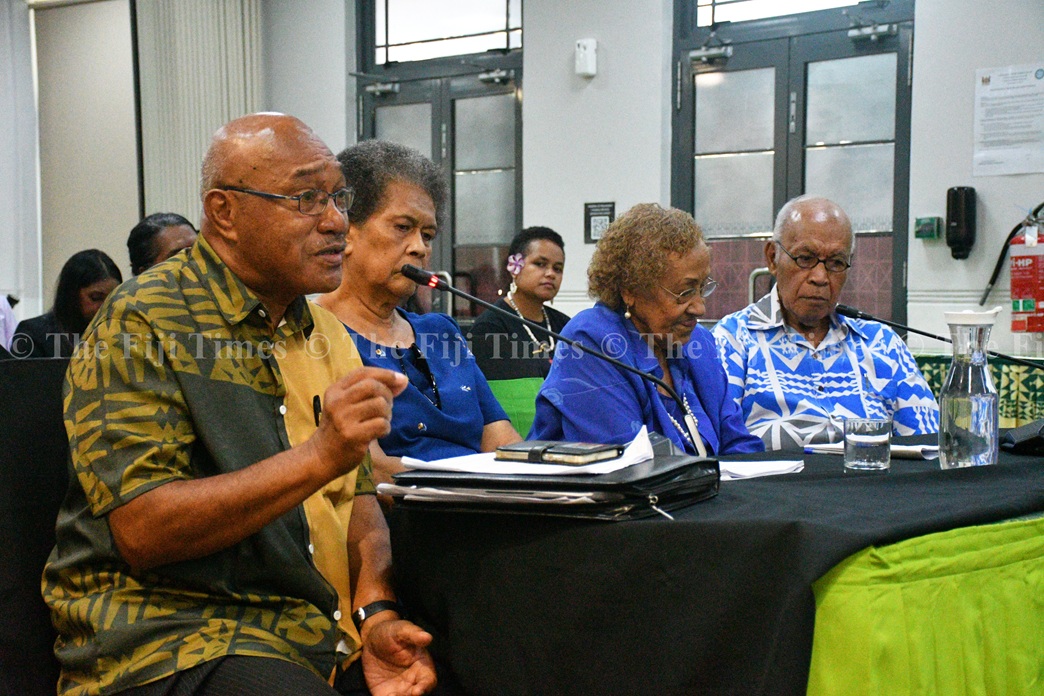
The Great Council of Chiefs (GCC) has called on the Government to amend the Draft Education Bill to better respond to the challenges facing iTaukei students, particularly boys and those in rural areas.
Speaking before the Parliamentary Standing Committee on Education, GCC education committee chairman Iosefa Volau said the review should focus on current realities, not just updating an outdated law.
“We were not there when the cake was made. So, we are just here at the end. Hopefully, the cake is still half-cooked, and whatever we contribute today will have an impact.” Mr Volau said.
He presented data showing that about 20 per cent of students dropped out by Year 12, with boys and rural children most at risk. Dropout rates between Year 8 and Year 12 were 31 per cent for boys, compared with 9 per cent for girls.
He linked these trends to wider social issues, noting that iTaukei people accounted for 70 to 82 per cent of drug-related crime offences.
“These challenges cannot have one shoe fits all; education solutions have been implemented blindly for many years.
“The major point being made here is that any study put in place must be targeted and relevant for iTaukei.”
The GCC recommended that the Bill clearly define its purpose and recognise the council’s role as custodian of the vanua — land, people, and culture — in guiding education policy.
GCC representative Susana Tuisawau raised concerns about the removal of ethnic identifiers from official records. She said the lack of disaggregated data made it difficult to identify and support students most in need.
“This erasure of ethnic identity makes it exceedingly difficult to analyse educational outcomes for iTaukei compared with Indo-Fijians,” Ms Tuisawau said.
She also warned that overcrowded classrooms and poor teacher–student ratios are contributing to behavioural problems and safety risks.
“Some desks come right up to the blackboards. That is a safety issue for students’ eyes and for teachers.”
Mr Volau added that headteachers are struggling to maintain discipline because suspensions and expulsions were restricted, reducing deterrence for serious misconduct.
GCC committee member Emitai Boladuadua highlighted the gap between constitutional guarantees of free education and the reality for families.
He said many iTaukei households, which account for 75 per cent of those living in extreme poverty, faced additional costs for uniforms, meals, and fundraising.
“The principle of free education should be upheld not just as a constitutional right, but as a practical reality,” Mr Boladuadua said.
The GCC recommended that fair assessment and student opportunities be added in the Bill.
Another member Salote Rabuka said scaling marks in external examinations ensured fairness, equity, and transparency in selecting students for higher education.
“Scaling is done for fairness and equity for all the student population and justice to the process of ranking students,” Mrs Rabuka said.
She said the Bill was silent on the rights and status of girls who became pregnant while in school.
“It is essential that the Bill explicitly addresses this, ensuring they are given clear, equitable opportunities.”
The GCC discussed concerns about penalising parents whose children fail to attend school. Mrs Tuisawau said poverty, distance, and access barriers could prevent attendance.
“The notion that you can impose a compulsory $200 is not enough for a poor parent to take children to school every day. They still need to meet costs of meals, uniforms, and sandals. We cannot impose penalties on parents.”
On this issue Mr Volau said completely free education could weaken parental responsibility.
“You are removing the responsibility of the parents. You only value things that you pay for. If you don’t pay, usually you don’t value it.”

