
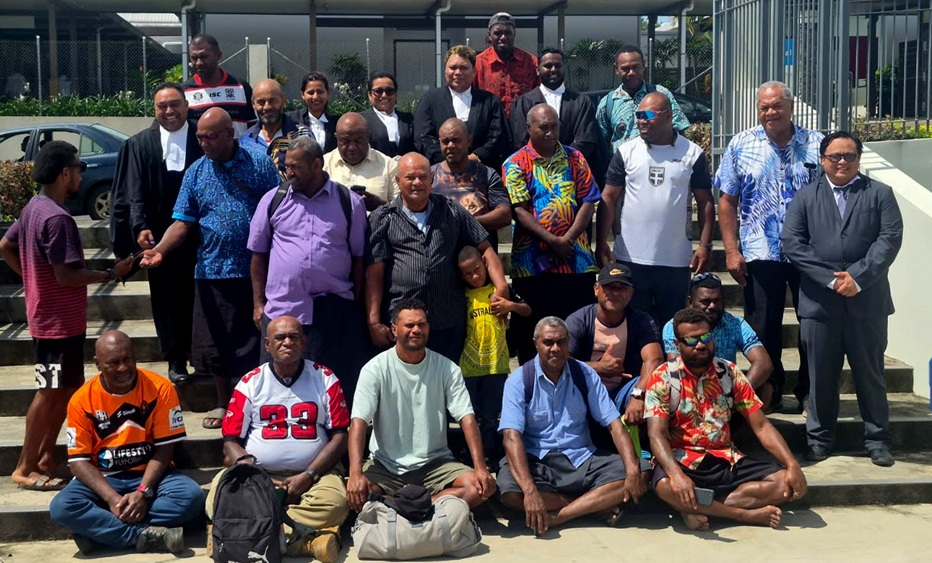
The High Court has thrown out sedition and political violence charges against a group of 26 people accused of plotting to overthrow the Government in 2015, ruling that the prosecution failed to present credible or reliable evidence.
All accused were acquitted yesterday after Justice Samuela Qica found there was no case to answer and the group were “at liberty forthwith”.
The charges were laid under the Crimes Act 2009 and centred on allegations that the accused took part in meetings, flag-raising ceremonies and plans to overthrow the Government of Fiji between January and July 2015 in Ra and Rakiraki.
In his ruling, Justice Qica stressed that at the close of the prosecution case, the court’s task was not to assess the strength or plausibility of the narrative, but to determine whether there was relevant and admissible evidence supporting each element of the offences charged.
“The legal test requires the court to determine whether there is relevant and admissible evidence for each element of the charged offence,” the judge said.
After reviewing evidence from 22 prosecution witnesses, the court found that the case fell well short of the required threshold, concluding that the evidence presented could not sustain the charges.
The ruling brings the long-running matter to an end, with the accused cleared of all allegations and released immediately.
“In the respectful opinion of the court, there is neither credible nor reliable evidence against the accused,” Justice Qica said.
“The prosecution had failed to establish the essential elements of action and intent required under the sedition and political violence charges.”
Addressing the charge of alleged sedition through plans to act as ministers in an unelected government, the judge noted that while some names of the accused persons appeared on a laptop, this alone was insufficient.
“The presence of a suspect’s name on a device does not constitute credible or reliable evidence to demonstrate that he was aware of it or consented to it.
“There was no proof the accused attended meetings or engaged in conduct amounting to sedition.”
On the charge of urging political violence, the court found no witness testimony confirming that the accused encouraged or urged anyone to overthrow the government by force.
“None of the witnesses who testified and were in attendance at the meetings indicated that any of the accused persons had encouraged or urged those present to forcibly or violently overthrow the existing government at that time.”
The court was also critical of photographic evidence allegedly showing military-style training at Navadilli. While acknowledging that the photos were properly extracted, the judge said they lacked crucial context.
“In the absence of any verifying witness, it remains unreliable whether the photos originated from a different time and place, were staged, or have been innocently misinterpreted.”
The judge further found that several items seized during police searches – including clothing, boots, and bags – were unlawfully taken.
“The seizure of additional items is deemed unlawful and exceeds the limits of the authority or warrant employed,” said Justice Qica, concluding that such evidence “lacks reliability and is not credible”.
As a result, the court dismissed all remaining counts, ruling that the accused persons have no case to answer, bringing the long-running prosecution to an end.
The accused in the case were Pita Camaimoala Vakatawa, Saimoni Nacolawa, Mosese Tawake, Ilaitia Korolala, Timoci Nacolatabisa, Jese Vatusumu, Penasio Manasa Luqa, Joseva Caucau, Isireli Serewai, Rokoua Duatini, Qalitia Lomavatu Vakacegu, Inoke Navunilagi, Tomasi Madigibuli, Vosavosa Tunakoro, Maciu Uto, Vetaia Dale, Temesi Waqa, Sevanaia Qaranivalu, Apimeleki Wailomo, Josua Navaluvou, Marika Qalo, Manueli Nadakula, Tevita Damudamu, Sanaila Mariqama, Tomasi Kacanavatu Navimalumu, and Peceli Nayadra.
Saimoni Nacolaw was represented by Mark Anthony and Robert Bancod of Millbrook Hills Law Partners.
The rest of the accused were represented by Legal Aid.

