
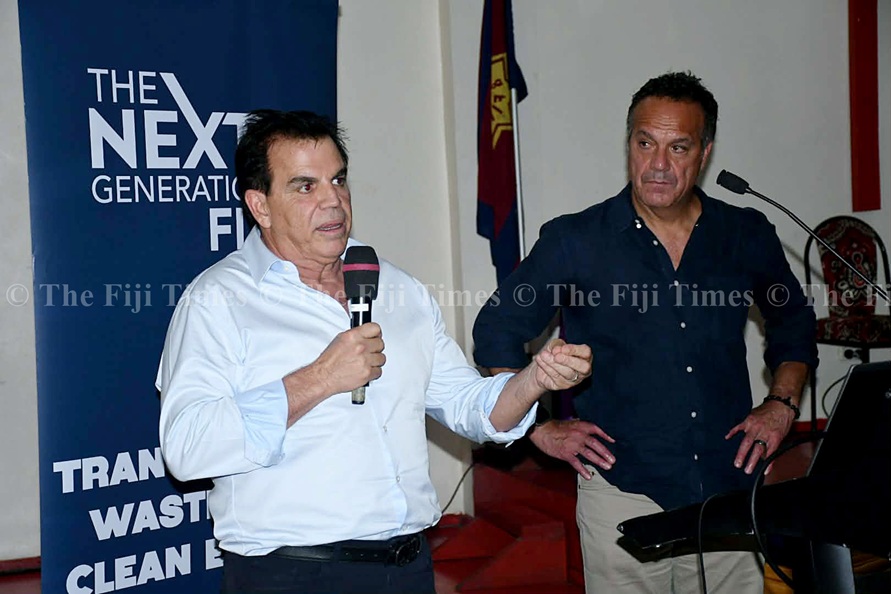
Fiji-born Ratu Qativi Robert Cromb is one of two Australian business tycoons at the helm of a proposed $1.4billion energy from waste power plant that could eliminate landfills from Fiji’s waste management system.
Mr Cromb, alongside Dial a Dump owner and waste and recycling expert, Ian Malouf, are investing their own money into The Next Generation (TNG) Fiji — the private firm that will oversee the proposed project.
While a government-sanctioned Environmental Impact Assessment on the billion-dollar project is in full swing, the pair were in the Western Division recently to field questions from residents, resource owners, businesses and government officials during a three-day intensive public consultation.
Armed with technical experts, researchers and engineers, the pair argued that such a facility would be a game changer for Fiji, although many residents were not impressed.
The project
According to TNG, the proposed power plant’s location would be on 85 hectares with a water port facility near Nakakoro Point in Vuda, Lautoka.
It will process 2700 tonnes of waste a day and 900,000 tonnes annually to generate a net 80 megawatt of energy to Fiji’s national grid.
This proposed energy output will equate to a supply to 45 per cent of Fiji’s national grid and is expected to significantly reduce landfills across the country.
Designed to withstand a Category 5 cyclone with air-cooled condensers ensuring water resilience and operational continuity, the energy from the water plant will be situated right next to a port facility that will feature deep water berths for large vessels.
The impact, says Mr Cromb, is immense.
“It will create employment for over 1000 Fijians, more than 100 technical jobs and offer training partnerships for locals,” he said.
“It will donate $5million to $10million to the Katalyst Foundation, and if anyone knows anything about the Katalyst Foundation we have done more for the education of Fijians than anyone else in this country and we have been doing it since 2012.”
He said the proposed port facility will open the door to trade and commerce opportunities.
The why
Fiji produces 200,000 tonnes of waste annually dumped and buried in landfills across the country. It also buys $US700 million in diesel each year.
These two factors, says Mr Cromb, is the driving force behind their push to establish a waste-to-energy power plant.
“It would be much easier to build a hotel but this power project is going to serve the future of our country,” he said.
“This power project means we don’t have to import diesel.
“We bought $US700million of diesel a year.
“That is a big item in our accounts. It is a big item that should be going to hospitals, to education facilities and not to oil companies.
“We produce 200,000 tonnes of rubbish every year.
“Every person knows whatever is official there is a lot more that is unofficial.
“You only have to drive from Nadi to here to know that number is wrong.”
He said a single waste to energy plant in the country would cut Fiji’s buying of imported diesel by $250million.
“Someone said one man’s waste is another man’s gold and that waste is an opportunity for us.
“It will reduce leaks of waste into our soil, it will decrease landfills, and it will reduce pollution.”
Concerned residents
Despite Mr Cromb’s affirmations during their three rounds of consultations in Lautoka, residents were sceptical and want the development taken elsewhere.
“I have spent my whole life in this area, we have our family home there,” said a longtime resident.
“While we like the idea of having this power plant and what it could do for our country, my only ask is if you take it somewhere else.”
Isireli Soqosoqo, a resident of Nakakoro Point, told developers the proposed plant sits near his property.
“I think that’s where this plant would be going,” he said.
“Since you’ve been explaining all this magnificent ideology and technology coming through, I couldn’t hear anything about the community. You never even mentioned community or the environment.”
Mr Soqosoqo, who bought his home 15 years ago following his retirement, expressed his disgust at the prospect of being displaced.
“If I come with the same technology and same idea, I build on your backyard back in Cronulla or back in Perth or Melbourne, how would you feel? I feel pretty disgusted.”
For the national interest
Driven by a passion to help, Mr Cromb maintained that apart from the global notoriety that comes with meeting the 2030 goals, Fiji stood to gain economically from the proposed $1.4billion venture.
“This is a world-class energy generation facility,” he said.
“It works to the highest standards and addresses critical environmental challenges and creates sustainable economic opportunities.
“This project is between Ian and I.
“We need people with courage and people who are crazy enough to do a project like this because none in their right mind would do this.
“I think that Fiji should open the doorway to at least think about this technology.
“There are 3000 of these plants across the world.
“If you don’t want this and the Government scrutinises this and they find fault with this project, then Ian and I will go away.”

