
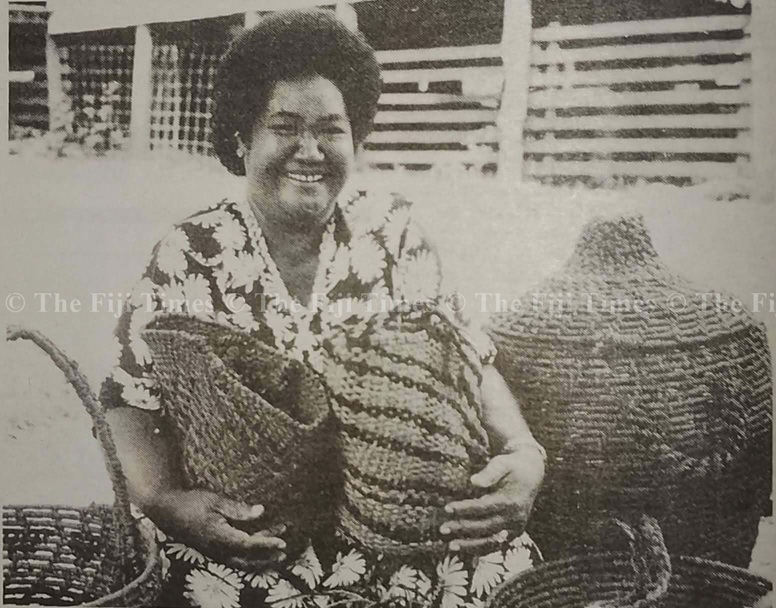
Laveti Ma’afu was a fine example of the changing role of women in society, moving beyond traditional village life to income-earning activities.
Her story, published in The Fiji Times on Thursday, April 2, 1992, told of how the woman from Tubou, Lakeba, Lau, had spent most of her life in the village helping her mother with the traditional chores of a woman, and that on the day the article was published, she was able to use that knowledge to make money and bring herself into business.
Laveti specialised in creating all types of basket ware from weaving magimagi or coconut sinnet.
She remembered helping her mother and grandmother weave and make handcraft at a very young age while her elder sisters were sent to Suva to be educated.
On the night of Monday, March 30, 1992, a large number of people turned up at the Australia and New Zealand Bank to witness the launching of Laveti’s craft.
The items on display ranged from baskets to other household items all finely woven from magimagi.
Laveti had been assisted in setting up a series of exhibitions around the country by the Fiji Arts Council, the University of the South Pacific’s Fiji Centre, and the ANZ Bank.
The exhibitions were funded by the South Pacific Cultures Fund.
In the olden days, magimagi was mainly used by Fijian men when building houses.
Launching the exhibitions, the wife of the Commander of the Fiji Military Forces, Adi Ateca Ganilau, said the use of magimagi was more common in Lau than anywhere else in Fiji.
She recalled the use of magimagi to measure land allotments, and to make fishing nets.
She said magimagi was most commonly used in place of nails while building bure.
“Magimagi was said to be far better than nails because it did not rot,” she added.
“The skill of using magimagi is a peculiar one which only certain clans have.
“It is a good thing that these items have been made to ensure that the material is not forgotten.”
Also in the same week, 20 representatives from government and non-governmental departments participated in a course to assist them in helping women like Laveti.
The training course organised by the Department of Women Affairs and Culture and International Labour Organization was held at the Hans Seidel Foundation in Nadave.
Course co-ordinator Rusila Beranaliva said the five-day course aimed to train women to be better equipped to help other women in business

