
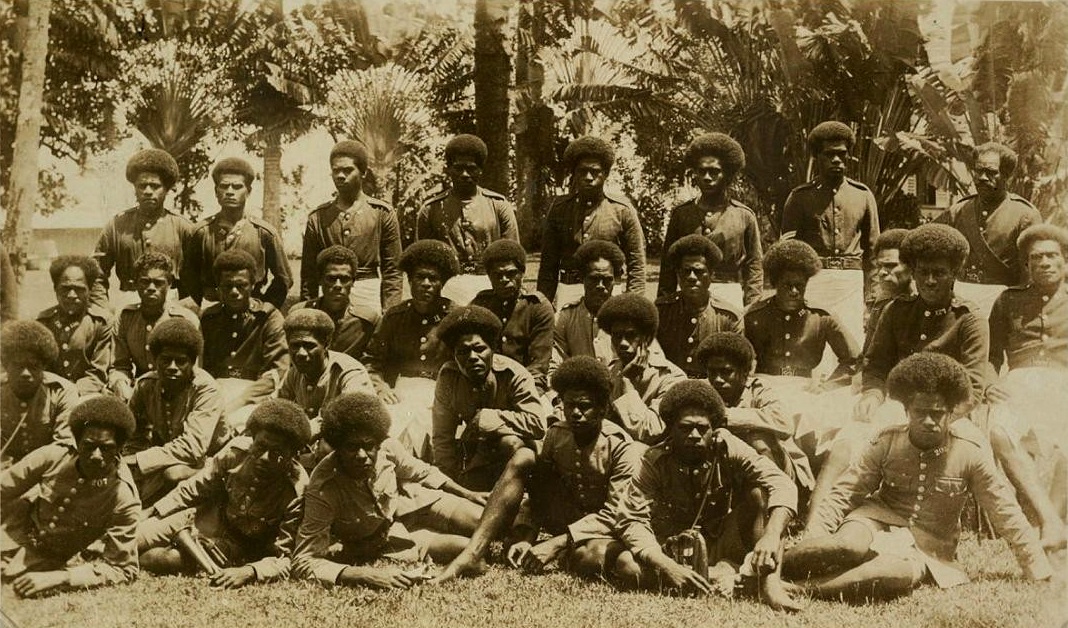
Did you know the Fiji Police Force changed its name three times?
It took me more than 30 years of life to discover something as simple and yet as profound as this.
It’s a small fact, perhaps, but like many things in life, the simplest facts often hold the richest stories.
For more than 150 years of its existence, the force has grown, from only 200 officers since its inception in Levuka on October 10, 1874, to a fully-fledged national organisation.
Acting Deputy Police Commissioner Aporosa Lutunauga said the force was initially known as the Armed Native Constabulary (ANC).
“It was led by the first commissioner of police and consisted of only 200 officers,” he said.
Mr Lutunauga said it was the first ministry established by the British after Fiji was ceded to Great Britain.
“It was created by the new colonial administration when the first officers were appointed by notice in the royal gazette.”
According to the Fiji Police Force website, it was first led by Lieutenant Henry Olive of the Royal Marine Light Infantry.
Mr Olive had no prior policing experience, but was the aide-de-camp to the then-governor.
“He was ideally suited to the job of training the men who were destined to become the ANC,” the website said.
The ANC was in many ways more military than police. It operated like a disciplined army, yet always under the command of a police officer.
The website said Mr Olive spent several years working closely with the ANC until its formal dissolution in 1906. By that time, the policing structure had evolved, and the constabulary had grown into an organisation with multiple branches and growing responsibilities.
Back then, policing in Fiji wasn’t uniform in function or appearance.
There were four classes of police.
They were the ANC known to Fijians as sotia, the regular police officers stationed in Levuka and Suva, and rural police officers who reported to district commissioners. There were also village police who answered to the village headman.
“Uniforms were similar for lower ranks, while isulu tavatava was worn with a blue collarless tunic, patterned after the original Chinese blouse uniform worn by the first recruits.
“Only the buttons were different. Those of the sotia were brass while the ovisa, as all other police were called, wore silver buttons.”
In 1882, as Suva prepared to take over as the new capital of the colony, Mr Lutunauga said, the police force became the first government department to make the move.
“At midnight in 1882, the then-governor moved the capital to Suva. The first ministry to relocate was the police, which set up its office at Totogo, which is now known as the Central Police Station.
“It later established a camp at Nasova.”
The website said the area was named after the site of the original police station in Levuka.
“The ANC camp at Nasova was also named after their camp in Levuka.”
Over the next century and a half, Suva presented new challenges for the police.
The capital’s growth brought with it more people, new communities, and evolving crime patterns. The force had to adapt, often with limited resources.
In 1967, the arrival of a new commissioner, RTM Henry, marked a turning point.
Mr Henry had served for two decades in Sarawak and the colonial police in Malaya.
Unlike his predecessors, the police website said, he introduced fresh ideas but soon realised Fiji’s policing budget was modest compared with what he was used to.
“An early example of this was when a new building was completed at Nasova, which combined classrooms for a school, now the Police Academy, and a gymnasium.
“When the latter was completed, it was just an empty building, no estimate for equipment having been included in the budget.
“It was a year before the requirements for fittings were included in estimates and approved by the Legislative Council, so the building could be used for the purpose for which it was designed.”
Still, reforms slowly took root.
Recruitment and training began to focus more on academic merit.
Leadership programs for promising young constables were introduced, and for the first time, the force began to attract recruits from neighbouring island nations like Kiribati and Vanuatu.
Another defining moment in the force’s history came at the dawn of the 1970s, as the world reeled from the social revolutions of the 1960s.
Discussions about the role of women in uniformed services were gaining momentum globally, and Fiji was no exception.
The YWCA and the Methodist Church were among those pushing for women’s inclusion in the police force.
The Government, under pressure and with little planning, agreed in December 1968 to a pilot program, recruiting eight women into the Special Constabulary. Their names deserve to be remembered.
They were Susana Touwa, Merewalesi Mataika, Kelera Tokalau, Menani Vukivuki, Adi Litia Vuniwaqa, Nellie Peters, Kesaia Masivivi and Annabella Peters.
These eight pioneers opened the door for gender integration in Fiji’s policing system.
By mid-1970, six of them joined seven others to form the first batch of 13 women to undergo formal police training.
That same year, Fiji celebrated its Independence.
As the nation entered a new era, so too did its institution.

