
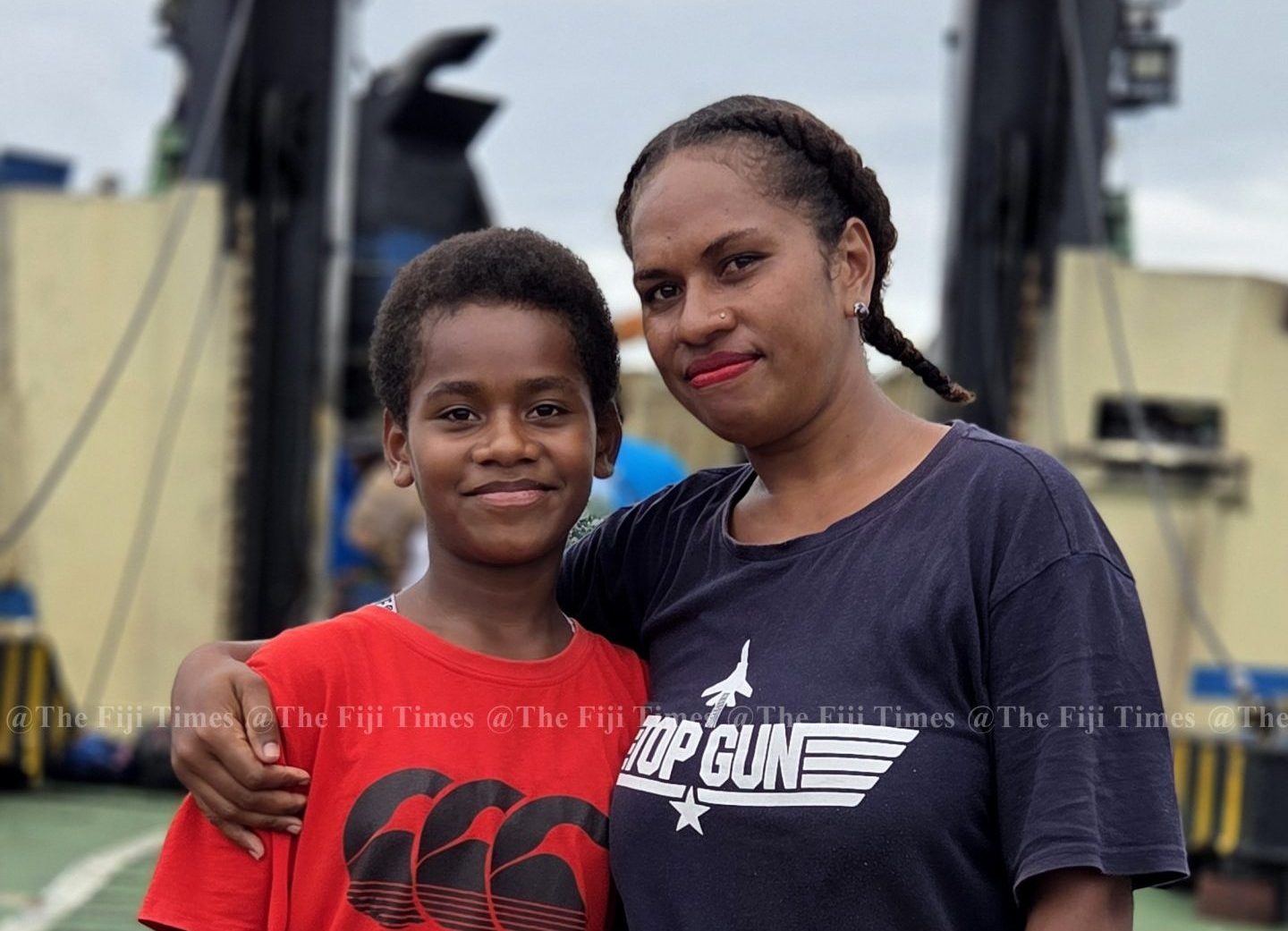
There are moments in time that leave indelible marks on the mind, experiences so harrowing that they linger long after the physical danger has passed. What was meant to be a routine journey home from the Christmas holidays in Lovoni, Ono-i-Lau, became such a moment for one family on Thursday morning, when the fibreglass boat transporting them to the Lomaiviti Princess 12 capsized in rough seas.
Back on land, Reapi Rokomoti struggled to hold back tears as she recounted the terrifying ordeal that she, her husband and their 10-year-old daughter endured while returning from her husband’s village.
What should have been a familiar crossing instead turned into a fight for survival.
Ms Rokomoti said that in the days leading up to the journey, the family had seen a Facebook post advertising a boat run to Lau. This was followed by a low-pressure system warning from the Fiji Meteorological Service.
Like many others, they assumed the boat company would reschedule the trip in light of the weather conditions. That did not happen!
“There were four adults in the boat and my daughter,” Ms Rokomoti said. “The sea was very rough, and the waves were already high when we left the village that morning.”
Not long after departure, the boat capsized in the open sea. Powerful waves and strong winds quickly pushed the vessel away, separating family members in the water.
“When the boat overturned, my daughter was clinging to one of my in-laws, whom she had been sitting with, while my husband was with me. I could hear my daughter crying and calling out, ‘Dad, Mum.’ I kept calling back to her, telling her to be strong and not to let go,” she said.
Ms Rokomoti recalled shouting instructions to her daughter through the wind and waves: to cling tightly to a fibreglass fuel tank, to hold on, and to wait for help. For 10 agonising minutes, the family remained in the water, battered by the sea.
Eventually, rescuers reached them and transported the family to the Lomaiviti Princess 12. Though safe, they were left shaken and traumatised. Their clothes were soaked, their belongings wet.
“We sat there drenched, distressed, and not knowing what to do next,” Ms Rokomoti said.
“The journey back to Suva felt overwhelming.”
In the midst of shock and exhaustion, there was kindness. Fellow passengers and crew offered food, tea, dry bedding and a place to rest. For Ms Rokomoti, that compassion provided comfort amid the chaos.
“Truly, God was watching over us,” she said.
“The kindness shown by the crew and passengers was a blessing.”
This is an experience her family will never forget.
Incidents like this raise serious questions about maritime safety, weather monitoring, and accountability. Water safety must never be treated as an afterthought, particularly for people living in our outer islands, where sea travel is not optional but essential.
There must be greater emphasis on infrastructure development, including the construction of safe jetties, stricter enforcement of weather advisories, and stronger safety protocols for all passenger vessels. Lives depend on these measures.
Those entrusted with responsibility, regulators, operators, and government agencies, must act with urgency and resolve. The challenges faced by residents of remote islands are well known. We have known this for decades! Governments have come and gone, and the challenges remain! We need decisive action now, not after tragedy strikes!
Can someone please lift their fingers off the keyboards and do something about this!

