
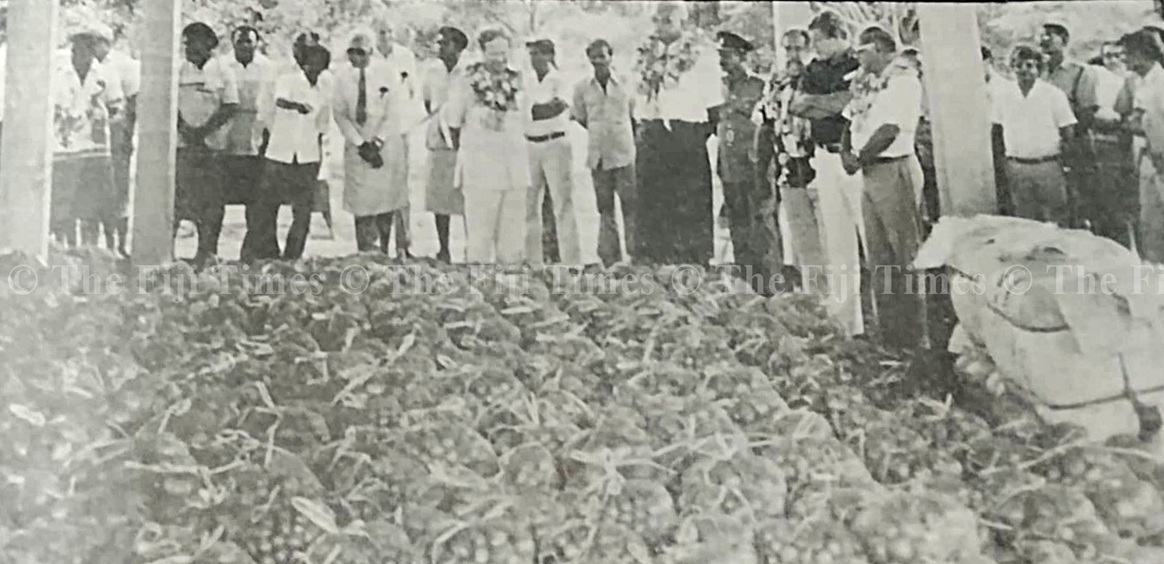
On November 14, 1984, The Fiji Times published an article on the introduction of onion farming and how it became an instant success, with crop testing and funding.
A farmer in Yaqara, Tavua, produced 350 tonnes of onions and this was Fiji’s first commercial onion crop.
A day prior, the then Prime Minister, Ratu Sir Kamisese Mara, cut a ribbon to open the way into a large shed where 1700 bags of onions harvested from the Yaqara farm were stored.
He told a large crowd gathered at the farm for the ceremony the harvest reflected the hard work, dedication, and cooperation between all involved in the project.
“Today we see human effort bearing fruit,” he said.
“I am confident the labour expended on the project will ensure its future success.”
The onion venture was carried out by Yaqara Projects Ltd in a joint venture with Queensland agriculturist, Dr Peter Blood, on a 75-25 equity basis.
The newly-registered company, a subsidiary of Yaqara Pastoral Co Ltd, had as directors, the parent company chairman Abdul Yusuf, Dr Blood and Dan Costello of Lautoka.
Australian High Commissioner Jeremy Header had confirmed that $312,000 in aid from the Australian Development Assistance Bureau would fully fund Yaqara’s 75 per cent equity in the project.
Dr Blood said varieties found successful in trials the previous year were planted over eight hectares and produced a yield of 350 tonnes of onions.
He said they hoped to expand the acreage in the next season to 40ha and at the same time also grow garlic which had shown promising results.
Dr Blood said they had also encountered problems mainly associated with weeds and an onion disease, but they could be controlled.
He said weeds were controlled up to the time that 75 per cent of the bulbing potential was reached.
Then the controls were relaxed which resulted in weedy patches showing up, but under them were full sized onions.
Mr Yusuf said among the reasons for choosing onions for planting were the success of initial trials and the amount Fiji spent – about $2million to import onions in the past few years.
He said studies showed that wage earnings from casual employment on the project would total more than $30,000 when the full 100 acres came under cultivation by 1985-86.
Mr Yusuf said the existing efficient distributors of onions in the country should continue to buy and distribute the local onions as they were doing for the first harvest.
He said when the following year’s crop came into the market, it would be necessary to have licensing protection from the government to avoid dumping by traditional suppliers or a price war.
Mr Yusuf said the Yaqara farm could meet at least 50 per cent of Fiji’s onion needs in the near future.
Ratu Mara said the project was of particular significance because it was part of the process to diversify the economy in line with the policy of import substitution and provide more domestic agricultural production.
He said the imported onions cost twice as much as the locally grown ones and he had been told they were just as good as the imported ones.
“I tasted some only last week, and I venture to say they were better than the imported ones,” he said.
Ratu Mara said the Yaqara area was known for its low rainfall and different soil types, and it was a remarkable achievement to have onions grown successfully there.
The chairman of the Economic Development Board, Ian Thomson, said that with the previous year’s onion imports reaching 4724 tonnes worth $1.04million and the year’s imports worth $1.52million, the EDB welcomed such import substitution ventures.

