
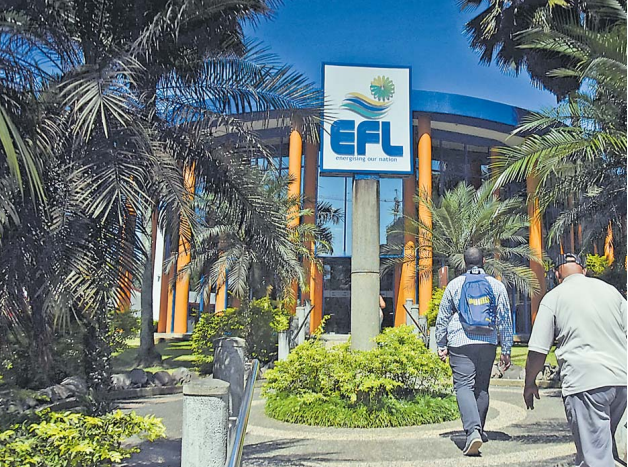
WHAT looks like a routine electricity tariff debate is actually a point-of-no-return moment for Fiji’s energy system. Once certain financial and ownership choices are locked in, future costs stop being debated and start being imposed.
Fiji’s fuel import bill rose to about $F1.6billion in 2023, a burden that feeds directly into electricity prices, transport costs, food prices, and inflation. Against that backdrop, the current tariff debate is not just about how much prices rise this year. It is about whether Fiji has quietly crossed a structural threshold after which affordability, resilience, and policy choice become permanently constrained.
Across infrastructure, utilities, and public services worldwide, a repeatable pattern emerges once long-term private capital is embedded (OECD, 2005; World Bank, 2017; UNCTAD, 2021). This is not about bad intent or blame. It is about structure and incentives. Electricity in Fiji now fits that pattern almost textbook-perfectly.
What follows is not prediction. It is a map of where Fiji sits in a repeatable infrastructure-financialisation pattern — and why action is urgent.
The utility financialisation cycle — Explained simply
Step 1: Entry through partnership (Completed)
The first step is always framed positively. Government brings in a private partner under the language of reform, efficiency, and shared risk. That is exactly what happened with the partial sale of Energy Fiji Ltd. At this stage, nothing appears wrong. But this is the moment the system locks onto a new path. Electricity ceases to be governed purely as a public service and begins operating as a financial asset within a return-seeking structure (OECD, 2005; World Bank, 2017).
Step 2: Financial structuring and return discipline (Completed)
Once private capital enters, the utility must recover capital, maintain investor confidence, and deliver predictable returns. This is not optional; it is how long-term investment works. Dividend discipline and financing requirements become embedded features of the system. Prices are no longer only about covering operating costs; they must also sustain cashflows and valuation.
From this point onward, pricing pressure becomes systemic rather than discretionary (OECD, 2018; IMF, 2020).
Dividend distributions provide concrete evidence of how these return expectations are operationalised once capital is embedded. In 2022, Energy Fiji Ltd declared and paid FJD 46.61 million in dividends, nearly doubling the approximately FJD 20 million paid in 2021, and in 2023 declared dividends totalling FJD 40.68 million (Energy Fiji Ltd, 2022; Energy Fiji Ltd, 2023).
Step 3: Operational pressure (Underway)
With capital embedded, pressure builds. Infrastructure ages. Climate risks intensify. Fuel prices fluctuate. Maintenance and upgrades become unavoidable. All of this is real. But a new constraint now exists: the system must keep cash flowing. Operational strain becomes the justification for borrowing, restructuring, and higher tariffs.
Tariff increases begin to look “inevitable” — not because regulators want them, but because the system has been designed to require them (World Bank, 2004; OECD, 2018).
Step 4: Public absorption of risk (Now)
This is where Fiji stands today. When service disruption becomes politically or socially costly — blackouts, instability, reliability risk — Government and regulators are pressured to act. In Fiji’s case, this pressure is already visible in repeated tariff reviews and proposals to fund large capital programmes through consumer pricing rather than structural redesign.
Here is the critical point often missed: tariffs do more than fund operations. They stabilise revenue (OECD, 2018; IMF, 2020). Stable revenue strengthens company valuation. Expanded assets, approved tariffs, and predictable cashflows reduce investor risk and consolidate value inside the utility. Risk is socialised through higher household bills, while value is quietly locked in (World Bank, 2004; Lazonick, 2014).
Where oversight failed — The missing brake
Why this drift went unchecked
The drift did not occur in an institutional vacuum. It was enabled by a deliberate regulatory override of normal public-sector governance safeguards.
In monopoly utilities, the Auditor-General is the principal independent public audit institution empowered to scrutinise how public risk accumulates across ownership arrangements, financing structures, capital plans, and consumer impacts — precisely the junctions where long-term exposure is created (INTOSAI, 2019; OECD, 2016).
That oversight was removed through the Audit (Exemption) Regulations 2021, a statutory instrument made under the Audit Act which expressly exempted Energy Fiji Ltd from audit by the Auditor-General of Fiji. The regulation took effect on December 2, 2021, replacing independent public audit with reliance on private external audit arrangements and internal governance processes.
This was not a technical adjustment. It altered the governance architecture at the exact moment when private capital was embedded, dividend discipline intensified, long-dated financing expanded, and tariff pressure shifted from cyclical to structural.
By design, the regulation severed the only audit mandate capable of following decisions end-to-end — from ownership and capital allocation, through procurement and financing, to downstream consumer cost exposure.
The consequence was predictable. With independent public audit removed upstream, scrutiny migrated downstream. Public debate narrowed to tariff outcomes, while the design drivers — capital structure, dividend policy, debt assumptions, procurement exposure, and constraints on consumer choice — became opaque.
Step 5: Orderly exit (Predictable if nothing changes)
Once revenues are stabilised and valuation improves, private investors can exit in an orderly manner. When that happens, gains have already been realised. Government and the public remain with long-term debt obligations, higher baseline tariffs, and reduced policy flexibility. The public keeps the liabilities. The value has already been extracted.
The true point of no return is not a tariff increase, but the approval of new long-dated financing, generation assets, or grid investments built on the assumption of continued household dependence (IEA, 2021; UNCTAD, 2020). Such decisions commit the system to repayment horizons of 20–40 years, embed fixed-cost recovery into tariffs, and hard-wire assumptions about demand, fuel use, and consumer behaviour into contracts that cannot be easily unwound.
Even where cheaper and more resilient alternatives already exist — rooftop solar panels with 25-year lifespans, batteries lasting around a decade, and four-to-six-year payback periods capable of supporting full household electrification, including induction cooking and electric vehicles — utilities locked into recovering sunk costs are structurally disincentivised from enabling rapid adoption. The constraint is not technological readiness or consumer willingness, but system design, in which approval thresholds and licensing regimes effectively cap household systems below the scale required for independence.
For example, full household energy independence typically requires rooftop solar systems in the 10–15 kW range, sized to meet current demand and future electrification needs. Under existing arrangements, however, installations up to 5 kW proceed without licensing, while systems above that threshold face additional approval and licensing requirements. A 5 kW system is insufficient to support full household electrification or EV integration, limiting savings and extending payback periods.
Why consultation alone cannot fix this
Public consultation matters — but it has limits. Consultation can influence timing and sequencing. It cannot unwind exposure created by ownership and financing design choices made years earlier (OECD, 2015; World Bank, 2019). That is why focusing only on tariff percentages misdiagnoses a design problem as a pricing problem.
This is not really a debate about electricity prices.
Let me repeat that: this is not about tariffs.
It is about who will own Fiji’s energy costs for decades to come.
What can still be done — lawfully and in everyone’s interest
The situation is not hopeless — but the window is narrowing. Action must happen now, while structural choices still exist.
Government (Law and ownership, not tariffs)
Government does not need to interfere in tariff determinations to act — and should not. Regulatory independence must be preserved. But Government is not a bystander. It remains fully responsible for the legal, ownership, and governance framework within which tariff decisions are made. That responsibility cannot be delegated away.
The audit exemption was created by regulation, and it can be revoked by the same legal authority that enacted it. No legislative amendment is required. No regulatory independence is compromised. Revocation would simply restore the normal line of sight expected for a monopoly utility with deep public exposure.
Beyond this, Government, acting as majority shareholder, has a clear and lawful obligation to ensure that the utility’s strategy aligns with the public interest. That includes the power — and the duty — to direct a governance audit examining ownership arrangements, financing structures, dividend policy, risk allocation, procurement exposure, and the treatment of consumer choice. Critically, such an audit must assess whether rooftop solar, storage, and household energy independence are being actively enabled or structurally constrained through planning assumptions, connection rules, and approval thresholds (INTOSAI, 2019; OECD, 2016).
This distinction matters. Tariff regulation operates at the surface. Governance decisions operate upstream. Tariffs answer the question of how much consumers pay this year. Governance answers the far more consequential question of whether those costs are necessary at all.
In short, this is not about micromanaging prices. It is about exercising lawful ownership responsibility before the window to do so closes.
FCCC (Regulator)
The regulator’s role is not limited to assessing whether proposed costs are reasonable within an existing system. It also carries responsibility for distinguishing necessary costs from design-driven costs. Necessary costs are those required to keep the grid safe, stable, and reliable under any configuration. Design-driven costs, by contrast, exist only because households are kept structurally dependent on centralised supply.
That distinction is no longer theoretical. If consumers are enabled to achieve genuine energy independence through rooftop solar, battery storage, electric vehicles, and induction cooking to replace gas, then substantial portions of fuel imports, generation expansion, and peak-capacity investment simply disappear rather than needing to be recovered through tariffs (IEA, 2022; AEMC, 2021). Costs that vanish when dependence is removed cannot credibly be treated as unavoidable.
A regulator acting in the public interest must therefore ask a harder question before approving tariff recovery: which costs remain once dependence is reduced or eliminated? Only those costs — grid stability, essential network maintenance, and system coordination — should qualify as necessary. Costs tied to sustaining a dependency-based model should be treated as contingent design choices, not passed through to consumers by default.
In short, price regulation without design scrutiny locks in inefficiency. FCCC’s task is not merely to moderate the speed at which tariffs rise, but to ensure that consumers are not required to fund costs that exist only because better options were structurally sidelined.
EFL (As an institution)
EFL’s long-term strength does not lie in repeated tariff increases or in defending a shrinking model of centralised supply. Electricity is not just another commodity. It is a foundational input into everyday life — determining the cost of food, transport, housing, healthcare, education, and small business survival. The way EFL is designed therefore shapes not only household bills, but the structure of the economy itself.
As an institution, EFL sits at the centre of Fiji’s development trajectory. If it operates primarily as an electricity seller, its incentives inevitably align toward maximising throughput and recovering costs through tariffs. If, instead, it evolves into an open-access grid platform, its role shifts fundamentally: from selling kilowatt-hours to enabling energy capability across households, villages, and enterprises.
That evolution matters. An open-access platform stabilises the network while actively enabling households, communities, and businesses to generate, store, and use their own energy. It allows villages to support local enterprise, MSMEs to reduce operating costs, farmers to electrify production, and households to lower exposure to imported fuel shocks. In doing so, energy becomes an enabler of productivity and resilience, not a brake on both. This is not a loss of relevance for EFL — it is a repositioning. In a distributed system, EFL’s value lies in system coordination, grid reliability, standards, balancing, and long-term resilience. These functions are essential to national security and economic stability, but they do not require keeping consumers permanently dependent.
When energy policy reduces costs across the economy instead of compounding them, electricity becomes a driver of development rather than a constraint (IEA, 2022).
In short, EFL’s institutional choice is not between public service and financial viability. It is between leading Fiji’s transition to a resilient, distributed energy future — or being locked into a model that increasingly conflicts with the lives, livelihoods, and development needs of the people it exists to serve.
Consumers and the public
Rising tariffs are not isolated events. They are signals that risk has already been shifted downstream — from balance sheets to households. What matters now is not short-term relief, but whether consumers retain any meaningful ability to choose a different future.
At this moment, consumers still have options. Households can reduce exposure through rooftop solar, storage, electrification of cooking, and electric vehicles. Communities can pursue shared generation, micro-grids, and demand reduction. These choices allow households to exit dependence rather than merely cope with higher prices.
But these options exist only while the system remains flexible — before long-dated investments hard-wire assumptions about continued demand into the grid.
That choice window is narrowing. Each approval of debt-financed generation, each expansion of centralised assets sized on the expectation of household dependence, shrinks the space for consumer exit.
As fixed costs rise, the system becomes increasingly reliant on keeping consumers captive to recover them. At that point, household independence is no longer just discouraged — it becomes incompatible with the financial design of the system.
Even if technologies remain cheap and available, households are locked into paying for infrastructure they no longer need — or cannot escape. From that moment on, tariffs are no longer prices that can be managed or avoided; they become obligations embedded in contracts and balance sheets.
This is why public understanding now matters as much as regulation. Tariffs can be debated annually. Design choices cannot. Once the system crosses that threshold, consumer choice does not return — not through consultation, not through elections, and not through future policy promises.
The bottom line
This is the moment that matters. Not when the next tariff is announced, and not when the next consultation closes — but before long-dated financing, centralised assets, and contractual assumptions lock Fiji’s energy system into decades of dependence. Today, households still have options: to generate, store, and manage their own energy; to reduce exposure rather than absorb higher prices. Once approvals are granted on the assumption of continued dependence, consumer choice does not return — not through consultation, not through elections, and not through future policy promises.
At that point, energy costs are no longer debated; they are imposed.
This is therefore not a dispute about tariffs, but a decision about ownership of future costs — whether they remain with households and the nation, or are quietly embedded in balance sheets and contracts beyond public reach.
Government still has lawful authority to act, the regulator still has scope to ask harder questions, and the utility still has the opportunity to reposition itself as an enabler rather than a gatekeeper. But the window is narrowing.
Miss it, and Fiji’s energy future will no longer be shaped by choice, policy, or public interest — only by obligations already signed.
SUNIL CHAND is an engineer and reform strategist with three decades of senior-level experience across manufacturing, regulation, and higher education. He served as Director of Projects at the FCCC from 2007 to 2009. The views expressed in this artyicle are his and do not reflect the views of this newspaper.

