
FIJI’s creative industry is undoubtedly vibrant, yet it is a world that is constantly evolving and challenging.
It is not for those who expect instant results or overnight success.
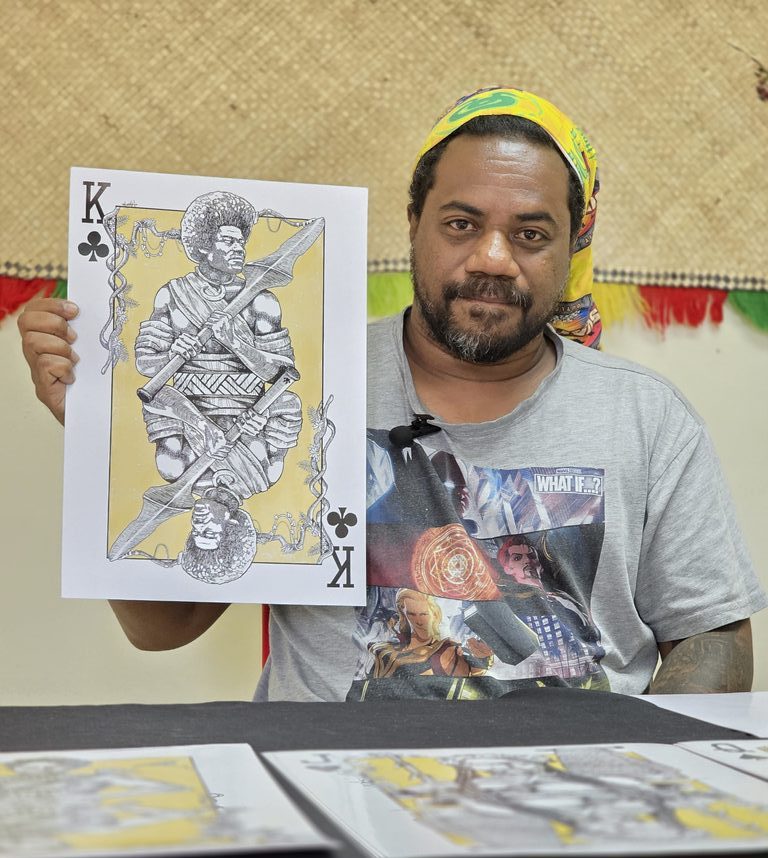
Emerging artist and poet Atueta Rabuka’s journey, from media personality to full-time artist, is proof of this reality.
His dream of devoting his life to art has been in the making since he was 17 years old.
Hailing from Kuku Village in Tailevu, with maternal ties to Rewa, Rabuka recalls a childhood marked by constant drawing.
He even defaced his father’s Bible and encyclopaedias until his parents relented and provided him with chalk to draw on the walls.
Rabuka said his artistic calling was not the result of pure genius, but of relentless practice.
“I believe talent exists, but skill is developed through persistence,” he said.
He likened it to rugby, noting that while anyone can play, professionals commit.
Influenced by his brother’s tapa designs and his cousin Mesu’s precise reproductions, Rabuka chose to ignore conventional career paths.
Instead of university, a visit to the Fiji Institute of Technology (FIT) now part of FNU, introduced him to formal art training.
There, he mastered mediums ranging from charcoal to oil painting under international tutors, as part of the final cohort before programme cuts.
Life’s setbacks soon followed.
Mishandling of fees forced Rabuka into the media industry, where he spent more than a decade working at Communications Fiji Limited, Fiji TV and FBC.
While rewarding, he said the work stifled his true calling.
In 2018, he resigned to restart his artistic journey, embracing poetry slams along the way as a means of creative growth.
Today, Rabuka is advocating for art to be recognised as an economic powerhouse.
He is calling for a shift away from colonial mindsets that label art as “useless”.
He said the sector needed structured support similar to agriculture, including education, investment and strong copyright enforcement to protect originality amid rampant copying.
On artificial intelligence, Rabuka sees potential for its use as a tool for fine-tuning work and brainstorming alternative ideas, but warned of erosion if society undervalues human creativity.
“Used responsibly, AI can assist artists,” he said.
However, he warned that abuse of the technology risked devaluing original work.
Rabuka’s journey in the creative space so far is proving that art is viable when combined with sheer commitment.
He agreed that tertiary institutions were lagging in placing importance on the arts and humanities.
However, he said early intervention from pre-school onwards was key to shifting perceptions and growing career pathways in design, film and beyond.

