
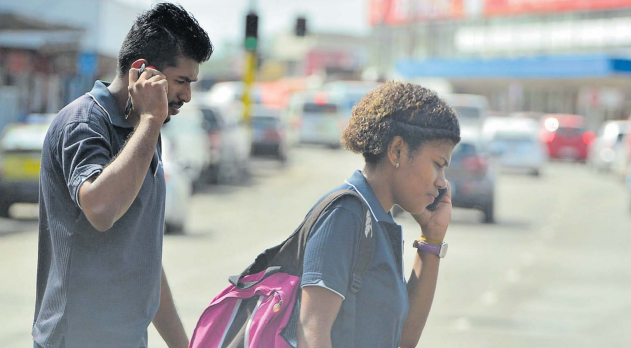
Fijian social media is filled with videos of crimes (or, I should say, alleged crimes). Theft seems rampant in Fiji, to the point that it has become a topic of conversation when I am catching up with friends and family back home. One common item stolen is mobile phones. I assume that these stolen smartphones are easy to sell, possibly providing a lucrative “venture” for thieves. In some videos, I heard perpetrators (alleged) specifically asking victims for their mobile phones. These incidents made me recall a similar experience a few years ago (I think 2019).
Anyway, I’ll save you the details on what I was doing at the time and my background, but long story short, we had an incident where someone’s smartphone was stolen at a bar. As per protocol, a police case was lodged to identify the perpetrators. As with many other similar cases, the chances of getting a stolen phone back or even catching the perpetrators seemed slim to none, so all we could do was lodge a complaint and leave it with the Police. However, at the time, my manager was relentless and couldn’t just let it go and leave it with the Police to figure things out, so we agreed to get some justice for the victim. Because this is Fiji, and unless you make some noise and breathe down someone’s neck, nothing gets moving, especially in the civil service. By no means do I intend to degrade the work our civil servants do with limited resources, poor working conditions and with lower wages — that’s a story for another day. Moving on, this is what we did in a nutshell, and what we learned from the incident.
-Lodge a police report immediately. The police will ask you to fill out a statement and describe the smartphone. You will need to provide the IMEI number for your phone. The IMEI number is like a digital fingerprint for your mobile phone (you can Google it). It is absolutely important for you to note down the IMEI number for your phone. It’s usually written on the phone box and in the settings menu of your phone.
-Following your statement, the Police will generate a search warrant for the specific IMEI number.
-They then take this search warrant and get it witnessed (probably not the correct term, but, for the purposes of this piece, signed off) by a Justice of Peace (JP). Now, you must be wondering why JP and not just run down to the lawyer’s office and get it signed off by a lawyer (Commissioner for Oaths). Well, I was wondering the same thing, and I don’t know the answer. We were trying to get the stolen phone back and the perpetrators taken to task, so we just tried to avoid agitating the hardworking officers with our million questions.
-Once the Police have the search warrant signed by the JP, they then present that search warrant to the mobile network providers. In this case, to Vodafone Fiji and Digicel Fiji. I do not know if they serve the same to TFL.
-The network providers then run a search on their network to check which sim card is linked to the IMEI number you provided.
-Remember, all SIM cards in Fiji are registered to a specific user. Network providers have to register a person’s details using their photo ID when they purchase a SIM card. So, with the IMEI number search, the network provider can check which SIM is used in the phone and who that SIM belongs to.
-The Police then take the result and progress their investigation. The network provider has full address details of the SIM card holder, so the Police can simply show up at the address (following their own procedures, of course). By now, the thief could have sold off the phone, but the new ‘owner’ has a few things to explain, like receiving stolen property. But let’s save the discussion of the demand for stolen items, which fuels theft, for another day.
In our case, the perpetrator ended up using the stolen phone themselves and led the Police right to their address, in Rakiraki (I think). Imagine a phone stolen in Suva and then ended up in Rakiraki. The arms of the law are long indeed. The Police also discovered that the individual was involved in other similar thefts and was part of a group that had recently broken into nearby locations. So, you can see how straightforward the process is and why it’s foolish for people to steal mobile phones, and even more doltish to buy these items from thieves. I’m not questioning the Police’s investigative techniques, but you can see how a mobile phone theft can uncover a larger network of crimes.
My fellow citizens, while the summary above may seem like it was a walk in the park, let me remind you that this is Fiji. Some things you have to do yourself, like being persistent, keep running after the Police, and keep asking for updates. We even drove the Police officer to get the warrant signed off by a JP at the Suva market. I also remember my manager even went up to see the Acting Police Commissioner or someone senior at the Vinod Patel Complex HQ at Centrepoint, because to us it was getting justice for the victim and setting an example that we won’t let these things go lightly.
With all the crime that seems to be rampant in Fiji, I was wondering how we can at least curb mobile phone theft and possibly help curb more serious crimes.
-The Police need to take the so-called ‘petty theft’ seriously. I think stolen phones are the simplest things to track and trace the perpetrators and recipients of stolen goods. Even if you can’t find the perpetrators, the phone will lead you to the recipient. Once word spreads, people will stop buying stolen phones. No demand, no sale, no theft (in logical theory, of course).
These ‘petty thefts’ can be a starting point for ‘young’ offenders, and if the police take this seriously and go after the petty theft, it might stop bigger theft. Remember, when we were young, spare the sasa, spoil the child. So, start small and hope it sets an example. Kerekere, please don’t start a discussion on corporal punishment now – you guessed it, let’s save it for another day. This ‘petty theft’ is like a cancer; if you don’t take it seriously when it is small, it will spread and plague our society.
-Does the Police need a special unit to investigate and expedite cases of mobile phone theft? Maybe to clear the backlog, go after these criminals, and get the perspective in order, so people are aware that they WILL get caught.
-Do the network providers need to provide some sort of service if someone’s phone is stolen? Should they have a dedicated desk to block SIM cards from being used on these stolen phones? Perhaps, we should have a database where we can register our phone’s IMEI number, and if we sell off our phone, maybe do a transfer of the IMEI too. Don’t forget our phones are everything in this day and age. It contains everything about us, and they don’t come cheap.
Of course, I understand the Police have their own processes in place, but something’s obviously not working. Instead of bloviating about what needs to be done and acknowledging the problem, perhaps let’s focus on expediting cases and treating these cases with some seriousness.
I may have missed some details in my summary, and I don’t necessarily know the inner workings of how the police deal with these types of cases. But I’m a member of the public, all I want is for phone thefts to stop and for the Police to link these stolen phones to solve crimes at large. Perhaps, the media can question the Police department directly.
I also understand that there may be some technicalities involved, and I urge the media to check with network providers and ask what they can do to help victims. Lastly, and probably, most importantly, there might be legal ramifications, like privacy, fair process and so forth, but that’s not what I’m discussing today. I’m sure some ‘Suva lawyers’ might be willing to share their opinion, and I look forward to wider discussion on this from practitioners, and most importantly, from victims about their experiences.
Pratish Raj is PhD Candidate (Law), at the University of Canterbury, Christchurch, New Zealand. The views expressed in this article are his and do not reflect the views of this newspaper.

