
Part 2
Major Reverend Viliame Tunidau, the outgoing Force Chaplain of the Republic of Fiji Military Forces (RFMF), is a living example of the fruits of struggle.
The ups and downs he cherished and endured, from Matuku to the suburbs of Suva, resonate deeply with many young men in society today — especially those from the outer islands who leave behind a life that grounded them in family, vanua and church for one that is as unpredictable and volatile as the ocean they sailed across.
In this second part of our glimpse into the life and journey of Mr Tunidau, he takes us through his time at Davuilevu and the challenges he endured, which ultimately shaped his spiritual and moral foundation, centred in Christ.
The call to ministry
Davuilevu is the esteemed and renowned training ground of many of Fiji’s venerated Methodist clerics. Viliame Tunidau entered its gates in 1996, driven by a deep passion and an enduring desire to become a talatala.
He recalled vividly remembering the moment following his final examination at the Fiji Institute of Technology (FIT), now known as the Fiji National University (FNU).
Rev Tunidau shared that after completing their final paper, he sat down with his course mates, and they spoke about their plans and aspirations.
“Some intended to continue their studies at the Fiji School of Medicine and the Fiji School of Nursing. Others planned to attend the University of the South Pacific or various other institutions. Some planned to enter the workforce.
“I simply stated, ‘I want to become a talatala’,” he said.
His declaration was met with polite nods and, perhaps, according to Rev Tunidau, a hint of surprise.
“While my peers spoke of conventional paths to success, I knew my journey would follow a different calling — one that demanded both spiritual dedication and practical resilience.”
Little did the young Viliame Tunidau know then that the path ahead would shape not only his ministry, but also his character, understanding of service, and his very approach to life.
A formative introduction
During his first week at Davuilevu, particularly at the Methodist Lay Training Centre (MLTC), Rev Tunidau was introduced to what was known as “field week”.
This integral component of the institution’s programme, applicable to both new and returning students, was designed to immerse them in the realities of manual labour, outdoor chores, and communal living.
“The work was demanding, which included clearing para grass and overgrown pathways, and assisting with practical maintenance tasks,” Mr Tunidau said.
Each task, however, was purposeful. Field Week was more than just a test of endurance; it was a formative experience meant to cultivate hardworking vakatawa (church stewards), instil discipline, and provide an authentic understanding of the physical and spiritual demands of ministry life.
It was during these early days, as sweat mixed with determination under the relentless Fijian sun, that Mr Tunidau began to sense the profound connection between service, humility, and leadership.
Daily discipline and routine
“The daily routine was rigorous. Each morning, we rose at 4.30am to prepare for the day. By 5am, we gathered for a 30-minute morning devotion, led by the staff member on duty,” he said.
Following prayers, duties were assigned, and by 5.30am each student was expected to be at their designated area. Activities included field work, grass-cutting, farming, and maintaining water drainage systems around the compound.
“At 7am, we returned to the dormitories to wash and prepare for breakfast, which continued until 8am. At 8.30am, we reconvened in the hall for a second devotion, followed by three hours of field work. From 12 noon to 1.30pm, we observed a period of lunch and rest,” he said.
The afternoon schedule commenced after rest, with a short devotion, followed by three additional hours of labour until later in the afternoon. This rhythm characterised the initial week at MLTC, which Rev Tunidau described as a “baptism of labour and endurance”.
While it was physically demanding, it provided essential formation, demonstrating that ministry begins with servanthood, discipline, and diligence.
Leadership
Rev Tunidau highlighted that a significant challenge during his time at MLTC was leadership.
“As the saying goes, ‘Leadership refines its followers.’”
Over the three years he spent at the institution, the head of both the MLTC and the Young People’s Department was the distinguished talatala, the Reverend Nemani Cakacaka, affectionately known by the moniker “Fero”.
Mr Cakacaka had also served as a chaplain with the MFO Battalion 3 in 1984, and his experience in the military had moulded him into a disciplined minister of the church, as well as an effective leader.
He possessed a commanding presence — firm in discipline, precise in speech, and unwavering in his expectations.
“During his duty week, he always wore a half-dress uniform of green military trousers and boots when conducting parade drills for us,” Mr Tunidau said.
“The Reverend also exhibited zero tolerance for lateness, complacency, and procrastination.”
Punctuality, responsibility, and complete commitment were demanded of every student.
Lateness, in his view, reflected poor character rather than mere inefficiency, and though his standards were strict, they instilled the values of resilience, discipline, and integrity in all who served under his leadership.
Rev Cakacaka was also known to be direct in his approach to discipline, according to Rev Tunidau.
“For example, if a student was late while wearing a watch, he would declare: ‘Tuck that watch under your underwear; it’s useless to you!’” he shared.
The point the pastor was making was unequivocal and universal: time without discipline is meaningless.
The lesson for Rev Tunidau was obvious from the start — punctuality reflects integrity, respect, and readiness for leadership.
He admitted that learning under such stringent leadership was not easy, and that while many of his fellow students perceived Mr Cakacaka’s methods as severe, his guidance was a profound blessing.
“Through his example, we learned to endure pressure, accept correction without resentment, and embrace disciplined service over emotional impulse. He demonstrated that ministry is not a vocation for the faint-hearted,” he said.
The true cost of ministry
From the lessons imparted by Reverend Cakacaka, his student Rev Tunidau began to understand that becoming a talatala required more than theological knowledge and preaching ability. It also demanded hard work, unwavering dedication, and personal sacrifice.
“It entails rising early, labouring diligently without complaint, submitting to authority, and committing faithfully to the call, even under discomfort or inconvenience,” he said.
Rev Tunidau began to realise that it was neither lectures nor devotions alone that shaped him. Rather, it was the daily regimen, the high expectations, the constructive rebukes, and the living example of a leader who embodied the principles he taught.
Under Reverend Cakacaka, young men were not merely moulded into ministers of faith, but into servants who were resilient, humble, and prepared to lead by example.
“I recall a particular admonition: ‘When you are in your appointment, do not approach the treasurer requesting stipends (votavota); work diligently, and your work will speak for itself and be rewarded.’”
This principle, Rev Tunidau said, emphasised that ministry is not driven by personal gain or remuneration, but by faithful service.
Commitment in small, unseen tasks becomes a true testimony of one’s character, and recognition, if it comes, follows God’s timing.
Legacy and relevance today
Reverend Nemani Cakacaka’s leadership and training remain instructive within the church today, especially for those who were taught and worked under his guidance.
“While the methods he employed — sharp rebukes and colourful expressions — may not require direct replication, the underlying principles are timeless and essential,” Rev Tunidau said.
“He envisioned leaders who are self-reliant, disciplined, and capable of managing both personal responsibilities and the spiritual needs of their congregation.”
Ministers, in Reverend Cakacaka’s vision, are to serve faithfully, act with integrity, respect the values of the vanua, and lead through purposeful action rather than mere words.
Next week, Major Reverend Tunidau shares a deeply painful account of the death of his father in 2000, and how this event sparked the flame of reconciliation within him.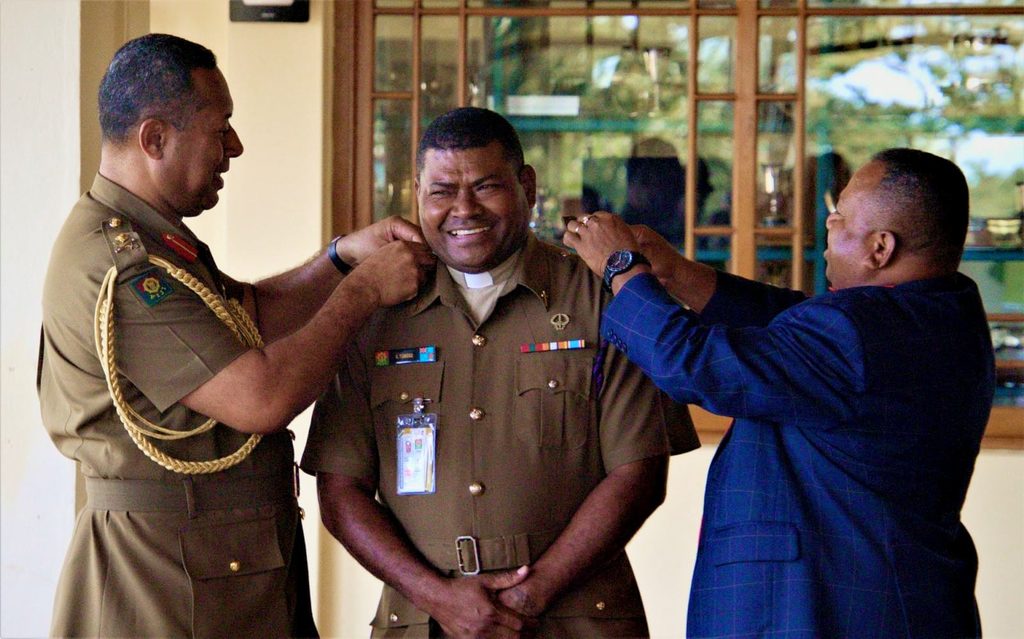
Mr Tunidau being promoted to the rank of Major. He is flanked by Commander Ro Jone Kalouniwai and former Minister for Defence and current Oppositon Leader, Inia Seruiratu. Picture: RFMF
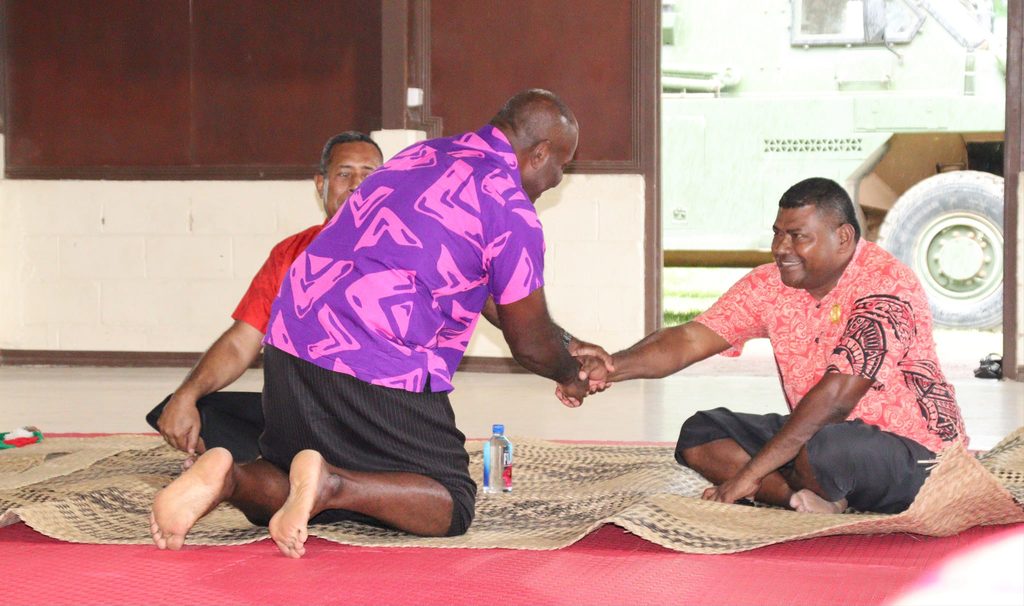
Major Reverend Tunidau during one of the reconciliation ceremonies held by the RFMF this year. Picture: SUPPLIED
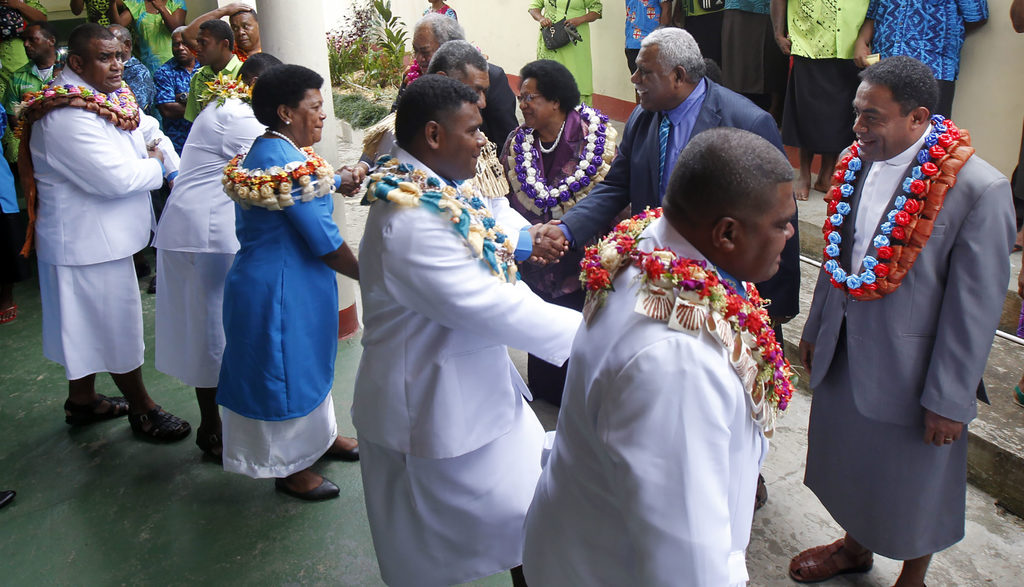
“Ministry is not driven by personal gain or remuneration, but by faithful service.” Rev Dr Jolame Lasawa (right) congratulates the graduates Davuilevu Theological College in 2019.
Picture: ATU RASEA/FILE
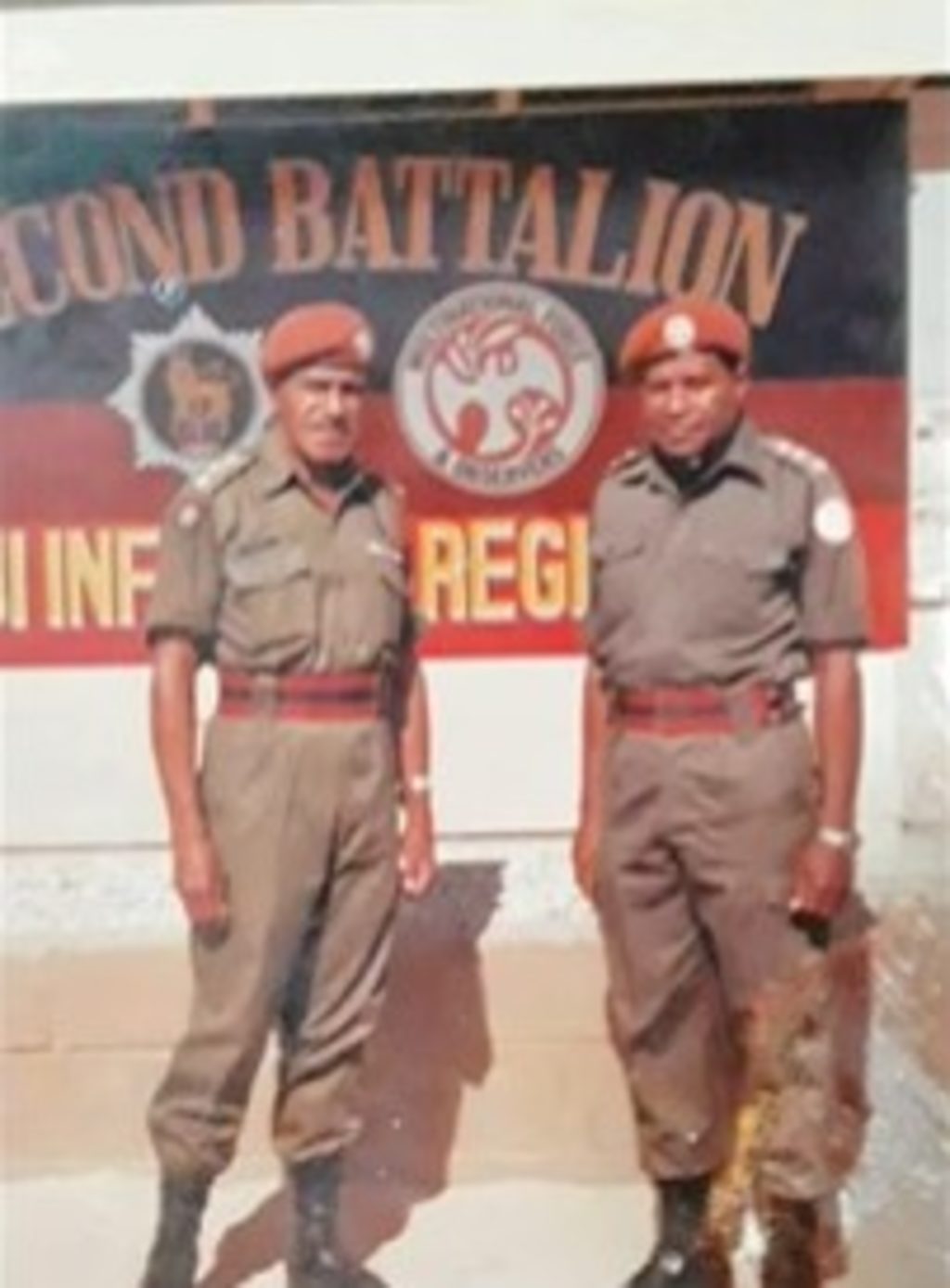
A mentor and guide. Reverend Cakacaka (right) while on his tour of duty abroad. Picture: SUPPLIED

