
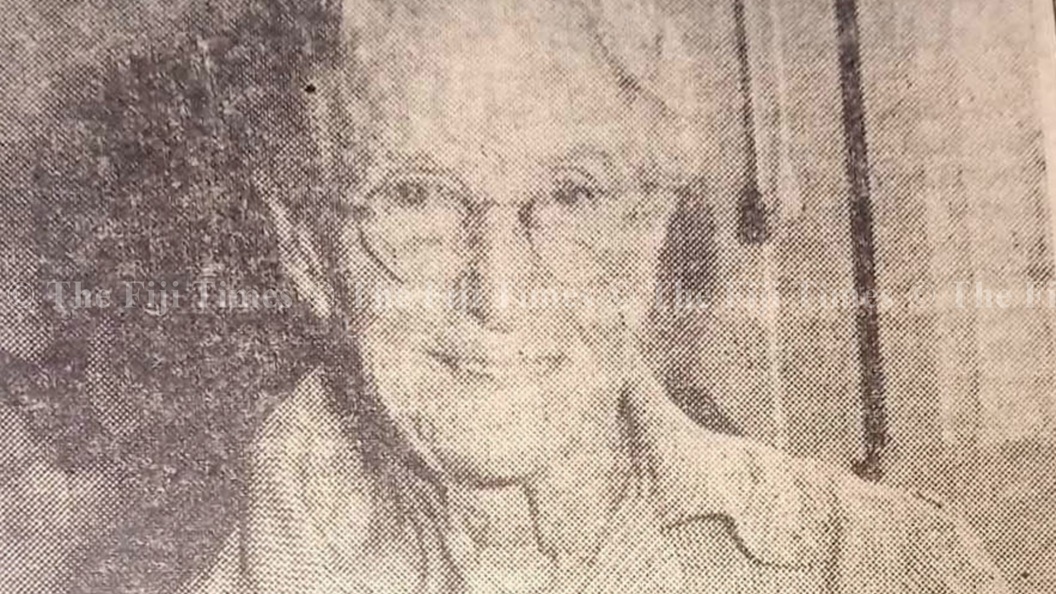
Life in Fiji was very hard in some ways, but it had its compensations, according to Annetta Florence Ragg.
The comment was made by the 85-year-old Toorak resident in Suva and published by The Fiji Times on Saturday, February 3,1962.
Mrs Ragg, who celebrated her birthday 16 days later, was born at Na Tovu Tovu in Rewa and had lived in Fiji all her life.
“In the early days it was all like one big happy family, everyone helping everyone else,” Mrs Ragg said.
“We had to make our own amusements, picnics and that sort of thing, but we enjoyed them very much.
“The women were very domesticated too. They liked cooking and sewing and looking after their homes.”
“If you were having a baby, your mother or a friend usually looked after you.
“You did not get the doctor and, of course, there just was no doctor in the outlying parts.”
Ms Ragg said ships called only about four times a year.
God stones from Kadavu
Flanking Mrs Ragg’s garden path on Amy St in Toorak were three very large round stones known as ‘god stones’, which were presented to her father after he built a reservoir on Kadavu in the early 1900s.
“The stones were in a waterfall and when the Fijians on Kadavu wanted rain they would turn them over,” Mrs Ragg said.
“Then when they had had enough rain, they would turn them back again. But when my father built the reservoir for them, they said they would not need them anymore and presented them to him.”
She said supplies of food such as tea often ran short.
Lemon tea
“My mother often sent us out into the bush to gather long lemon grass and young lemon leaves to make lemon tea,” Mrs Ragg recalled.
“There was no milk except tinned milk.”
She said her mother later raised her own cows and fowls.
“I can still remember her standing on the verandah crying as she saw her cows and fowls washed down the river in one of the floods.”
At the time, Mrs Ragg’s father, Henry Augustus Smith, had a hotel and store at Na Tovu Tovu, which was the stop-over for travellers from Levuka to Suva, which was then a two-day journey.
When boats began coming directly to Suva, Mrs Smith took on contracting and building reservoirs and tunnels in various parts of Fiji.
She first went to a school conducted by two sisters, ‘the Miss Robinsons’, on the site where the Narsey Store was located in the 1960s.
“You had to cross Nubukalou Creek in a boat in the early days, and all the big boats stopped at the mouth of the creek as there was no wharf,” she said.
Later, she went to a public school and then became the first border.
“I was the only one for a few months but gradually others came,” she said.
Five children
Married at 20, Mrs Ragg had five children — Alice, Lily (Mrs Noerr, NZ), Eileen (deceased), Ollie and William.
“I was married in Suva’s first Catholic church, which was where St Felix School is now,” she said.
That building today is Marist Brothers Primary School.
In spite of her years, Mrs Ragg was very active, did all her own cooking and sewing and loved her garden, which was one of the few to be seen on Amy St.
“Toorak was named after Melbourne’s Amy St, you know,” she said. “And while you would not think so now, it was once a very pretty place.”

