
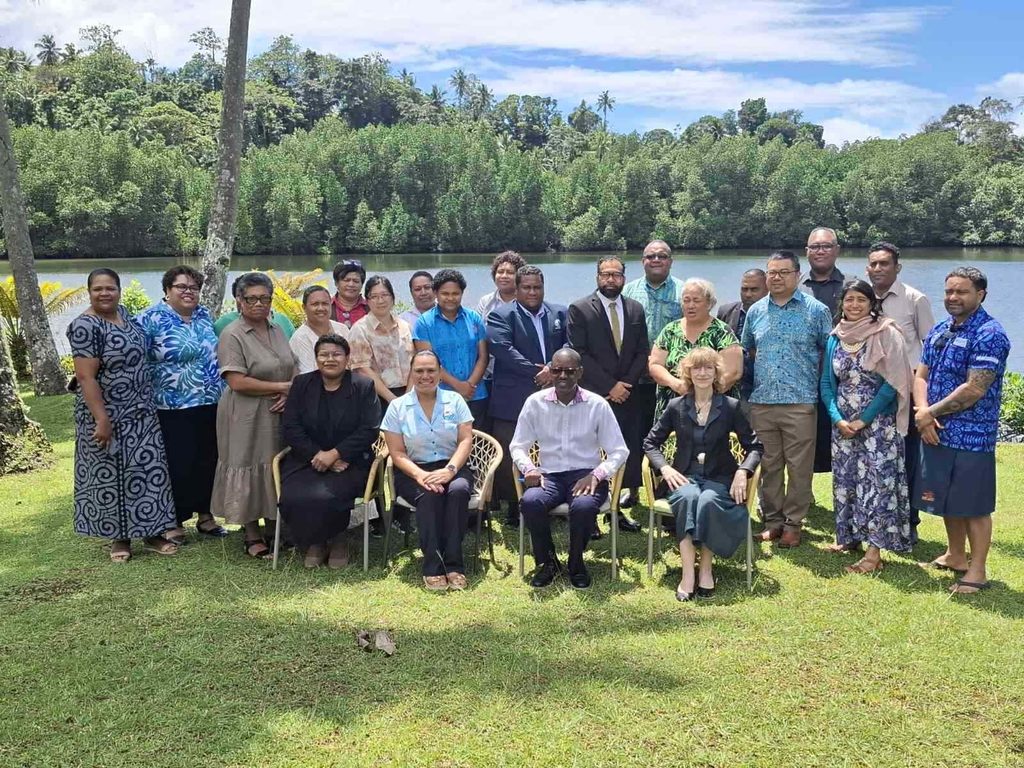
THE Fiji Commerce & Employers Federation (FCEF) joined government, workers’ representatives and Organisations of Persons with Disabilities on Monday December 1 for the Tripartite Plus Workshop on promoting labour rights and inclusion of persons with disabilities.
The workshop, facilitated by the International Labour Organization (ILO) in partnership with the Ministry of Employment, Productivity & Workplace Relations, provided the necessary platform for open and practical dialogue on building an inclusive labour market.
As the recognised voice of employers in Fiji, we welcomed the opportunity to participate and to ensure that the realities facing businesses – large, medium and small – were reflected in the national conversation.
We acknowledge the Government and the National Council for Persons with Disabilities for leading the development of the new Rights of Persons with Disabilities Policy 2025–2035, which sets out a progressive vision for inclusion.
The challenge now lies in turning that vision into meaningful employment outcomes.
Fiji’s economic landscape is dominated by micro, medium and small enterprises (MSMEs), which employ approximately 60 percent of our national workforce.
These businesses form the backbone of our economy, yet they operate within tight margins, rising costs and limited access to capital.
What employers need are systems that make inclusion practical and sustainable.
This requires shared responsibility, from government, workers’ organisations and social protection systems, not an approach that places the full weight on employers alone.
Recent figures from the Fiji Bureau of Statistics underline the urgency of the task ahead.
Of the 296,825 people currently employed in Fiji, only 1199 are persons with disabilities representing 0.42 percent of the working population.
While many persons with disabilities are of working age, the vast majority are not in paid employment.
This tells us that the issue lies in a lack of accessible pathways, from school-to-work transitions to skills and progression training, recruitment systems and workplace readiness supports.
Throughout our engagement with members, several themes consistently emerge:
• The cost of workplace adjustments: While many accommodations are low-cost, others, particularly structural changes, can be significant. Incentives, grants or tax offsets would play a meaningful role in enabling employers, especially MSMEs, to hire more inclusively.
• Accessible, demand-driven skills development: Training programmes must be adapted for persons with disabilities and aligned with real labour market needs.
• Practical guidance and technical support: Businesses, especially MSMEs, require tools, templates and advisory support, not just compliance obligations.
• Partnership with Organisations of Persons with Disabilities: Inclusion is strongest when informed by lived experience.
• Whole-of-government coordination: Employment inclusion intersects with education, health, transport and social protection.
Fragmented support creates barriers for both workers and employers.
At FCEF, we remain committed to promoting disability-inclusive business practices, supporting employers to understand their obligations and working with government, trade unions and OPDs to design policies that reflect both human rights principles and business realities.
What is clear is that inclusion requires partnership.
Employers cannot do this alone nor should they.
We believe a coordinated national approach, supported by practical incentives and accessible systems, will enable more Fijians with disabilities to transition into waged and self-employment.
As Fiji advances the Rights of Persons with Disabilities Policy, we stand ready to contribute to solutions that are realistic, sustainable and grounded in the everyday experiences of our business community.

