
Christmas Eve 2022.
Sitiveni Rabuka triumphantly walked out of the parliamentary chamber bound for State House to be sworn in, again, as Fiji’s elected Prime Minister.
Moments later, former Prime Minister Voreqe Bainimarama exited, flanked by former Attorney General Aiyaz Sayed-Khaiyum
“How are you all?” he asked members of the media assembled in the foyer.
“How do you feel sir?” one reporter asked back.
“This is my democracy and this is my legacy – 2013 Constitution,” he replied
Today, while the powerful political party he founded, FijiFirst, no longer exists, the Constitution he helped put in place is still the supreme law of the land.
The Supreme Court of Fiji in a landmark ruling earlier this year had laid out a workable pathway and the Coalition government is hard at work on relevant pieces of legislation to kick start the review and amendment of the 2013 Constitution.
A panel of law experts, academics, and civil society leaders have raised urgent questions however about whether Fiji’s current parliament possesses the democratic legitimacy to undertake meaningful constitutional reform, following the mass defection of former FijiFirst MPs.
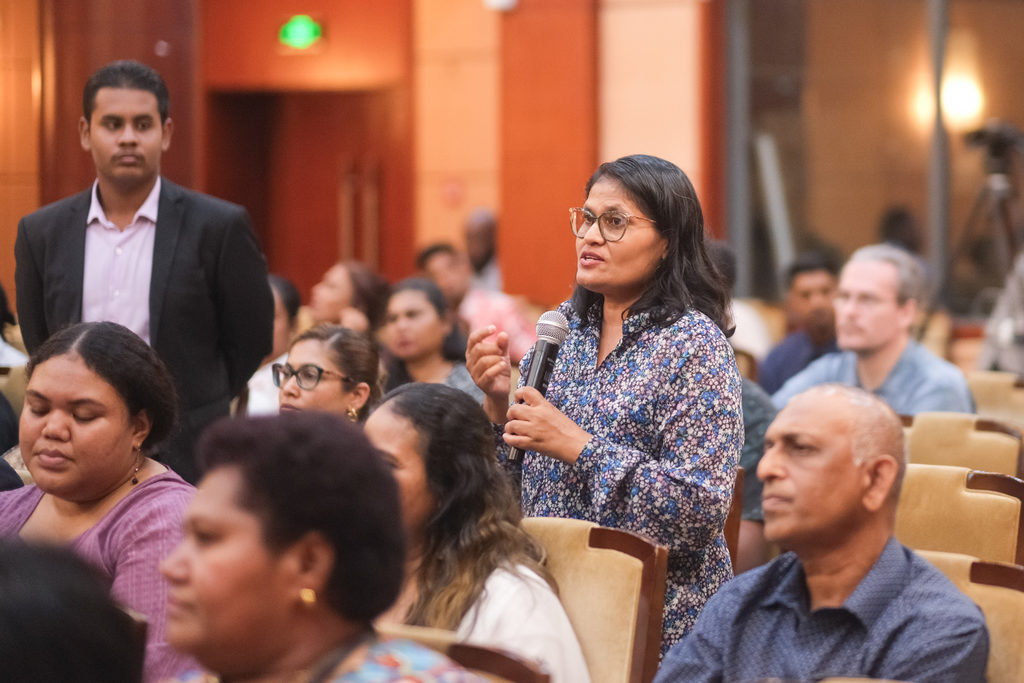
The recent discussion, hosted by Dialogue Fiji, centered on a deepening political paradox, which is that while the Prime Minister Sitiveni Rabuka’s coalition government now commands a significant parliamentary majority, this was only possible through post-election defections rather than at the ballot box.
This reality, panelists argued, casts a long shadow over any major constitutional initiatives attempted before the next general election.
Pillars of legitimacy
Governance expert Emele Duituturaga outlined three non-negotiable elements for legitimate constitutional change.
“No, it wouldn’t be legitimate if it was just up to the members of parliament,” she stated.
“It doesn’t matter how many people defect from one side to the other.”
First, she argued for a “broad-based political consensus” involving all major parties and stakeholders, including those not currently in parliament, on the need and scope of reform.
Second, the nation’s top legal minds must provide clarity on the constitutional and legal pathway, particularly regarding entrenched clauses.
Finally, the process must be driven by an independent, non-partisan commission comprising respected legal experts, civil society leaders, women, youth, and community representatives.
“Otherwise, we go back to pulling out a copy already designed from a drawer,” Duituturaga warned, emphasising that the process, if not the actual amendment, could begin before the next election, which must be held by January 2027.
Legal or democratic mandate
The tension between technical legality and political legitimacy framed the debate. Law Professor Ana Rokomokoti noted the complexity, distinguishing between legal, political, philosophical, and moral legitimacy.
While laws passed by the current parliament are legally legitimate, she pointed to a potential violation of the original democratic mandate.
“It’s arguable that the 2013 Constitution is the policy of the former government,” Rokomokoti said.
“Therefore, it’s natural for you to expect that those who were voted in along those party lines to support every aspect. So when they deviate, there’s a violation of the mandate that they were originally given.”
However, she concluded that the ultimate judgement on legitimacy “is for the people to decide.”
New parliament needed
Professor Jon Fraenkel highlighted the unique dilemma of the former Fiji First MPs, many of whom were elected largely on the coattails of former Prime Minister Frank Bainimarama’s personal vote.
“What do they actually represent? They had such a small number of votes,” he said.
He argued that Fiji’s parliament “urgently needs a major renewal,” which the next election could provide.
“It’ll be the first election for a long time where you know that the former authoritarian-backed regime is not gonna come into office, which will give major opportunities to commence the process.”
Eroded mandate
Dialogue Fiji executive director Nilesh Lal delivered the most direct critique, describing the government’s super-majority as “manufactured” and not earned at the ballot box.
He argued that the defections, facilitated by the Political Parties Act, were “contrary to Section 63 of the Fijian Constitution” and have “essentially eroded in a very drastic way the mandate of the voters.”
Lal asserted that critics of the 2013 Constitution applied a high threshold to assess its legitimacy, and the same standard must apply to any new process.
“The reality is that the current parliament, although it might have legal authority, it lacks democratic legitimacy,” he concluded.
What now?
The panel converged on a central, uncomfortable truth, which is that while the Supreme Court has reaffirmed the current constitution’s legality, and the parliament retains the legal power to legislate, its moral and democratic authority to reshape the nation’s supreme law is now fiercely contested.
The discussion suggests that for any constitutional reform to be widely accepted as legitimate, it must either await a freshly mandated parliament or be conducted through an impeccably independent, inclusive, and transparent process that transcends the current compromised parliamentary composition.

