
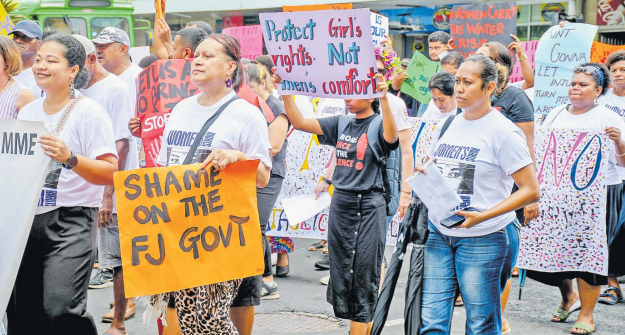
EACH year, global, regional and national movements mark the 16 Days of Activism Against Gender-Based violence, an annual campaign that calls us to reflect, act and re-commit to creating a future where all women and girls live free from fear, harm and discrimination.
The campaign was founded in 1991 during the first Women’s Global Leadership Institute at Rutgers University, where 23 women from around the globe came together, including one representative from the Pacific. This means that the Pacific was at the table when the 16 Days of Activism was created. Through the contributions and stewardship of Shamima Ali, Coordinator of the Fiji Women’s Crisis Centre, Fiji and the wider Pacific were placed at the very roots of this global movement.
The 16 Days begins on the International Day for the Elimination of Violence Against Women (November 25) and ends on Human Rights Day (December 10), a deliberate and powerful reminder that gender-based violence is a profound violation of human rights.
This year, the global 16 Days theme by the United Nations is: “UNiTE to End Digital Violence against All Women and Girls”. This highlights a growing and urgent issue that threatens our collective progress: technology-facilitated gender-based violence (TFGBV), which is fast becoming prolific in our own region.
It is a form of violence that hides in plain sight, embedded in the very digital spaces that were designed to connect, empower and unite us. Yet the same platforms that bring Pacific people closer together are increasingly being weaponised to reinforce old patterns of harm. From abusive messaging and image-based abuse to online stalking and cyber-harassment, TFGBV is spreading rapidly across our Pacific region, reaching women and girls in their homes, workplaces, villages and schools. It is intimate, relentless and borderless, and its impacts can be just as devastating as physical violence.
Women’s and feminist organisations are already driving efforts to stem this new tide of violence, but they cannot address this alone. As the Pacific Community (SPC), we are deeply humbled to support our Pacific member countries and territories as they seek, implement and adapt the solutions that work on the ground – be it through targeted collective action or ongoing efforts to share information and practice through the TFGBV Pacific Learning Network.
Women in the Pacific face some of the highest levels of violence in the world.1 In several Pacific Island countries, as many as two in every three women have experienced physical or sexual violence in their lifetime – some of the highest prevalence rates recorded globally. And while comprehensive data on femicide in the Pacific is limited, recent reports from Fiji alone illustrate the severity of the issue: police recorded multiple domestic-violence-related deaths this year, reminding us that violence is not only widespread but can be fatal. These numbers are sobering. They tell a story of harm that demands not only acknowledgement, but action and accountability.
Our region has a long history (or her’story) of seeking solutions that work for us. In 1983, the late Hilda Lini of Vanuatu reflected on Pacific feminism – highlighting the number of actors in the women’s development space, a persistent challenge over 40 years on:
“We Pacific women do not wish to be confused, nor do we wish to be alienated from our traditions and cultures. We can make our own choices and wish to do so… women in the region are not adequately accommodated in development plans because there is a general lack of information in the Pacific, particularly on the social and economic impact of development, and socio-economic changes.”
Her reflections speak to the resilience of pacific women, then and now. Even then we understood the so-called “women’s issues” were never ours to bear alone. Yet women continue to carry the heaviest burdens, from unpaid care work to disproportionate impacts of crises, to the devastating and often fatal consequences of gender-based violence.
Several other key dates during the 16 Days period – including Women Human Rights Defenders Day on 29 November, World AIDS Day on 1 December, and International Day of Persons with Disabilities on 3 December – provide further opportunity to unpack other interconnected and intersecting issues.
“Gender is not an issue that can be addressed on its own – we must think also of how it intersects with our other challenges and opportunities and develop our policies and approaches with gender equality in mind,” said Hilda Heine, President of the Republic of the Marshall Islands, host of the region’s 15th Triennial Conference of Pacific Women and 8th Meeting of Pacific Ministers for Women last year. “We must take risks, create new partnerships, and be unwavering in our commitment to bring about substantive gender equality for the region.”
It can feel daunting but let us not forget the progress made to enact laws to bring perpetrators of violence to justice or policies developed to integrate gender equality across all spheres. SPC, through our Gender Equality Flagship, continues to help countries navigate this journey working through regional frameworks, sister CROP agencies, national governments and civil society to ensure that all our efforts remain people-centred, member-led and culturally grounded.
Whether we are supporting women in the fisheries, maritime, energy or geospatial sector, we also take the extra time and effort needed to ensure that everyone is involved. This may include measures of equity to offset a historical underrepresentation of women, to safeguard against the disproportionate impact of gender-based violence or account for the unequal distribution of unpaid care work.
The scale of violence in our region demands courage, responsibility and collective action. Ending violence against women and girls is not solely the work of governments, police or women’s organisations. It is the responsibility of every single one of us. We must choose ZERO tolerance for violence against women and girls, not as a slogan but as a social standard. We must hold people accountable, ensuring that harm is neither minimised nor excused. We must change norms, attitudes and behaviours that allow violence to continue.
I am encouraged by our next generation – youth leaders who have called on us all to ‘make a splash for gender equality’: “By actively listening, respecting boundaries as well as not resorting to violence. By standing beside us with respect because girls don’t need saving, we need boys that can stand beside us.”
Across our Blue Pacific Continent, I hope to see us all with courage, purpose and compassion for the 16 Days of Activism and may our collective splashes become ripples of change for Pacific women and girls. But as our youth leaders remind us, we must take the plunge, be courageous, and stand up against violence in every space. We can do this as individuals, as friends, as communities, and as nations, united in purpose, and committed to transforming the region for the better.
We owe nothing less to the women and girls of our region, now and into the future.
MERESEINI RAKUITA serves as the Principal Strategic Lead – Pacific Women and Girls and leads the Gender Equality Flagship at the Pacific Community, where she is driving transformative institutional and regional efforts to ensure that all Pacific women and girls, in all their diversity, are safe and equitably share in resources, opportunities, and decision-making. The views expressed herein are hers alone.

