
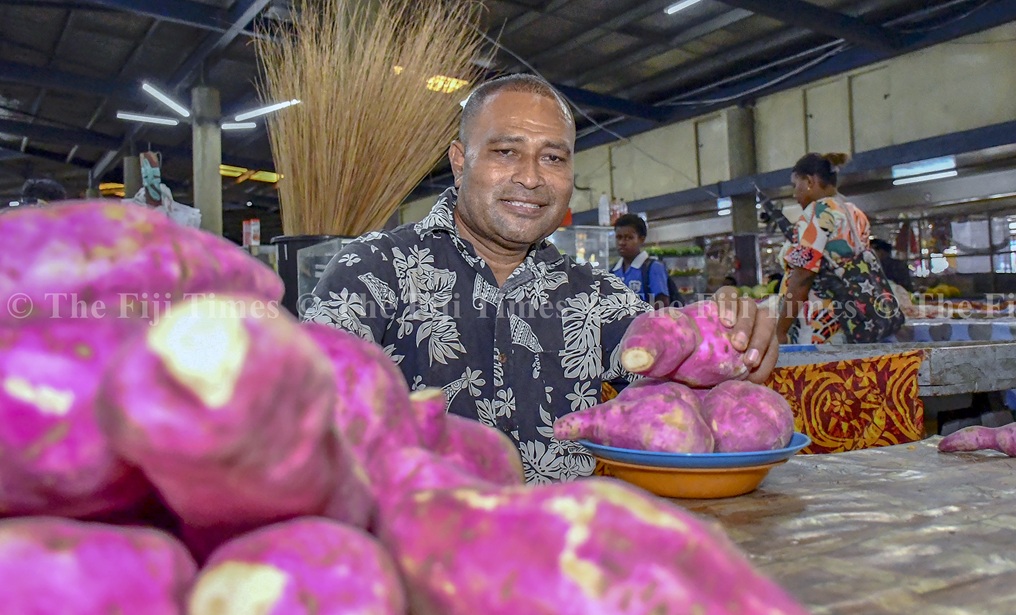
In the bustling heart of the Lautoka Municipal Market, Takelo Sorovou is a familiar face managing an expanded stall topped with dalo and kumala.
His thriving business is a testament to survival after its inception during a time of global pause and lockdown in 2019.
Mr Sorovou recalls the moment necessity became the mother of invention.
“I started it during Covid in 2019 when there was a lockdown in the city,” he said.
Mr Sorovou detailed the difficult circumstances that led him to the market.
“With the city shut down, employment vanished, and financial stability dissolved.
“I had a lot of financial problems. I couldn’t get a job. I couldn’t get insurance. I was in lockdown.”
Unable to work or simply stay home, Mr Sorovou had to find a way to provide.
“We had to come out and do something.
“That’s why I came to start up.”
Mr Sorovou began with nothing but faith and a minimal investment.
“I started with a small bag of cassava from a middleman,” he said.
The early days were challenging, with high costs demanding careful management.
“During Covid, it was very expensive, maybe, $120, $150, and you had to make do with what you could do to get a profit.”
Initially, Mr Sorovou viewed the stall as a stopgap, however, meeting new friends in the market changed his perspective and his future.
“I came here and met some new friends. They taught me how to go through business in the market, because business in the market is different from other businesses.
“So, I learned from them and now I’m enjoying it.”
The small operation that began with just a single bag has since flourished.
“I started with only one big of cassava when I came here. That’s the only thing I could afford. But now you can see, I’ve got more stalls here.”
Mr Sorovou said the market’s flow has changed over time.
“Before, we used to have seasons, good season, low season, but now, a lot of functions are going on. Every weekend, there’s a function. So people will come in and buy dalo, kumala. So there’s a feast every day.”
Mr Sorovou said sales peaked towards the end of the calendar year.
“Mostly near Christmas. At the end of the year, it’s the time when they have Christmas parties, functions, soli, village soli. Like October, November, December. It’s a big season for us.”
For Mr Sorovou, the ability to build a customer base and control his own time are the primary rewards.
“One good thing too, I’m starting to bring in my customers. Customers, when they want dalo they call me. Or they come here. They want cassava, kumala, they come here.”
Mr Sorovou is adamant that new vendors must embrace one crucial trait: patience.
“One of the things I learned here is patience. When you stay here, you’re patient.
“You’ll not get $100 a day, every week, every day or $200 every day for your sales.
“Sometimes you’ll get more, sometimes you’ll get less. But if you have patience, as soon as you build up customers, you’ll have no problem.”
His growth is supported by his immediate and extended family.
“I have my family too. My brothers and sisters who are supporting me. They work overseas. They buy from me and send it to my friends.”
Mr Sorovou’s biggest win is the freedom the business affords him as a parent.
With his eldest now at USP and his second at FNU, being his own boss allows him to be present.
“I can look after my children.
“I don’t need to ask for a bus to give me permission to go and see them in school. So, whenever the teachers call or the school needs me, I’m there.”
Mr Sorovou and his wife, who works for the Biosecurity Authority of Fiji in Nadi, now enjoy a stable household income.
“We might say we’re our own boss, but we have to really work hard. We don’t slack down, we work hard.
“Every morning I wake up. Sometimes at 2am or 3am I off-load my dalo here.
“You might make some sacrifices but the reward is sweet.”

