
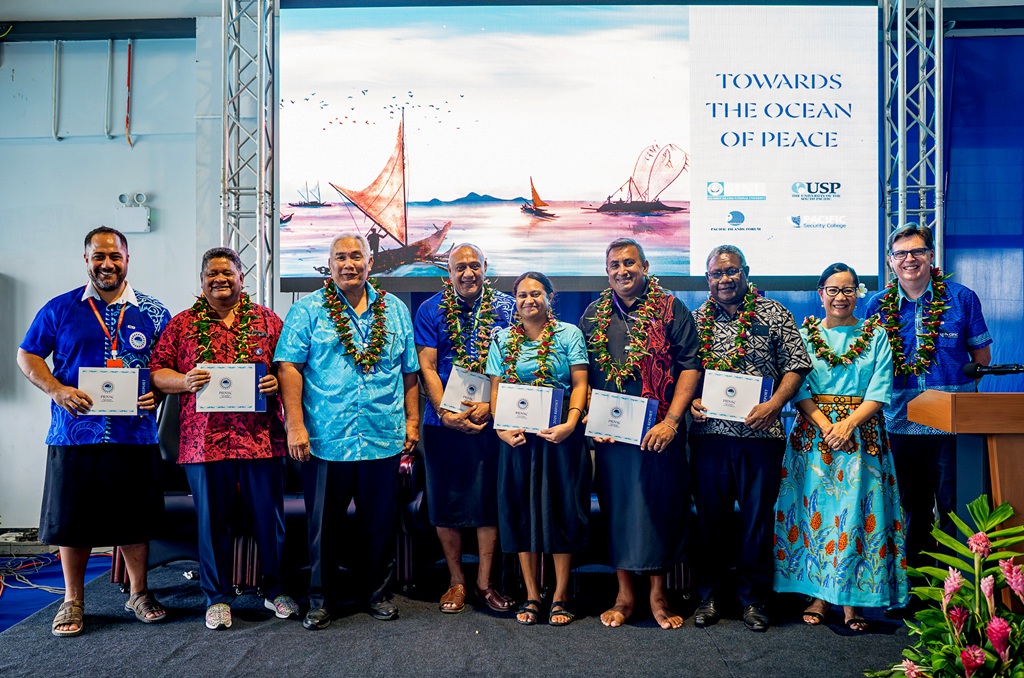
A landmark report on the Pacific’s future, from climate change and cybercrime to illegal drugs and geopolitical rivalry has been launched at the Pacific Islands Forum Leaders’ Meeting in Honiara.
The report captures the outcomes of the 2025 Pacific Regional and National Security Conference (PRNSC) that was held in Suva, where leaders stressed that the region’s greatest strength remains its unity.
For three days, heads of government, ministers, regional agencies, academics, civil society and global partners explored how the Pacific can navigate the “polycrisis” of challenges while shaping its future as an Ocean of Peace.
The Ocean of Peace vision
Prime Minister Sitiveni Rabuka told delegates that conflict prevention and Pacific values must guide responses. He said the “Ocean of Peace Declaration would form a critical part of the region’s approach to preventing conflict and instability, positioning the Pacific well to maintain peace and security into the future.”
The Prime Minister of Niue, Dalton Tagelagi, added that “true security would require preserving the precious heritage treasures into which each Pacific citizen was born: our people, land, values, culture, spirituality, resources and oceans.”
For Pacific Islands Forum Secretary General Baron Waqa, aligning the Ocean of Peace with the Boe Declaration and the 2050 Strategy for the Blue Pacific was essential. “This is where we will build our mighty drua, or waka, for the great journey ahead,” Mr Rabuka said.
Climate: the closing window
Leaders repeatedly described climate change as the Pacific’s single greatest security threat, warning that the “window for adaptation was quickly closing.”
Progress has been made internationally, including the establishment of the Loss and Damage Fund and the International Court of Justice’s advisory process on climate obligations. But as Cook Islands Foreign Minister Tingika
Elikana put it: “Our collective and united voice will carry more weight than our individual fragmented voices.”
Pacific officials also pointed to opportunities ahead, particularly Australia hosting COP31 with the Pacific. But without urgent global financing, delegates warned some countries may face “serious social dislocation.”
Methamphetamine crisis
The Pacific’s war on drugs is fast becoming a race against time.
Delegates at the Suva conference heard that methamphetamine use has exploded into a full-blown crisis in Fiji and is spreading across several other island countries, tearing apart families, straining health systems and undermining national security.
“The 2050 Strategy gives us the vision, but now we need the tools,” said the Chairperson of Fiji’s HIV Outbreak Cluster Response Taskforce Dr Jason Mitchell.
“That includes real-time data, harm reduction programs, and law enforcement that works with, not against, health interventions.”
Ms Virginia Comolli of the Global Initiative Against Transnational Organised Crime did not mince words: “If we do not start thinking regionally and resourcing locally, we are going to lose this fight. The meth trade is outpacing our current responses.”
In response, delegates pushed for urgent reforms, including harmonised drug laws across the region, tougher cross-border enforcement, and stronger involvement of civil society, churches and the media in driving community-based solutions.
Women, peace and security
A recurring theme was the need to bring more women into decision-making. Samoa Police Deputy Commissioner Papāli’i Monalisa Tia’i-Keti told the forum: “Our traditional view of security has always been from a male perspective, and now this is an opportunity for us, women and minority groups, to have a platform to raise and to also address security issues from a female perspective.”
With two in three Pacific women reporting incidents of violence, panellists said tackling domestic abuse was central to regional security. Greater female representation in police and defence forces would help build trust and safety at home.
Maritime resources and sovereignty
The ocean is the Pacific’s lifeblood, a source of food, jobs and identity, but it has also become the region’s front line. Illegal fishing, the push for deep-sea mining and the worsening impacts of climate change all threaten the survival of island communities.
Pacific Ocean Commissioner Dr Filimon Manoni issued a clear warning: “We cannot remain passive and let these decisions be made by others, because our future is intrinsically tied to global decisions about what we want to do on the ocean.”
The stakes are high. The fisheries industry alone employs nearly 28,000 Pacific Islanders and brings in around US$1billion each year.
Experts say that with smart management, revenues could triple. But leaders warned that unless illegal, unreported and unregulated fishing is stamped out, the region risks losing both its economic lifeline and long-term security.
Cybersecurity and new threats
Alongside traditional concerns, digital dangers loomed large. Cybercrime was described as a priority threat undermining economies, rights and trust. Participants urged stronger legislation, infrastructure investment and regional partnerships with the private sector.
Hope and unity
Niue’s Prime Minister Dalton Tagelagi struck an optimistic note, reminding delegates that “the clear answer from the conference is the Pacific will rise and beat these challenges.”
That spirit of resilience was echoed by Solomon Islands’ Foreign Minister Peter Shanel, who said: “The Ocean of Peace is like a beacon of light. It is important for us to see the Ocean of Peace made up of principles that will guide our relationships and allow us collectively to navigate a challenging international system.”
The challenges ahead, from climate change to cybercrime are daunting.
Yet the report launched in Honiara underlines a central truth: the Pacific’s shared traditions, cultures and unity remain its strongest shield.
For leaders and communities alike, the message is clear. The voyage towards an Ocean of Peace has already begun, and it is one the region must take together.

