
How did the container get through?
THIS is the question that readers would have been asking. This is also the question that led to all kinds of speculations and conspiracy theories at the time — those speculations still persist. Let me analyse what transpired with the advantage of hindsight and extensive research here. There were a number of factors at play that need to be understood and linked to each other in order to throw some light on this intriguing question. Indeed, how did the container make its way to different destinations for storage when Sitiveni Rabuka’s troops were on post-coup alert?
Firstly, as mentioned earlier, those were extraordinary times. A humble and highly respected son of the yasayasa vaka ra had been removed from the prime ministership at the point of guns. Vuniwai Timoci Bavadra was from Viseisei, the place where, according to legend, the Kaunitoni berthed and off-loaded the first Fijians. It was from there that Degei and his progeny made their way inland and thence to different parts of Fiji. The First Landing Resort gets its name from this important snippet of Fijian history because oral records tell us that our Fijian ancestors first landed at Viseisei.
Written history tells us that under Fiji’s first resident governor, Sir Arthur Gordon and subsequent colonial rule, the western provinces of Ba and Ra became divided between the Burebasaga and Kubuna confederacies. This was an imposed socio-political order that has never been totally accepted by the people from Ba and Ra. We have seen murmurings — sometimes overtly — for the setting up of a fourth confederacy in the West of Fiji to better reflect provincial similarities, differences and alliances. These have largely been ignored, but surface whenever there is political instability in the country. Thus, there was resentment and anger in parts of Western Fiji in 1987.
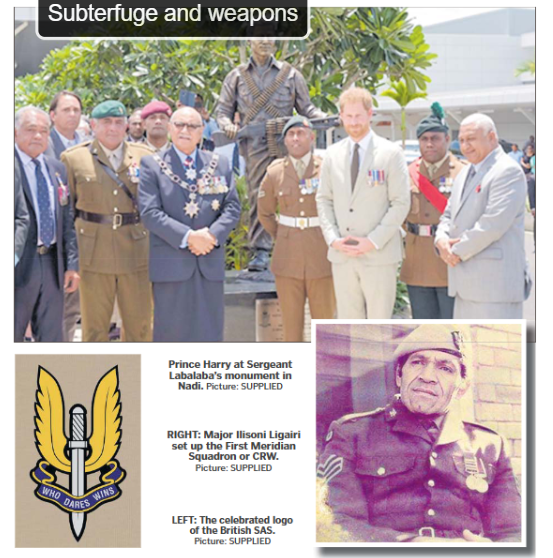
A second factor that needs to be considered is that the Fijian Military was not totally united under Mr Rabuka at the time. This is why he set up the First Meridian Squadron (or CRW) just one day after the May 14, 1987. The unit’s founding father, organiser and director was former British 22nd Regiment Special Air Service officer, Major Ilisoni Ligairi, a retired SAS permanent staff instructor who, upon returning to Fiji in 1984 for retirement after serving a 20-year stint with the 21 and 22 SAS regiments in Great Britain, was called up by Mr Rabuka to form the elite unit. There is more on the SAS later in this article.
Major Ligairi obviously came with a pedigree and profile that no other could have matched at the time. It is no secret that Rabuka was not totally safe in the aftermath of the 1987 coup even though he was being portrayed as the “saviour” of the Fijian people. He was obviously aware of this as seen in the fact that the special elite unit was set up and commanded by a close patron of his. Mr Rabuka also admitted recently that during preparations for the political upheaval of 1987, Fiji lacked sufficient arms and ammunition. This is what he shared:
“I realised that we didn’t have enough weapons and ammunition in Fiji to do what I wanted to do. So, I sent a very quick message to the captain who was there to pick up the ship and surprised him by asking that, get that ship commissioned in Singapore before you sail back to Fiji.”
Thus, Rabuka did not only need special protection from an elite squad, but he sent for more sophisticated weaponry to counter any threats that could arise. Of course, we will have noted that two military officers accompanied Kahan and his group when they faced process obstacles in their quest to get the fateful container released from Carpenters Shipping.
Clearly, the military regime that ruled at the time had doubts about its own level of Fijian support. This appears to be the reason why it refused to put the 1990 Constitution to a referendum and why an election was not held for some years; the government wanted no visible demonstration of any lack of support among those Fijians whose interests it was supposedly defending (Lal in “Dateline”, SBS Television November 10, 1990). It needs to be noted that Mr Rabuka defied Ratu Sir Kamisese Mara straight after the 1987 coup was executed. I will elaborate on the Mara-Rabuka rivalry later, but for this article, we need to accept that these two leaders did not see eye to eye — neither in 1987 nor later.
A third factor that is either treated with too much sensitivity or given a wide berth is the fact that there were fissures in the chiefly hierarchy and the Great Council of Chiefs itself. These fractures still persist today. Many analysts have pointed out that the 1987 coup was aimed at supporting a traditional aristocratic polity (the Fijian chiefly system) and its feudal relation to the economy. Anthony van Fossen (1987, p.24) says that the “coup of May 1987 upheld the aristocrats’ desire to maintain their political control over an indigenous economy defined in terms of ownership which is communal or ethnic, rather than capitalist or social democratic”.
He adds, “the second coup of 25 September 1987 occurred three days after the coalition and Alliance parties had agreed to form a joint caretaker government”. This was the highly promising but ill-fated Deuba Accord. The “agreement would lionise Ganilau, allow Mara to make a comeback, bury concern with corruption in the past, and minimally satisfy Bavadra and the coalition. It appeared to give little or nothing to the minor aristocrats and ethnic extremists who had risen to public prominence since the first coup and who favoured the recent recommendations of the Great Council of Chiefs” (van Fossen, p.30).
A closer look at these minor aristocrats and ethnic extremists who had risen to public prominence since the first coup clearly showed that Fiji could no longer be divided clearly into ethnic enclaves or Fijian chiefs and commoners or any other groupings that had managed to persist from independence in 1970 to the May coup of 1987.
This is where Ratu Mosese Tuisawau joined the fray and featured so prominently in the guns’ saga.
In the case of this prominent son of Rewa (and Burebasaga), he was Ratu Mara’s wife’s brother. Adi Lady Lala Mara was the Marama Bale na Roko Tui Dreketi, the paramount chief of Burebasaga. She was, by extension, one of the three paramount chiefs of Fiji – the other two being the Turaga na Tui Cakau of the Tovata confederacy and the Turaga na Vunivalu na Tui Kaba of the Kubuna confederacy with his seat in Bau.
The interesting part of pertinence here is that Ratu Mosese Tuisawau was apparently not comfortable in the traditional structure where his sister held the top position and appeared to be always influenced and guided by her husband, Ratu Mara the Prime Minister of Fiji.
This discomfort and resentment showed clearly when Ratu Mo joined the NFP and became one of its few Fijian Senators who relentlessly took the ruling Alliance Party to task in the Senate.
One of his key points of contention that gained traction every now and then was that the then Native Lands Trust Board (NLTB) was an unfair institution that tended to serve only the chiefs at the expense of commoner Fijians.
This same contention would bring much Fijian political support to PM Bainimarama later.
Few know or recall that Ratu Mo was one of three local applicants for the critically important post of Manager of the Native Land Trust Board (NLTB) in 1973 — three years after independence and less than one year after Fiji’s first general elections.
The Alliance Government of Ratu Mara had thought it prudent to award the post to Josevata Kamikamica who had not even applied for the position. Sure, Ratu Mo was a member of the NFP at the time just as he had been part of the NFP team in the lead-up to independence. But he was also Ratu Mara’s brother-in-law, and he would have been deeply disappointed by this disregard for something that he dearly aspired to.
From Page 40
Thus, it was obvious in the aftermath of the May 1987 coup that there were divisions in the military, dissent from the Yasayasa vaka ra and demarcations between traditional Mara supporters and the newly emerging voices of demand and dissent among the Fijian polity.
Given this, when we go back to how the deadly container was scrambled out, we find the overt involvement of at least two military officers, a high chief from Burebasaga in Ratu Mosese Tuisawau and a cross-ethnic group of either deliberate or careless and ignorant enablers.
It is these centres of influence and the characters that fronted up that led to the clandestine passage of arms from Lautoka Wharf to the various hiding places scattered all over the western part of Viti Levu under the missed watch of Rabuka’s coup soldiers in May 1988.
We will pursue how the security forces traced and located the arms next week. Here I wish to highlight a bit more about the British SAS.
Fijian involvement with the SAS
The British SAS is a highly secretive elite force that was founded as a regiment in 1941 by David Stirling; in 1950 it was reconstituted as a corps.
Members of the SAS are organised and trained for special operations, surveillance and counterterrorism.
It is renowned for its rigorous selection process and high-level training regimens. Observers of history will know that 1941 was a critical time for Britain during WW2 as Germany was bent on breaking the British resolve and defiance. The SAS played a key role in harassing German forces by operating behind enemy lines.
Fijian troops have featured prominently in the British SAS.
Those of us who have a keen interest in our involvement with the SAS will recall how our very own Sergeant Talaiasi Labalaba acquired legendary status within the SAS at the Battle of Mirbat.
On July 19, 1972 the Popular Front for the Liberation of the Occupied Arabian Gulf (PFLOAG) unleashed a surprise attack on the British Army Training Team (BATT) house, which had nine SAS soldiers, based just outside the port of Mirbat, Oman.
Labalaba, aged 30, was shot in the neck whilst firing a 25-pounder gun at the attacking guerrilla forces. Despite being mortally wounded, he somehow kept firing the 25-pounder single handed. His Omani loader was seriously wounded early in the battle.
Captain Mike Kealy and fellow troopers Tommy Tobin and Sekonaia Takavesi ran a gauntlet of enemy fire in an attempt to save him, but he was up and firing only because of the warrior spirit he carried with him from Fiji. The wound in his neck was fatal.
Sergeant Labalaba’s monument, a statue, can be seen at Nadi International Airport.
Major Ilisoni Ligairi, who formed Mr Rabuka’s CRW unit in June 1987 was also an ex-SAS man — a permanent staff instructor.
Mr Rabuka’s security was evidently in the best of hands. These two prominent military sons of the Vanua Levu portion of Cakaudrove would have a disappointing falling out in 2000. But that’s another story for another time.
DR SUBHASH APPANNA is a senior USP academic who has been writing regularly on issues of historical and national significance. The views expressed here are his alone and not necessarily shared by this newspaper or his employers subhash.appana@usp.ac.fj

