
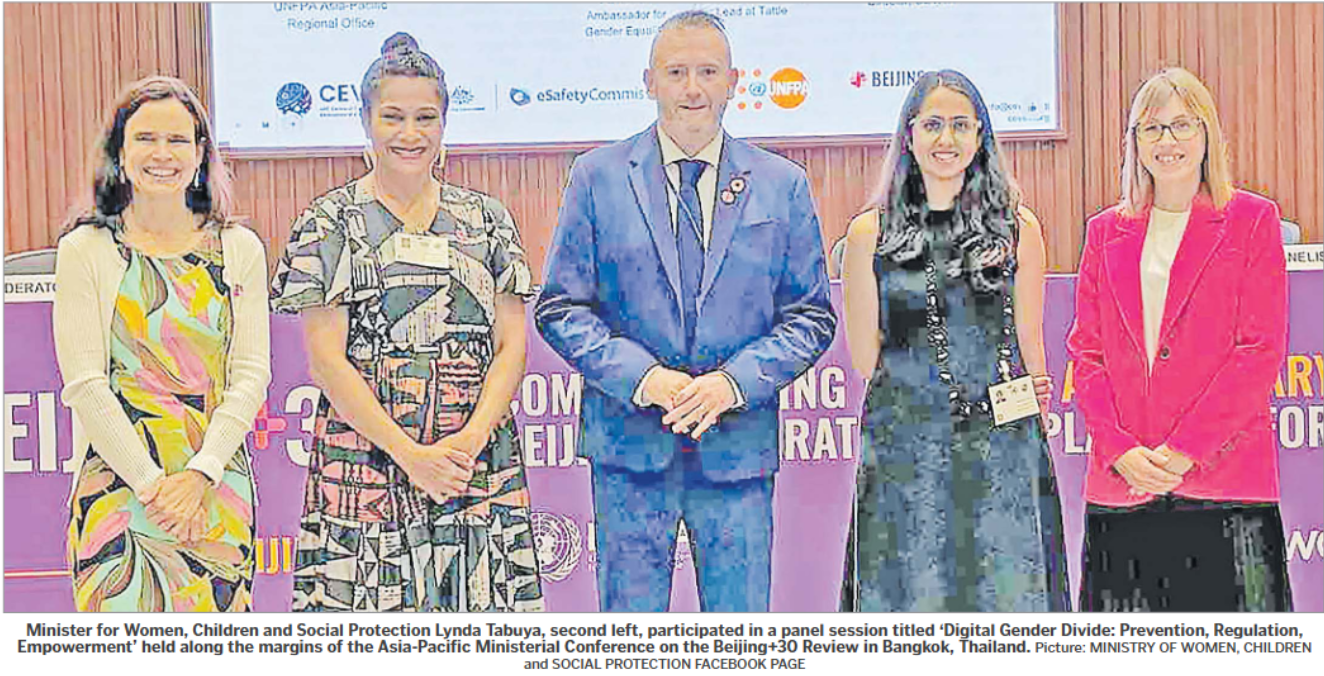
EFFORTS to achieve gender equality are often undermined by “glossy reports”, ineffective leadership, inadequate technical expertise, and weak accountability.
This was the message from Minister for Women Lynda Tabuya while delivering Fiji’s country statement at the Asia-Pacific Ministerial Conference on the review of the Beijing Platform for Action (BPfA) in Bangkok, Thailand, this week.
During her statement, Ms Tabuya also lamented the initiatives that failed to reflect the lived realities and needs of local communities, as she reaffirmed Fiji’s commitment to adhere to the promises outlined in the Beijing declaration.
She said while Fiji had faced difficulties, the country had also made important strides.
“Female students now comprise 57 per cent of graduates in tertiary institutions,” she said.
“We’ve enacted gender sensitive legislation and policies, bolstered maternal health services and witnessed a growing recognition of the need to address gender-based violence.”
Ms Tabuya also paid homage to women’s rights organisations in Fiji for being steadfast champions of justice, equity and accountability.
“We have tirelessly fought to protect and advance the rights of all women and girls.
“While these accomplishments mark progress, the challenge lies in translating these into meaningful change for all women and girls.
“Education must not only unlock potential, but also must lead to tangible equality, ensuring women’s full participation in the formal economy, fair access to financial, digital and technical resources and a strong presence in leadership roles across all sectors of society.”
She also said that significant barriers still persisted, mostly in the form of patriarchy and deeply ingrained discriminatory social norms.
Ms Tabuya said these obstacles constrained the roles and opportunities of Fijian women and girls.
“The burden of unpaid care and domestic work continues to fail or fall disproportionately on their shoulders, confining many to informal and low paying economic activities that provide little security or recognition.
“Too many Fijian women and girls continue to face gender-based violence. Equally pressing is a limited access to sexual and reproductive health and rights, which hinders the care choices and autonomy.
“In this context, Fiji recognises the critical need to address a web of interconnected challenges to progress towards gender equality.
“This involves boosting economic empowerment, safeguarding bodily autonomy, enhancing sexual and reproductive health and rights, recognising the importance of unpaid care work, encouraging women’s participation in the formal economy and leadership positions, robustly.”
Ms Tabuya also talked about Fiji’s commitments, particularly through initiatives such as the Fiji Country Gender Assessment and National Action Plan (NAP) to Prevent Violence against All Women and Girls, and the Women’s Economic Empowerment Plan.
She said Fiji’s NAP reflected the country’s unwavering commitment to addressing gender based violence at its root, which was patriarchy.
“We recognise that Fijian women and girls, in all their diversity, cannot be truly safe until they achieve equality with men and boys with equal access to resources and opportunities.”
“Gender responsive planning and budgeting ensures that our commitments to gender equality are backed by real financial investment through the national budget.
“Without proper budget allocations and policies, these remain empty promises.
“In February 2024, we initiated the design of a five-year gender equality accountability initiative to track and ensure that our policies, programs and budgets across all government agencies and sectors are effectively implemented with a gender responsive approach.
“Fiji recognises that the promises of Beijing 1995 cannot be fulfilled by maintaining the status quo.
“We must critically examine our financial and technical partnerships, for gender equality has to be structured and delivered.”

