
Elon Musk, potentially one of the most influential innovators in history, has redefined the boundaries of what’s possible in space technology once again.
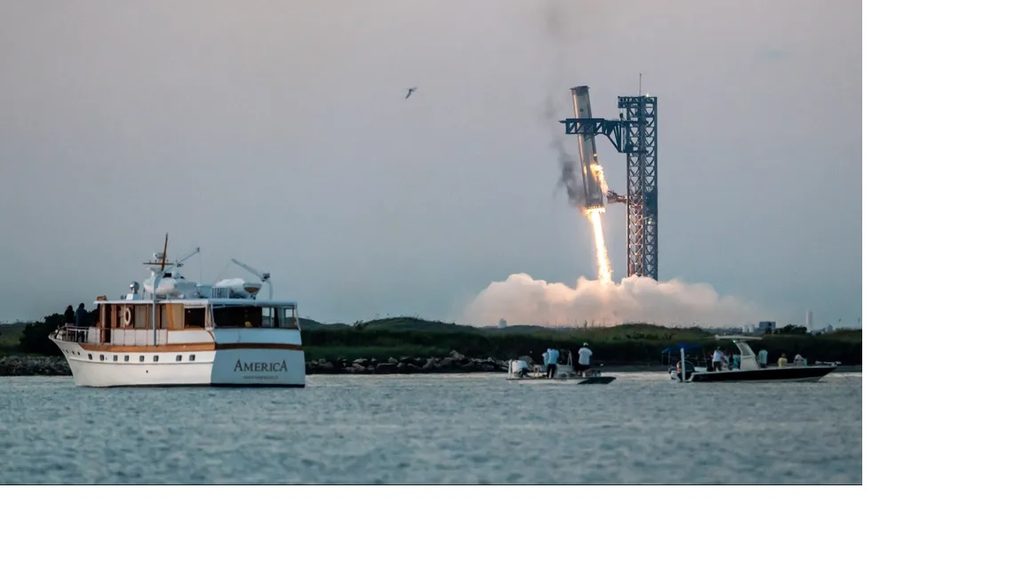
SpaceX recently achieved a remarkable feat: they caught a massive rocket booster with a precision-engineered metal tower on the very first try.
Imagine catching a rocket taller than the Statue of Liberty, like it’s nothing.
FOR years, space agencies have struggled to reuse expensive rocket parts.
The National Aeronautics and Space Administration (NASA) dive team retrieves and refurbishes their boosters, which usually fall into the ocean. The damage sustained renders many parts unusable.
But Elon has flipped the script.
The company’s Falcon 9 rockets already have an impressive ability to return to Earth and land autonomously.
But now, they’ve gone several steps further with their new rocket, Starship, which landed flawlessly into the outstretched arms of a metal tower.
The implications of this innovation are profound.
SpaceX’s Starship booster didn’t just return to a landing pad but arrived at the precise location it launched from, coming to rest inch-perfectly in giant metal arms, nicknamed “chopsticks,” attached to a launch tower at SpaceX’s Boca Chica, Texas, site.
This breakthrough now makes the world’s largest rocket, Starship, fully reusable, dramatically reducing costs for space missions and making the future of interplanetary travel more attainable.
Such innovations lay the groundwork for permanent stations on Mars, as well as lunar bases, by enabling more affordable and frequent launches.
Standing at an impressive 397 feet (121 meters), Starship surpasses the Statue of Liberty by nearly 90 feet. The booster itself is 233 feet tall and generates a staggering 16.7 million pounds of thrust, which is more than double the power of the Saturn V rockets used during the Apollo missions to the moon.
In this test, the booster separated from the Starship vehicle after liftoff and, having exhausted most of its fuel, reignited 13 of its 33 engines to control its descent. Then, just as it neared its landing point, it reduced its engines to three and deftly manoeuvred into the metal arms on the tower, nicknamed “Mechazilla’s chopsticks.”
From launch to landing, the entire process took just seven minutes. Musk captured the moment on his platform, X (formerly Twitter), saying, “The tower has caught the rocket.”
SpaceX employees erupted in celebration, cheering as the booster completed its flawless descent. Dan Huot, an on-site commentator, remarked, “Even in this day and age, what we just saw is magic. I am shaking right now.” From SpaceX’s headquarters in Hawthorne, California, SpaceX’s Kate Tice added, “Folks, this is a day for the engineering history books.”
NASA has already commissioned two Starships to land astronauts on the moon within this decade, as the agency looks to Musk’s innovation to advance its exploration goals.
SpaceX’s longer-term plan for Starship includes supporting missions to the moon and, eventually, Mars, allowing humanity to expand its reach beyond Earth.
Musk’s bold advancements in technology and engineering offer us an important lesson here in Fiji.
SpaceX’s latest accomplishment in achieving precision rocket recovery—an idea that, not too long ago, was reserved for science fiction—is proof that with determination, ambition, and belief in possibility, any dream can be realized. His work shows us that when we dare to think beyond our traditional limits, we open the door to previously unimaginable achievements.
Fiji, like many other nations, has unique challenges and opportunities. Often, as a small island country, we may feel bound by limitations in resources, geography, or infrastructure.
However, Elon Musk’s example reveals the power of harnessing innovation and perseverance to create solutions that can transform lives. His journey teaches us that with focused effort and a willingness to challenge conventions, we too can achieve remarkable things.
Imagine what could be possible if we embraced a similar spirit of innovation and resilience. In sectors such as renewable energy, sustainable tourism, and agricultural technology, we have untapped potential to lead the way.
For instance, just as SpaceX has revolutionized space travel by making rockets reusable, we could lead in environmental sustainability by pioneering renewable technologies that preserve our natural resources and set an example globally.
Our abundance of sunshine and wind makes Fiji well-suited for renewable energy development, and with a national commitment to innovation, we could become a model of sustainable living for the rest of the world.
Moreover, we can look to Musk’s approach to learning from failure as an inspiration for our journey. SpaceX’s early attempts at rocket recovery weren’t always successful.
In fact, the company faced several high-profile failures before finally achieving consistent results. Yet, each failure served as a stepping stone toward eventual success, offering valuable insights and building resilience.
Similarly, here in Fiji, we should adopt a mindset that values learning from setbacks. By supporting our local entrepreneurs, encouraging creativity, and not shying away from challenges, we foster a culture of growth and resilience that will pay dividends in the long run.
Fijian youth, in particular, should look to leaders like Musk for inspiration.
SpaceX started as an ambitious idea, yet it became a game-changer through the perseverance of people who believed in a vision of the future. By developing skills in science, technology, engineering, and mathematics (STEM), our young people can be part of a new wave of problem solvers and innovators who shape the future of Fiji.
As we build up educational resources and invest in training for tomorrow’s leaders, we lay the foundation for a thriving community that is ready to meet global challenges with confidence.
Until next week, take care and be safe!
* ARNOLD CHANEL is an investor and business executive with years of tech expertise. He can be contacted on ceo@vanguardtech.pro. The views expressed in this article are his and not of this newspaper

