
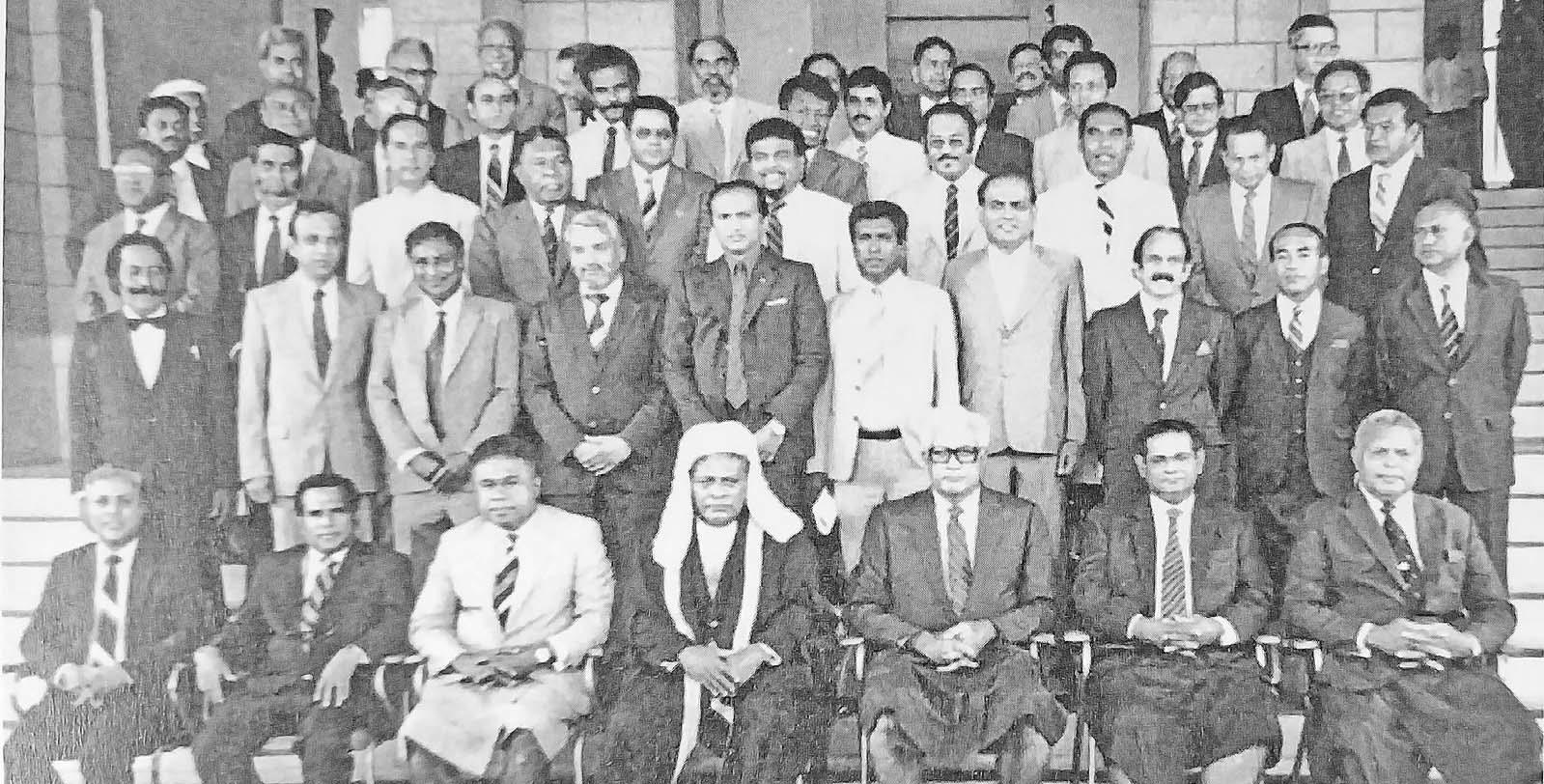
After joining the Senate in 1970, Harish Sharma continued to make a name for himself.
In his memoir Road to Parliament: A Glimpse into the Life of Hon. Harish C. Sharma, the former National Federation Party (NFP) leader related that before his Senate appointment was set to expire, he was endorsed by the NFP to contest the 1972 General Elections for the Sigatoka Indian Communal constituency.
Mr Sharma wrote that the first general elections under the new 1970 Constitution were held in 1972, whereby NFP won 19 seats, 12 communal and seven cross-voting out of 52 seats.
It was here that Mr Sharma joined the new House of Representatives.
Throughout the years, as is the case with all political parties, internal strife had begun to show in the NFP and there was a split into two factions.
Mr Sharma recalled that the NFP was in complete disarray before the April 1977 elections.
“Under the backdrop of such political turmoil, the NFP entered the 1977 General Elections,” Mr Sharma wrote.
“The results of the April 1977 elections were a surprise as the NFP won the poll with 26 seats to the Alliance Party’s 24 seats. The Fijian communal vote was split as Nationalist Sakeasi Butadroka and Independent Ratu Osea Gavidi won by exploiting the Alliance split.
“The NFP was not prepared to form a government, firstly because it had not expected the Alliance Party to lose, secondly, it did not have sufficient numbers to run a stable government and thirdly the party itself had serious internal problems.
“It is hard to find a better example of a hung parliament, as was the case in the April 1977 elections and a golden opportunity to form a Government of National Unity.”
This later led to the dissolution of Parliament on June 1; however, outgoing Prime Minister Ratu Sir Kamisese Mara formed a new Cabinet on September 29.
Mr Sharma said after years of Ratu Mara-led Alliance Party rule, the country was straining severely under the weight of widespread mismanagement, corruption, falling incomes for farmers and workers, and the emergence of great inequalities in the wealth of rich and poor.
“It was seen as a tired government, entrenched in arrogance and insensitive to the sufferings of its people. The tripartite forum which was meant to be a consultative body of the government employees and employers, with equal voices, had degenerated into a collusive and partisan cabal of crony capitalism clearly favouring the rich.
“The large poor underclass was neither seen nor heard. The anti-Mara fatigue was getting louder and louder and unbearable by the day.
“The final nail in the coffin was the imposition of a wage freeze by the Mara Government becoming the catalyst for the formation of the Fiji Labour Party, under the sponsorship of FTUC, the representative body for organised unionised workers.”
Against this backdrop, the Fiji Labour Party was formed in 1985 and despite the angst between FLP and NFP, there were plans to have a strategic alliance between the two parties to defeat Ratu Mara.
In April 1987, Ratu Mara conceded defeat, giving way for a new Government to take office, led by Dr Timoci Bavadra.
“Dr Bavadra wrote a letter to the Governor General stating that he was ready to form the new government. In accordance with the Westminster system, Dr Bavadra and other ministers were sworn in by the Governor General as Prime Minister and ministers of the new NFP-FLP coalition government.
“We were euphoric when our Labour and National Federation Party coalition won a convincing victory over the Alliance Party in the 1987 General Election. When voting ended on April 11 after an eight-day polling, we had won 28 seats to the Alliance’s 24,
“Our leader and new Prime Minister, Dr Timoci Bavadra, wasted no time in claiming power and naming a 14-member Cabinet. I was named as Deputy Prime Minister and given the ministerial portfolios of Housing and Urban Affairs and the Ministry of Information.
“Every minister and member of his ministry started in earnest to do their work and discharge the responsibilities for which they were elected. I had three permanent secretaries to work with.”
However, things changed on the morning of May 14, 1987. In his memoir, Mr Sharma wrote that Taniela Veitata was preaching peace and harmony on the floor of Parliament.
“While Mr Veitata was advocating peace and harmony, simultaneously Lieutenant Colonel Sitiveni Rabuka, who was sitting with members of the public dressed in civilian clothes, moved up to the Speaker’s chair and said, “This is a military takeover. Stay down and remain calm. Mr Speaker, this is a military takeover”.
“Addressing Dr Bavadra, the colonel said, “Mr Prime Minister, walk out with your men.” All the Government members were marched out of Parliament.”
Mr Sharma said they were in the dark that such plans were being hatched, even as the then government received daily briefings from the police commissioner, military commander and Home Affairs secretary.
He recalled that they were marched out of Parliament at gunpoint and “herded like animals” into the waiting trucks.
They were kept in a room at the Queen Elizabeth Barracks, and in a show of solidarity, the Christian, Hindu and Muslim members of Parliament each recited their own religious hymns and prayers to get through the ordeal.
“Little did we realise that the coup makers had hatched an alternative plan. On Sunday morning the soldiers forcibly separated the Indo-Fijian members from our iTaukei brothers and sisters.
“On the spur of the moment, we all decided to join hands as a show of passive resistance. I was sandwiched between Adi Kuini Bavadra and Temo Sukanaivalu.”
They were finally released after six days.
“It would be remiss of me not to mention the healing part played by Reverend Iliesa Koroi during the days of our incarceration.
“He sat down with us, spoke to us, prayed with us and gave us much-needed comfort and courage. He was such a kind and understanding human being. His face radiated peace and goodwill.”
During this time, Mr Sharma said Fiji’s economy was in “tatters”. Above all, cane farmers had refused to harvest cane for six months and an intervention was sorely needed.
The 1970 Constitution was subsequently abrogated and after the Deuba Accord was rejected by NFP-FLP faction, the second coup was carried out on September 25, 1987.
“The second coup was far more vicious, destructive, inhuman and openly directed against the Indian community and its leaders who were incarcerated, their properties plundered and destroyed and a number of families made homeless.
“Jai Ram Reddy and Mahendra Chaudhry found refuge at late Ujagar Singh’s home in Ba. Both could have been murdered or mutilated if found by the robbers and criminals supporting the coup.
“The second coup had a devastating effect on the Indo-Fijian community. For once, they began to realise that perhaps there was some truth in Butadroka’s contention that we were vulagi (visitors) in the country of our birth.”
During the second coup, Mr Sharma was in Australia, however, he chose to return to Fiji, and he was arrested upon arrival. He stayed behind bars for a few days before being released, after which he was given shelter by the then Indian High Commissioner in Fiji.
He had sent his family to Australia at this time, but Mr Sharma stayed back. Undeterred despite the hardships faced in the years after the coup, Mr Sharma decided to contest in the 1992 elections, however, he lost by four votes.
He said within 18 months of the election, the Rabuka Government’s budget fell, and he had no choice but to advise the President to dissolve Parliament and call for fresh elections.
Mr Sharma contested the elections in 1994, and won, bringing him back into Parliament.
“I retired from Parliament at the end of 1998 as the deputy leader of the opposition, but I would be less than honest to say that I retired from politics.
“As is often said that there is only entrance to politics – there is no exit. I hope to remain an active member of NFP during my lifetime.”

