
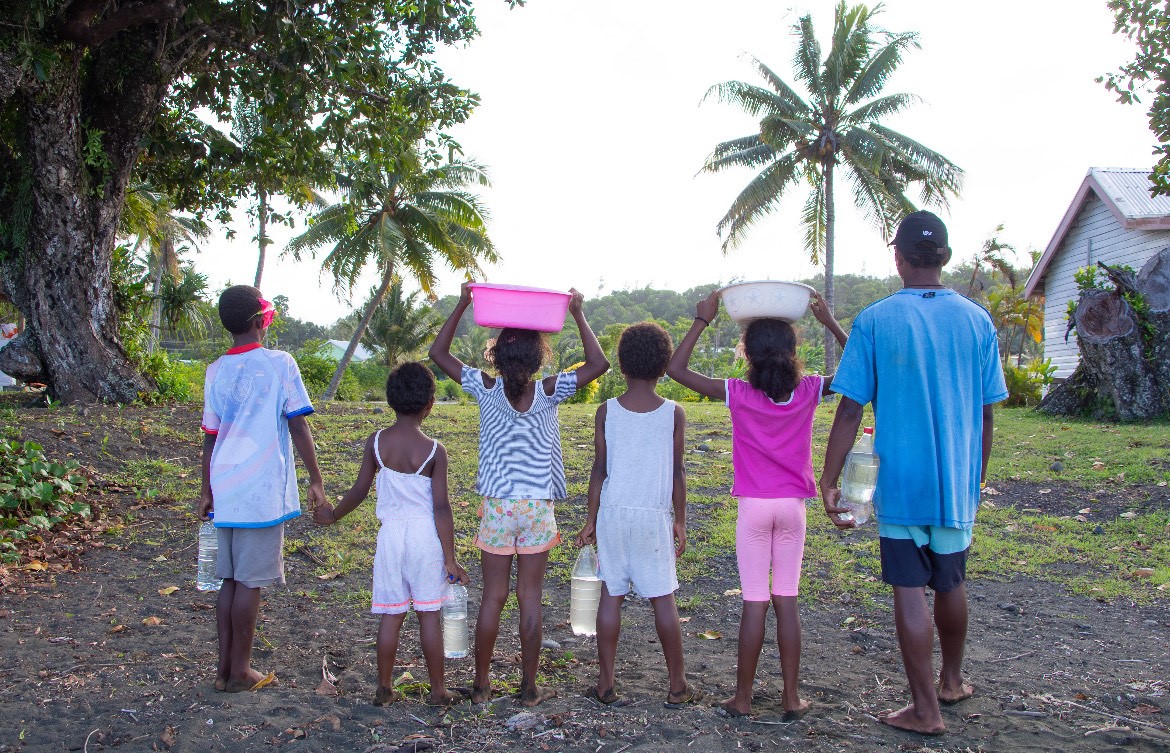
Villagers of Nataleira, Dawasamu in Tailevu are continuing to grapple with a severe water crisis despite the recent restoration of clean water in the Central and Eastern divisions.
According to Save our Fiji, an organisation dedicated to resolving water issues in rural Fiji, Nataleira, Dawasamu is situated near their only water source, a river.
The villagers say the water source supplies the farm and livestock, and that this poses an imminent threat to the villagers’ only drinkable water supply.
When there is heavy rainfall, the villagers’ water problems worsen due to the infiltration of debris into their only drinkable water supply. The village is made up of approximately 106 families with an estimated 439 individuals.
“Our children get different kinds of skin diseases, rashes and blisters from bathing in the water,” said Avuita Ramoli.
“They get diarrhoea, stomach aches and sometimes throw up when they drink from the taps.
“Sometimes little fish, small prawns, mosquito larvae and dead leaves come through the taps and when the dam is cleaned. We have to leave the tap on for an hour so all the sediment is drained out.”
These challenges are faced by every family in the village of 106 families which have been worsened by the recent heavy rains. “We clean the dams regularly,” Mr Ramoli said.
“The soso (sediment) in the dam reaches our ankles when we go to clean it. It’s a big job and takes us hours to scrub it clean.
“Sometimes we’re unsure of what is in the sediment because animal waste goes into the dam too.” Fellow villager Josefa Bau said every time it rains, their water source from the river gets dirty.
“The pipes clog up with dirt from all the foliage, dirt, animal feces and other things,” Mr Bau said.
In a recent interview, Sailosi Muatabu, Nataileira’s water committee deputy chairman, explained how the village is situated by the Ciuciurati falls.
However, without proper barriers, it becomes susceptible to the accumulation of rocks, debris and waste, impeding water flow and quality.
“One time there was a pilot project done by the FijiFirst government and Water Authority in the early 2000s to create a water filter system that would filter the water before it got to the village,” Mr Muatabu said.
“The filter was installed and there was never any follow-up from the Government or the Water Authority to check if it was working.”
Despite their best efforts to maintain the system with limited expertise, the community received little assistance when it broke down. Multiple attempts to address concerns with the authorities have yielded no tangible results.
“What we need is a natural filtration system, but we lack the expertise to do so,” Mr Muatabu said.
Nataleira’s problems are not uncommon; comparable problems with water are seen in many Fijian hinterland and rural settlements.
They have adapted as Fijians, but the basic aim is still to have access to clean running water.

