
The role and function of the military in Fiji’s democracy is a topical issue that keeps popping up every now and then.
Also, human rights activists have for some time been consistent in highlighting that impunity has remained a perennial problem among Fiji’s security and armed forces.
On top of that, there have been constant referrals to the constitution, for providing immunity from prosecution for members of the security forces.
And for the most part, the military, as an institution, has often been on the receiving end.
The democratic principle of political control of security or armed forces finds its origins in the concept of representative democracy.
This notion dictates that civilian institutions are paramount over defence and security apparatus, including military leadership.
The common expert belief is that democratic control must be a reciprocal process between armed forces and society and legal guarantees, should safeguard the state from subversive political and military aspirations.
I remember quite well, that in November last year, there were public murmurings in the media over an announced Cabinet reshuffle.
Around the same time too, there were concerns about Government’s non-consultative approach when it voted at the UN General Assembly against a ceasefire in Gaza to protect civilian. In both cases, the military publicly expressed its viewpoints and these were reported widely in the media.
It even once said, early in the life of the current administration, it had “growing concern” over the government’s “sweeping changes”.
All these pronouncements got people worried — anxious because in genuine democracies it was not conventional for the military to frequently express its disapproval of political decisions.
We know all too well that in 2006 military-government exchange happened frequently and resulted in the overthrow of the Laisenia Qarase-led government.
In responding to the military’s concerns in late 2023, University of Canterbury’s political sociologist and director of the Macmillan Brown Centre for Pacific Studies at the University of Canterbury Professor Steven Ratuva said intervention in political governance, using constitutionality as justification “raised some concern”.
And he pointed out the interpretation of the constitutional provision relating to “security, defence and wellbeing of Fiji and all Fijians” should be seriously discussed and addressed because the current interpretation seems to be “at odds with the security role of the military”.
“The whole nation is in a state of collective anxiety over this and it seems that we have not really steered clear of the long tail of the coup culture while still skirting dangerously around the margins of democracy.”
Basically, the bottom line of what Prof Ratuva was saying was this — the military should be subordinated to the people via democratically-elected individuals and it must be subjected to the oversight of the judiciary as well as civil society and the media.
This democratic notion of civil-military relations emerged during the period of geopolitical tension referred to as the Cold War.
It was underpinned by the growing need to prevent the military from being a self-serving player that pursues its own interests and objectives.
So by the end of the Cold War, nations believed military might not only had to be subjected to societal control, but this control needed to be ‘democratically constituted’.
Now the focus has shifted to the need for democratic governance of the entire security sector.
Hence, genuine civilian control of the army should mean that the people, through their institutions, representatives and authorities, have control over the military’s missions, composition, budget and procurement policies.
In Fiji, it would be prudent practice to have the military answerable to the people through the parliament, judiciary civil society and the media.
Also, while individual members of the military personnel should be given the right to exercise their rights, the military and military leaders should not interfere or attempt to influence domestic politics.
The absence of this notion of neutrality is because of entrenched unclear provisions in the law, which put the future of constitutional government in Fiji at ransom and allow an expansive interpretation of the role of the military.
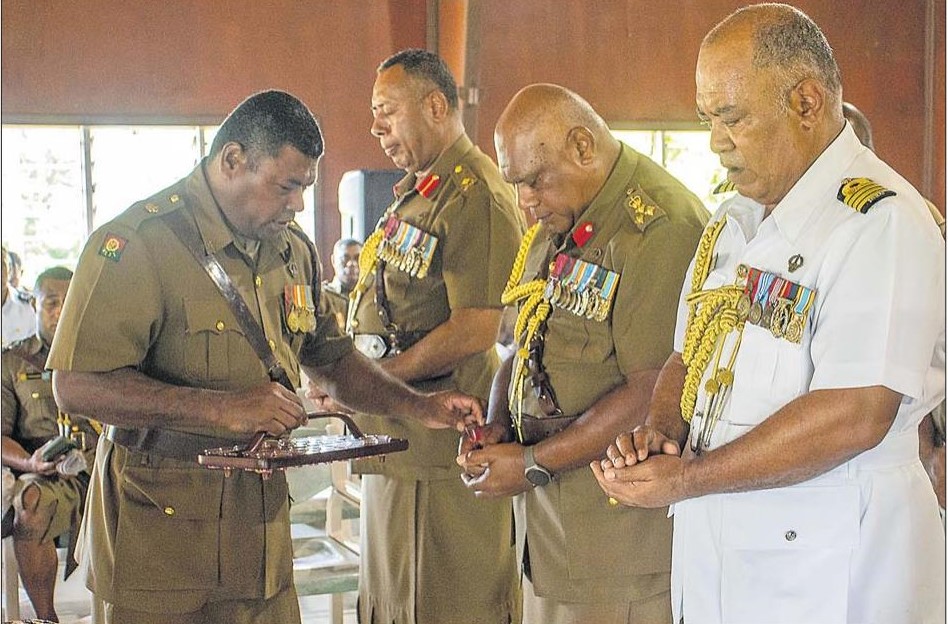
But not all is doom and gloom in Fiji. Last week we heard that the Republic of Fiji Military Forces (RFMF) has embarked on a journey toward “reconciliation and restoration”.
And army commander, Major General Jone Kalouniwai, in his address to soldiers during a church service said that there was a need for the RFMF to redeem itself as an institution and embark on a process of transformation, reconciliation and restoration.
Kalouniwai touched on the 1987, 2000, and 2006 coup and mentioned that the RFMF played a significant role in those political upheavals.
He stressed the importance of acknowledging past wrongs and seeking reconciliation with those who have been affected by the actions of the RFMF, in an attempt to heal the wounds of the past. His words are indeed encouraging and provide glimmers of hope.
However, to change the paradigm which the military boss wants to see happen, we will have to look at our constitution and change vague provisions within it that has given the military undue power.
The military will have to also agree that these provisions that have crept into the constitution because of political interests of its designers have perverted democratic ideals and because of that they need to be changed to restore people’s trust and confidence in our laws and in our security and armed forced.
We need a change in our soldiers’ mindset and their leaders. They need to feel the gravity of withdrawing from meddling in politics and give up the unjustifiable advantages they gained under the law and post-2006 military leadership.
The ball is in the RFMF’s court. Given its recent noble intentions on “transformation, reconciliation, and restoration”, I see no reason why there can’t be change.
Until we meet on this same page, same time next week, stay blessed, stay healthy and stay safe!

