
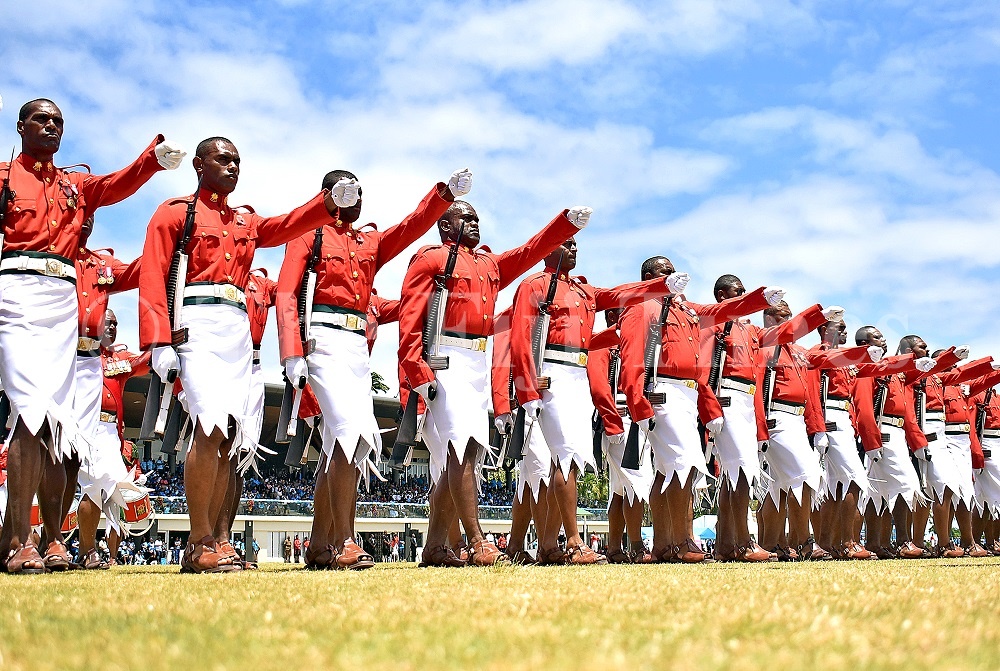
The Sunday Times of November 12, 2023 (p. 8) had a full page of statements about the Republic of Fiji Military Forces (RFMF) that I thought would have drawn passionate corrections from observant citizens of Fiji. But they did not.
The big (and legitimate) story and good messages on that page were all about Remembrance Day which rightly recalls the many military personnel who have lost their lives during World War I and World War II, the other military campaigns such as in Malaya, and peacekeeping in the Middle East.
One story had the Tui Labasa (Ratu Jone Qomate) expressing a “fervent desire for global peace” referring to the conflicts between Russian and Ukraine, and between Israel and Hamas (with the Palestinians bearing the brunt of the brutality.). All legitimate hopes, that all share.
But Tui Labasa also said “Citizens of Fiji owe the disciplined forces, especially the Republic of Fiji Military Forces, a huge appreciation for keeping the peace in this country”.
Really? Which planet has Tui Labasa been living on these last 36 years?
The Commander of the RFMF on the same page is reported to have commendably said “the RFMF will strive to maintain peace and stability in the country to allow the government of the day to work well”. This is good news for Fiji.
But the Commander is also reported to have said “Fiji is a very peaceful country in contrast to the many violent overseas countries Fiji’s peacekeepers served in”. Really?
Defence Minister Pio Tikoduadua (a former military officer himself serving under RFMF Commander then later Prime Minister Bainimarama) also said “Fiji is a peace-loving nation and Fijians shared this peace to the world through the various peace-keeping missions. We can only share peace if we have it and that is the gift we give to the world and we have been at it for almost 50 years now”. Really?
Ignorant international readers of these statements would of course take them at face value.
Yet honest observers might question those statements, as a sad denial of the historical reality of RFMF’s violence in Fiji since the first Rabuka coup of 1987.
It is true that Fiji’s military has never acted with organised or large-scale brutality against their own citizens compared to some other countries where democratic governments have been overthrown. However many individual soldiers have indulged in serious acts of violence against their own people – and I will come back to the tragic events of the November 2000 mutiny later.
My point, however, is that when an army overthrows a government by force of arms – as the RFMF has repeatedly done – that is a violent act, deeply disturbing to peace and harmony, and putting the country at risk of more violence, as Fiji’s own history has shown.
So how extraordinary it is that all these three honourable gentlemen (and I do mean that sincerely) declined to remind the RFMF soldiers today that their officers have several times rejected peace and dialogue in Fiji, and have violently overthrown lawfully elected governments, who were prevented from doing the work that the voters of Fiji had elected them to do.
These RFMF officers have also inflicted massive long term damage on the incomes of the poorest people of Fiji, setting us back decades, in comparison to countries like Mauritius who do not have armies.
How to forget the coups of 1987, 2000 and 2006?
Those who care about peace and stability in Fiji must ask themselves, why these three responsible senior and high-ranking citizens of our country can talk about the historical role of the RFMF in
Fiji and neglect to mention that treason was committed by RFMF soldiers in 1987, 2000 and 2006.
There has never been any doubt about who conducted the 1987 coup (Sitiveni Rabuka),). He wrote his own immunity into his 1990 Constitution. Later, however, he was given immunity by a democratic Parliament that is, with the agreement of both the House of Representatives and the Senate (I was then a NFP parliamentarian), because of his co-operation in the passage of the 1997 Constitution.
Sadly, the truth about the 2000 coup (and 2000 mutiny) has never been fully brought out. George Speight has been held responsible for the violent events of May 19, 2000 which triggered that crisis and remains incarcerated today.
But the evidence presented to the Evans Board of Inquiry Report after the November 2000 mutiny noted that Commodore Bainimarama had been informed about the coup plotting between some RFMF officers and failed politicians six months before, and even seven days before the May 19 events, but inexplicably failed to stop the Counter Revolutionary Warfare (CRW) soldiers who violently took over Parliament.
Even while they kept Prime Minister Mahendra Chaudhry and his colleagues hostage in Parliament, the salaries and rations of the CRW soldiers were maintained, and arms kept going into Parliament.
It was only when Speight revealed plans to appoint Ulaisi Vatu as a new Commander and Filipo Tarakinikini as Chief of Staff, that the tide turned.
The CRW coup was put down, but Mahendra Chaudhry and his colleagues were not reinstated as government. The 2000 coup had succeeded.
Then there followed the disastrous mutiny by some CRW soldiers. They killed innocent soldiers and were then brutally put down. Five CRW soldiers who were not necessarily associated with or involved in the mutiny were taken by RFMF officers from custody in Nabua Police Station, and later that day tortured and killed.
No one has ever been brought to account for this extrajudicial killing of five CRW soldiers without trial, judge or jury.
The entire RFMF know of the senior RFMF offi cers responsible for these deaths. This cancer festers away in the hearts and minds of the RFMF even if no former commander wishes to acknowledge it.
No doubts about the 2006 Coup
There is no lack of truth about the treason involved in the 2006 coup by Commander Bainimarama and the RFMF, who brutally removed the lawfully elected government of the late Laisenia Qarase on grounds of corruption which were never proven.
Bainimarama ran a military dictatorship for eight years during which he imposed the 2013 Constitution on Fiji. He did not do this through a referendum or a parliamentary vote, but through the signature of a President he himself had appointed on a Decree that he and his associated had drafted.
The 2013 Constitution moreover gave Bainimarama and his accomplices complete immunity, supposedly guaranteeing that there would never be any punishment for his coup in 2006 and, in 2009, his unilateral abrogation of the Constitution.
This was the Constitution that the people’s representatives had voted for in 1997.
How extraordinary that all a soldier has to do is to take over all the state apparatus in the country at gunpoint, and then give himself immunity through a constitution he himself devises.
I believe every rank and file RFMF soldier and officer can see that no-one who has led the plotting of our military coups has ever been formally found guilty of any unlawful act against our country and punished appropriately.
Instead what they can see is that the coup perpetrators and their quiet accomplices have all been materially rewarded through the coffers of the taxpayers.
That rewarding of coup accomplices applies even to some appointees of the latest Coalition Government of Sitiveni Rabuka.
What hope is there?
However sincere may be the statements of Commander Kalouniwai and Hon Pio Tikoduadua about their desire for peace and dialogue, why are they not reminding the RFMF soldiers and officers about their sad failures in the past during the coups of 1987, 2000 and 2006.
What real hope is there for the rank and file of RFMF soldiers and officers, to obey their oaths of office to the lawful government, and genuinely maintain peace and law and order in Fiji knowing full well that there has never been any punishment for those who have betrayed those oaths?
- PROF WADAN NARSEY is one of the region’s senior economists and a regular commentator on political and economic issues in Fiji. The views expressed in this article are not necessarINIONily the views of The Fiji Times.

