
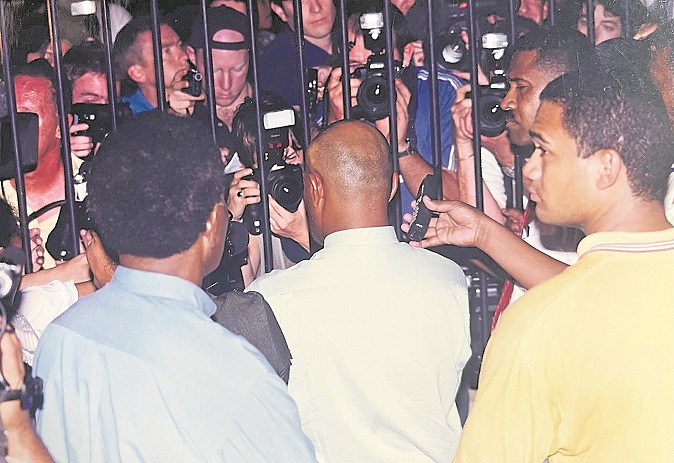
Day 18 of the 2000 civilian coup and tension was reported between the rebels and the Republic of Fiji Military Forces.
The army had told coup leader, George Speight and his rebels to release the hostages, put down their weapons and surrender.
The Fiji Times in its June 6, 2000 story titled “Give in, army says”, the military was reportedly warning the rebels and was standing by its decision to govern for three months before a general election took place.
The military administration as reported was to be implemented once the commander, Commodore Frank Bainimarama was satisfied the country’s state had normalised.
The article highlighted that the army intended to take over governance only when Speight released the hostages and surrendered.
They (the army) intended to take over governance to allow for the formulation of a constitution and a national general election.
Commodore Bainimarama told this newspaper he had support from chiefs and members of the public.
He said he had been warned by European Union representatives that should Speight or members of his team’s names appear in the interim administration all benefits would be shut down.
“I have met all ambassadors and while they condemn the military’s action, they understood the reasons that necessitated what we did,” he said.
“We (military) are here to bring about stability which can only be achieved through the release of hostages and return of weapons.”
Speight in the previous night (June 5) said soldiers should be the first to understand the fight for indigenous rights.
He said Commodore Bainimarama and other indigenous Fijian soldiers should be concerned with the international backlash.
The army had cancelled the commission of officers in Mr Speight’s group and stepped up mobile patrols in the area around Parliament.
On June 7, 2000, Day 19 of the takeover this newspaper reported on Mr Speight and his men wanting to meet with the chiefs after rejecting the chiefs resolutions.
Commodore Bainimarama said that the Great Council of Chiefs cannot be convened at the whim of anyone.
“Now they have the gall to come back and tell us to call a meeting of the Great Council of Chiefs to decide (between an interim military or civilian government),” he said.
“The Great Council of Chiefs consists of our chiefs; it is not a village council meeting which can be called at the whim of anyone.
“At any rate I don’t think they want to be called every second week to decide on issues every time they come up.”
Commodore Bainimarama said the rebels also wanted the military to hand over executive authority to the council.
“I keep telling them that I will inform the Great Council of Chiefs in good time, once stability comes back to the land.”
Commodore Bainimarama admitted that he wanted to resign when senior officers decided that the only option for Fiji was for Ratu Sir Kamisese Mara to step down as president and the military to take over.
“We don’t want to lead, I don’t want to lead,” he said.
“I had wanted to resign when we had come to the conclusion that the only option was for the RFMF to step in and approach Ratu Sir Kamisese, but I felt that it would have divided the military.”
By June 9 (Day 21) of the takeover, the military had appealed to chiefs and churches to put pressure on the rebels in Parliament to give up the hostages.
Commodore Bainimarama said they would only talk to Mr Speight and his advisers if they changed their stand and accept the army’s position.
He said the military would offer Mr Speight and his men amnesty and their concerns would reflect in the new constitution only if the hostages were released and arms returned to the Queen Elizabeth Barracks.
He said he didn’t see the need to include Mr Speight and his group in any interim government because his senior officers were already dealing with issues raised by the rebel group.
“There really is no need for them to come into the government of the day, there really is no need for them to have representation in the interim government and there really is no need for them to continue the fight they’re doing now,” he said.
Commodore Bainimarama refused to elaborate on other options available to the military should the chiefs, churches, groups and individuals fail to appease Mr Speight.
He had stressed that the military would not use force to free ousted prime minister, Mahendra Chaudhry and his ministers held hostage since May 19.
“We have hostages sitting in there. Would you like to be a hostage there and have the military come in?” he asked.
“We hope that (with) the support of the people at large, especially the chiefs and the indigenous people, we can break their resolve.
“I am not at liberty to commit the RFMF nor the people of Fiji to demands that will bring the country down.”
He said the military would try to restore peace in Fiji over the next three months before handing the reigns over to an interim government.
By June 13 (Day 25) of the takeover, it was reported that there was tension again at Parliament.
Soldiers had fired on rebel leader George Speight’s motorcade.
Nobody was hurt in the incident but one of the vehicles was hit twice.
According to this newspaper, senior figures in the Parliament calmed the feelings of about 2000 supporters as some tried to retaliate.
Warnings were issued by Speight’s advisers on the repercussions of such actions against the 31 hostages still in captivity at gun-point.
A complete breakdown in talks may have been caused by the shooting as trust in the military mechanism crumbles.
Speight was reportedly shaken by the experience preferring to meet a delegation from Nasukamai Village from Nalawa in Ra rather than conduct a press conference.
Speight was returning from sharing afternoon tea with some Methodist Church ministers when his entourage was shot at.
According to the article had earlier attended a meeting with former vice president and Tui Vuda, Ratu Josefa Iloilovatu, army chief Commodore Frank Bainimarama, Great Council of Chiefs negotiating committee chairman, Ratu Epeli Kanaimawi and government’s choice for presidency, Ratu Jope Naucubalavu.
Ratu Jope’s vehicle, driven by his son, was stopped and all those travelling in it were arrested and questioned until a threat from the parliamentary complex of supporters going out on the streets forced Colonel Apakuki Kurusiga to return the group.
Republic of Fiji Military Forces’ spokesman Captain Eroni Volavola said the soldiers had asked Speight’s driver to stop, the latter refused.
“Warning shots were fired. The soldiers had signalled for the vehicle to stop but they forced their way through,” his statement said.
But Speight’s group believe the shooting was an attempted assassination.
“They have aggravated the already tense situation. It was a stupid thing to do because it would have destroyed negotiations,” adviser Joe Nata said.
“They were not asked to stop at any time. It was hard asking our supporters not to go outside the gate, but I assure the general public we will not retaliate.”
This newspaper reported that a car in the entourage had a bullet hole.
And by 4pm army spokesman, Lieutenant Colonel Filipo Tarakinikini had admitted it was a mistake, apologising to Speight’s group.

