
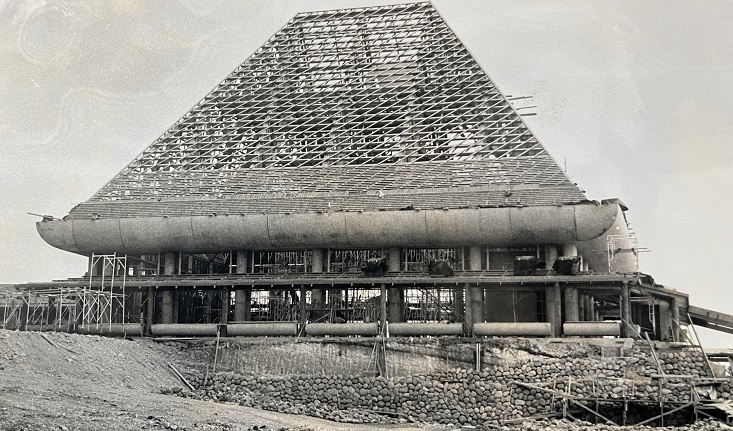
Specifics of the proposed parliament complex that was to be built at Battery Hill site at the corner of Vuya Road and Sukuna Rd in Suva were very detailed in 1973.
As reported by this newspaper on September, 1973 the parliament committee had recommended a House of Representatives chamber that could seat 100 members with a public gallery for 200 people.
There was to be a distinguished visitors’ gallery that would have space for 20 people and a press gallery that would accommodate 20 presses in the proposed august house. The Parliament committee wanted a gallery for 10 officials and four Hansard reporters.
They also recommended two cubicles for translators and one cubicle for a monitoring console, a taping machinery and provision for live broadcasting of proceedings.
For the Senate chamber, it was to seat 40 members with a public gallery that could accommodate 80 people.
There was also to be a distinguished visitors’ gallery for 10 people, a press gallery to accommodate 10 people, a gallery for 10 officials and four Hansard reporters and two cubicles for translators.
For the Senate chamber there was a cubicle for a monitoring console, a taping machinery and provision for live broadcasting of proceedings, similar to the House of Representatives chamber too.
The other recommendations that the parliament committee included for the proposed project was a state reception hall for 500 people which could be used for exhibitions as well and a 4500sq ft. library that included a reading room and a research section.
The Speaker of the House of Representatives and the President of the Senate were to have chambers and restrooms, lounge space, dressing rooms and washroom facilities.
The Deputy Speaker, the Vice President of the House of Representatives, the Leader of the House of Representatives and the Leader of Government Business in the Senate were to have offices with sufficient spaces for lounge chairs.
The recommendations made also included the accommodation for administrative staff.
This was to include offices for the clerk of the House of Representatives, the assistant clerk, clerk to the Senate, accountant, clerical staff, typists, the sergeant at arms and a parliamentary draftsman.
A VIP lounge area too was to be included in this proposal. Hansard reporters played a key role in Parliament so it was important that they be provided with a good space in the proposed project so the recommendation included Hansard staff having offices for the editor of debates, assistant editor, senior Hansard reporter and the other Hansard reporters.
For the Prime Minister, his suite was to include an office and restroom, lounge, interview room, permanent secretary’s room and room for typist and attendant.
As for the Leader of the Opposition’ suite it had an office and restroom, lounge, interview room, private secretary’s room and room for typists and clerical staff.
Seven suites would be available for ministers and assistant ministers in the proposed parliament complex.
There would be offices for Government and Opposition Whips, conference rooms for Government and Opposition backbenchers, 30 individual members’ offices and a 2000sq ft. recreation room.
There was to be a lounge room for both Houses accommodating 100 people and a dining room with adjoining refreshment room which was to accommodate about 120 people.
Four committee rooms according to this newspaper were to be allocated to the House of Representatives and the Senate would have one general meeting room for 35 people.
The Senate was to have two separate committee rooms while senators would have six individual offices.
Journalists from the public relations office and media would get two rooms and there would be provision for a post office and tele-printer.
On December 1, 1988 this newspaper published a story that the government had approved the proposals for the construction of a new Parliament House in Veiuto.
Cabinet had agreed that the project be built on vacant land between Battery Rd and Ratu Sukuna Rd adjacent to the official residence of the Prime Minister at the time.
The buildings in the compound of the Prime Minister’s residence would be used as support facilities for the new Parliament.
This was highlighted by the Minister for Information, Ratu Inoke Kubuabola.
Cabinet had approved the outline of the buildings and type to be erected to accommodate the requirements for the new parliament.
Cabinet had also approved the provision of $2.5 million in the 1989 Budget estimates for the project.
The former Parliament Chamber in Government Buildings and offices at the rear of the chamber were handed over to the Judiciary to accommodate the Supreme Court of Fiji.

