
It is astonishing to me that no one at the National Economic Summit asked the question: Whose job is it to protect the “rule of law”? Indeed, no one, not even the president of the Fiji Law Society has publicly asked: What is the “rule of law” in Fiji today, despite its centrality to any number of issues plaguing Fiji today at every turn?
Despite its importance in preserving the rule of law, no one is asking why has there been no “punishment” for those who committed the heinous crime of treason in 2006? Indeed, no one is asking how “immunity” (i.e. no punishment) can be promised in law for those who trashed the rule of law, as the 2013 Constitution allegedly guarantees.
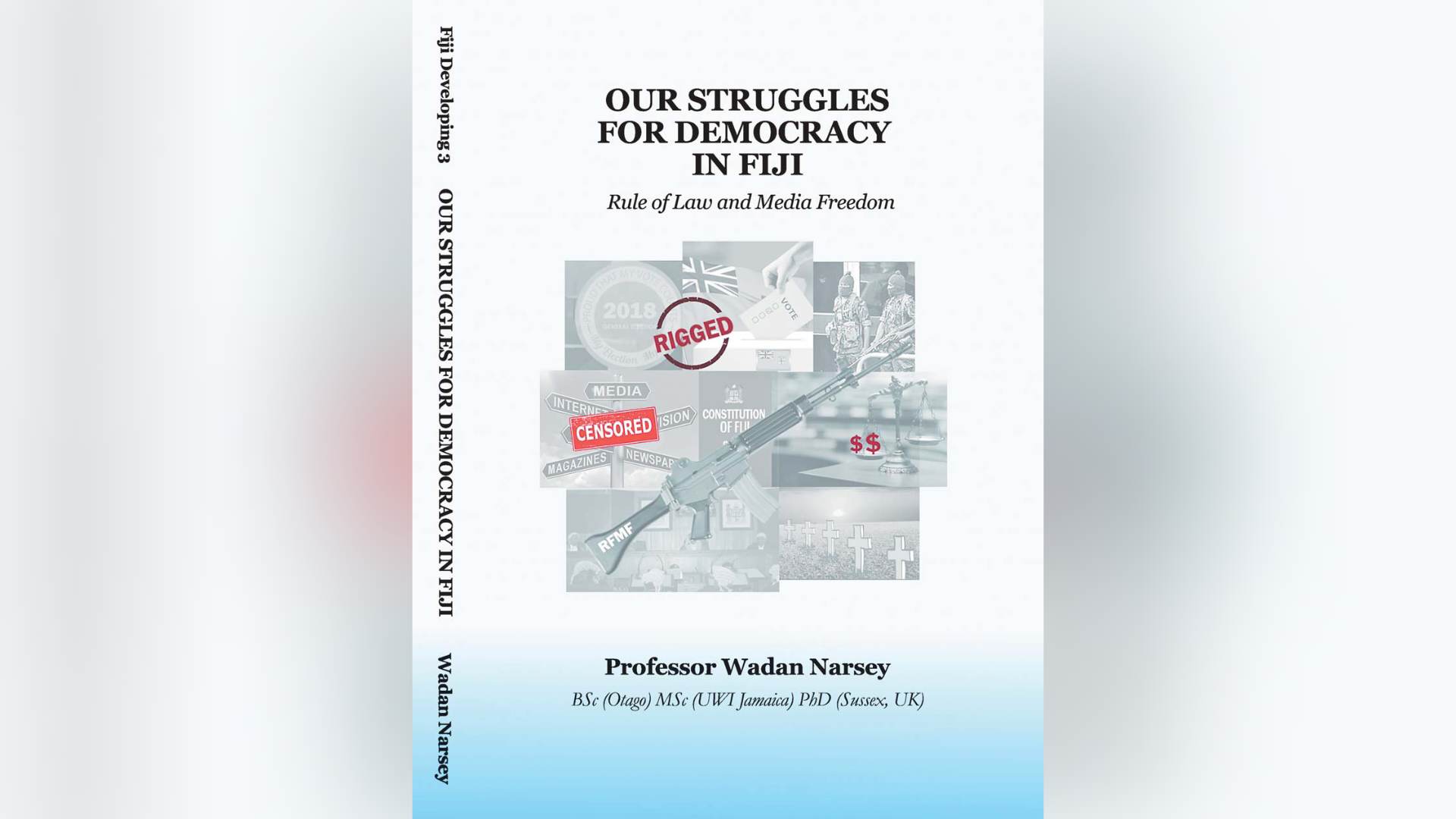
My personal perspective on these questions can be clearly seen from four decades of community education articles in my Volume 3 Our Struggles for Democracy in Fiji: Rule of Law and Media Freedom, available for sale at the USP Book Centre.
These articles range from my opposition to the 1987 Rabuka coup and other coups, and my writings trying to get to the bottom of the 2000 coup and mutiny, the 2006 coup and all the subsequent machinations of the Bainimarama/Sayed-Khaiyum governments.
These articles also help explain why we have failed to protect the rule of law in Fiji since the 1987 coup and why our failures continue.
My Volume 3 contents
The contents of Volume 3 are shown on the opposite page with one common theme emerging in many sections — what would be a good electoral system for multiethnic Fiji? This is a question still valid today in 2023.
The Contents pages also show the incredible censorship that was taking place between 2009 and 2014 with “(Cens)” in the titles of the articles censored from mainstream Fiji media. Section B may generally be seen as writings calling for the fair treatment of Indo-Fijians in the electoral system and the allocation of public resources by Government.
Reading 10 pointed out the fatal weaknesses of the Alternative Vote system recommended by Reeves Commission and adopted in the 1997 Constitution unanimously passed by both Houses of Parliament, of which I was also a member (my writings in Section C).
But Reading 11 also gave my recommendations for a better electoral system for Fiji. In Section C, which covers some of my initiatives during my time in Parliament (1996 to 1999), Reading 17 includes an advertisement which I personally took out in The Fiji Times of April 24, 1999, extolling the virtues of the Rabuka (SVT) and Reddy (NFP) partnership.
The messages in this advertisement applied equally 23 years later to the partnership of Rabuka (The People’s Alliance party) and Professor Biman Prasad (National Federation Party) (see article in forthcoming Volume 4).
Section D covers all the events following the 2000 coup and especially my arguments for the Interim Qarase Government not to throw out the 1997 Constitution just because the electoral system had weaknesses.
Many of these arguments were continued into Section E covering the Qarase years between 2001 and 2006. But in Section F covering the immediate aftermath of the 2006 coup, I felt obliged to revisit the hidden events of the 2000 coup and mutiny which I felt were the real origins of the Bainimarama coup in 2006 (Reading 41).
That Reading and Reading 42 (Call for Commission of Truth, Justice and Reconciliation) are still two of the most important in the book and both must be again revisited of there is to be any resolution of the rule of law in 2023.
Section G (The People’s Charter) and Section H (the Draft Yash Ghai Commission Report) must be thoroughly understood as the evolutionary and far more reasonable collective alternatives which the Bainimarama government also initiated.
The articles also explain the Machiavellian reasons why they were rejected by Voreqe Bainimarama and Aiyaz Sayed-Khaiyum. But why did all the people who helped in the formulation of the People’s Charter quietly accept its shelving, with no overt protest?
Why did all the thousands of people who assisted in the formulation of the Yash Ghai Draft Constitution fail to protest when Voreqe Bainimarama and Aiyaz Sayed-Khaiyum callously rejected the draft?
Why did the people of Fiji not protest when the 2013 Constitution was imposed unilaterally on Fiji (Reading 65)? Section I covers my numerous writings under the heading “Media censorship under a biased media” recording many of my censored writings pointing out the nefarious censoring roles of the Media Industry Development Decree and various other organisations who were either under financial pressure from the Government or benefited as recipients of Government funds.
I will come back to the related issues in the next article. The longevity of the Bainimarama Government’s reign cannot be understood without understanding the psychology of civil society coup supporters (Section J) and especially my article based on psychologist Zimbardo “Why Good People Support Evil” (Reading 99).
Then Section K explains how the 2014 and 2018 Elections were effectively rigged through the skewed electoral system in the 2013 Constitution designed by Aiyaz Sayed-Khaiyum, the toothless Electoral Commissions, and the denial of NGO rights to supervise the elections.
The censorship tendrils even reached a few key USP academics analysing the 2014 Elections (Reading 121). These readings are still important for the necessary revision of Fiji’s electoral system, before the next elections in 2026.
Section L then exposes numerous aspects of the facade of democracy maintained by Voreqe Bainimarama and Aiyaz Sayed- Khaiyum between 2014 and 2022, including use of the Speaker to muzzle free speech in Parliament, the now forgotten Fiji flag fiasco (one on the nose for the Government in this period), banning the indigenous Fijian language from Parliament, cancelling Ratu Sukuna Day, banning Brij and Padma Lal from Fiji, and the huge “elephant in the room” questions posed by the removal from office of the late Laisenia Qarase by a Republic of Fiji Military Forces comprised largely of indigenous Fijian soldiers.
There is also the expose of the Bainimarama government trying to criminalise prominent lawyer Richard Naidu’s trivial social media post (Reading 147) and an expose of all the major business houses who massively funded FFP between 2014 and 2018 by giving $10,000 donations in the names of their wives, daughters, mothers and other relatives in order to circumvent the $10,000 limit and stretching the limits of law.
What is the rule of law today?
The writings in Volume 3 and Reading 141 make it quite clear that PM Qarase was unlawfully (treasonously) deposed by Bainimarama and the RFMF, as established by the 2009 Court of Appeal and that the 1997 Constitution was still in place.
Reading 137 makes clear that in a 2001 case Koroi v Commissioner of Inland Revenue Justice Anthony Gates had correctly pronounced: “It is not possible for any man to tear up the Constitution.
He has no authority to do so. The Constitution remains in place until amended by Parliament, a body of elected members who collectively represent all of the voters and inhabitants of Fiji. Usurpers may … rule for many years apparently outside of, or without the Constitution.
Eventually the original order has to be revisited, and the Constitution resurfaces”. Justice Gate’s 2001 judgment negating Voreqe Bainimarama’s attempt to abrogate the 1997 Constitution following the 2000 coup applies equally to the Bainimarama government’s attempt to replace the 1997 Constitution with the 2013 Constitution. Surely the 1997 Constitution is still in place?
Why therefore is the new Coalition Government attempting to remove or modify piecemeal some of the many nasty elements in the 2013 Constitution introduced by the Bainimarama government to suit its Machiavellian purposes such as the MIDA? Is the Coalition Government itself being Machiavellian in trying to see if they can use some of the enemy’s weapons rather than rejecting it outright as would be common sense?
I accept that going back to the 1997 Constitution may seem difficult given that the current Parliament has been elected under the electoral rules imposed by the 2013 Constitution.
But I suspect that a high level judicial review by an international panel of constitutional experts might easily recommend that for all practical purposes, the current Parliament continue for the full term, but mount the 2026 Elections under a revised and improved electoral system, to elect a new Parliament (Lower House and Upper House) which would then operate under the 1997 Constitution.
The 2013 Constitution would then be suitably confined to the dustbins of history, like its authors.
Crime and punishment
All smart lawyers know that the concept of “punishment” for those who break the rule of law, is crucial: as a deterrent of the offender and others, for retribution and reform of the criminal, all ultimately with the objective of protecting society.
So why has there been no “punishment” for those who clearly committed treason in 2006? On the contrary the 2013 Constitution gives wide-ranging immunity to Bainimarama and all coup collaborators stretching back not just to the 2006 coup, but also to the 2000 coup and mutiny. Of course, there was no punishment meted out for treason committed by (now Prime Minister) Rabuka in 1987.
But the fundamental difference in law is that Rabuka was guaranteed immunity in the 1997 Constitution approved by both Houses of a legitimate elected parliament in 1997 (of which I was also a member then, mea culpa).
In contrast, the 2013 Constitution was unilaterally imposed on Fiji by the military, unelected Bainimarama government, without any parliamentary approval or referendum, “signed into law” by one individual, arguably also an illegally appointed president.
The fundamental legal flaw in this 2013 Constitution is that it brazenly stipulates that any changes whatsoever, however small, must require three quarters of an elected parliament and three quarters of a referendum, when neither condition was required for its imposition in the first place. What a legal “Animal Farm” has Fiji been reduced to.
What a joke when Aiyaz Sayed- Khaiyum reminds the Coalition Government to “abide by the 2013 Constitution”.
The people are responsible
While it is easy for writers to hold political, social or corporate leaders responsible for what goes wrong in society, I suggest that the people of Fiji look in the mirror ask themselves: what did you do to protect democracy and the rule of law when things were going wrong?
The honest answer will be: we did nothing; we carried on with our everyday lives; we kept our heads down so we did not get any blows. We are all responsible for the Fiji we inherit today.
The few who did speak up (like some brave journalists and an academic or two) often paid the painful price. More pointedly, what has the Fiji Law Society really done for 16 years while the rule of law has been trashed in Fiji?
What is the FLS doing today to bring the legal conundrums to the attention of the Coalition Government which is now in a position to do something about it?
Finally, I thank The Fiji Times and its owners, Motibhai & Co, for publishing most of these articles for the education of the public, especially during the censorship years.
• PROFESSOR WADAN NARSEY is a leading Pacific economist and a frequent writer of columns in The Fiji Times.

