
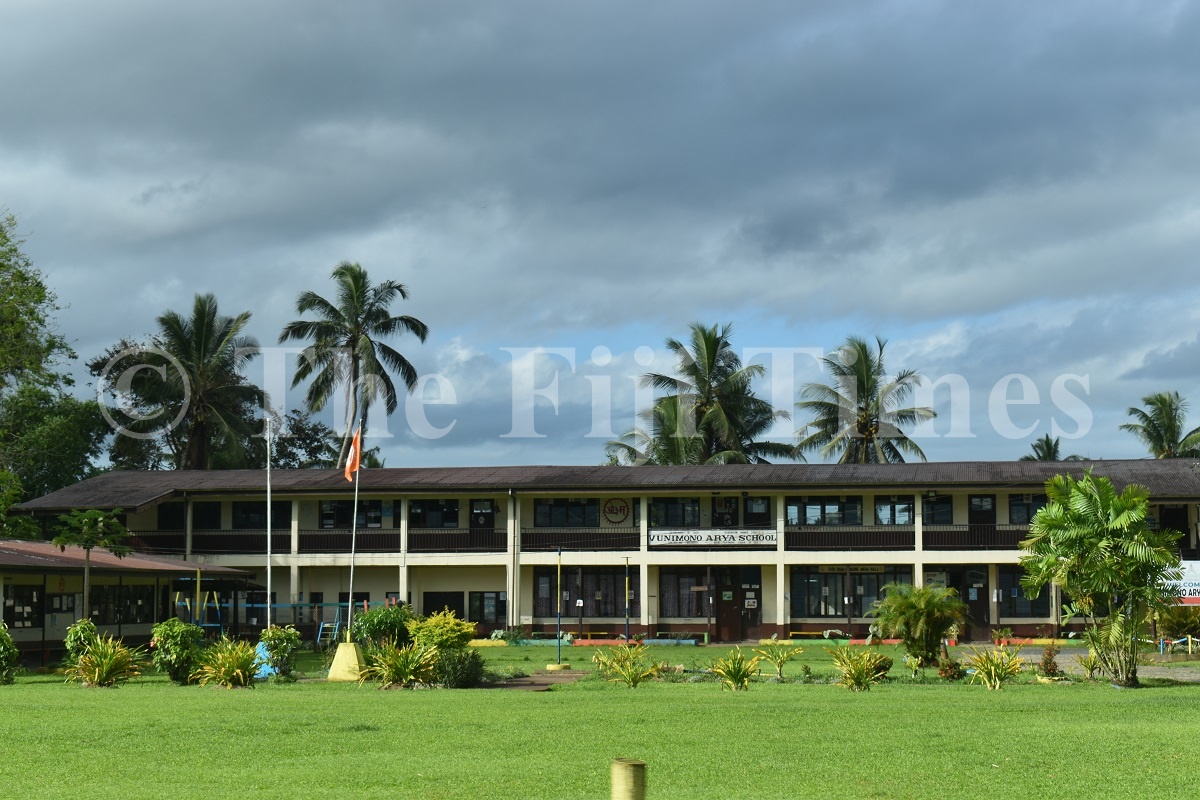
For the past 93 years, Vunimono Arya School in Nausori has educated the children of the Rewa Delta and its surroundings.
It was established in 1929 as Dharmshala — an institution to school the children of indentured labourers, but changed over the years to embrace children of all ethnicities.
Located along Wainibokasi Rd, Nausori, the two-storey facility was constructed immediately after the devastating floods of 1931 which washed away bure that were used as classrooms back then.
Arya Pratinidhi Sabha of Fiji media relations officer Kamlesh Arya said the Sanatan Dharm Maha Mandal of Rewa contributed largely towards the construction of the new buildings after the flood.
“In 1934, the Sanatan Dharm Maha Mandal built a new school on its property at the site of the old building that was destroyed during the hurricane and flooding in 1931,” he said.
“Prior to its establishment, there was no school for children of Indian descent, as all were either missionary schools or government schools.”
He said after the construction of the new facility, the school was renamed Arya Boys School.
“With the construction by the Maha Mandal it was decided to transfer the girls from the school to the new institution and renamed it Vunimono Arya School.”
In 1942, after the arrival of the United States military into Fiji, the school was used to accommodate US soldiers and equipment, leaving the future of students in limbo.
“There were no alternative arrangements made for classes, but the education system needed to continue, so lessons were taken under the shade of trees for a period.
“Later, temporary bure were constructed where classes were held. However, that was also taken by the military.”
The political pressure and the presence of the military made things difficult, and management decided to temporarily stop operations at the school.
However, as World War II neared its end and the situation normalised, the school reopened in 1944. With progress in the representation of women and girls in the early ‘60, the school began admitting girls leading to it becoming a co-educational institution.
With the intention of catering for more students and to improve their learning experience, the old colonial building was demolished and a new wing of eight classrooms worth $154,000 was constructed in 1996.
“The new wing provided the opportunity to have a hall included in it in memory of Pandit Tota Ram Sanadhya, who came to Fiji as an indentured labourer.”
The school celebrated its golden jubilee in 1991, a significant milestone, and celebrated the fact that it had taught and nurtured more than 10,000 students who had contributed or were contributing towards the growth of the Fijian economy in some way.
Over the years, the practice of having a Vedic teacher – to educate students about Hindu cultural practices – and a Fijian language teacher – to teach the iTaukei language – has allowed the school to maintain its title of a medium mainstream multiracial urban school.
Mr Arya said despite having strict regulations of no non-vegetarian food and no dance performances on the school premises, the student’s attendance reflected the dedication and trust of parents in the sabha.
“Non-vegetarian food is not allowed in any of the schools of the sabha. It’s a policy and so far it has been respected by the community where the schools are located.
“According to the Vedic theology, dances, fine arts and others are mostly for adults and when you are in primary school, the exposures to dance performances is sometimes not sanctioned and young kids are subjected to horrendous types of dances while some are very obscene.
“The allowable dance performances are the Khattak or Bharatanatyam, which must be taught rather than through a visual aid such as television.”
Mr Arya said the school has faced many challenges over the years, but they have continued to ensure nothing impacted on their students’ education.
“We have faced social challenges as the population in that area has increased and the last development we did was the construction of the two-storey building and after that there has not been any development undertaken because of financial difficulties.”
He said the introduction of the new free education grant (FEG) in 2014 halted the development plans of the school as inter entity loans were disallowed under the FEG regulations.
Mr Arya said they hoped to develop a new building in the future to accommodate the increasing request for space in classrooms.
He appealed to the public for financial support to undertake development in the school for the welfare of the students and the community as a whole.
The school has a library, staff room, canteen, a kindergarten and classrooms accommodating a total of 358 students.
Head teacher Shalesh Mudaliar said despite being affected by COVID-19 and the recent cyclones, the school continues its operations unimpeded.
He acknowledged the support of the teachers and parents in the successful operation of the school over the years.
At present, the school is gearing up to celebrate its centennial in 2029 and preparatory work for the event has begun.
The sabha has allocated a grant of $10,000 to mark the occasion.

