
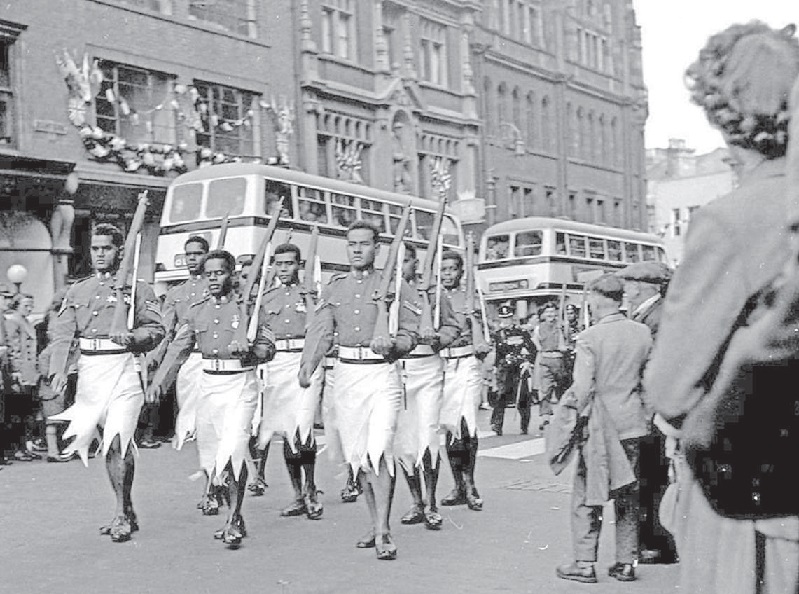
Though much has deservedly been written of the part played by the Fiji Military Forces (FMF) in World War II and in Malaya, not many people remember the part played by the pre-war territorial force in preparing the way for the development of the FMF.
In its contribution of officers and non-commissioned officers, and of other material, to train the recruits who made up the various battalions, the old territorial force undoubtedly formed the backbone of the units which the outbreak of war made necessary. Details of the pre-war territorial were written by a special correspondent in this newspaper on Monday, January 11, 1960.
The article highlighted that after a long and costly war there was always a natural tendency to revert as quickly as possible to peacetime routine. That reaction was seen in Fiji after World War I, and little interest was shown in military training. But the spirit, if only a flickering spirit, was kept alive by a company of Fijian volunteers trained by Captain A H Stafford and Captain Harry Gardner.
The company usually drilled at Albert Park. The men would fall in at night at the drill hall on the reclamation and marched to Albert Park. There was little lighting at the part in those days and Captain Stafford tells with some enjoyment how easy it was to lose track of the barefoot troops in the darkness.
The men were keen and it was fortunate that the spirit was kept alive. When the territorial were organised on a proper footing in 1924 there was a compulsory training company in addition to the Fijian volunteers. Later a volunteer machine-gun section under Captain FG Forster was added.
It was a mixed up affair and it had to be run on the money rarely exceeding 300 pounds a year. As far as the officers were concerned, it was a case of a small band of enthusiasts keeping things going and this applied particularly to the Fijian officers, non-commissioned officers and men.
When the territorial were formed it was considered fitting that the head of the Police Force — possibly with lingering ideas of the armed constabulary in mind — should automatically be the commanding officer.
Thus in succession the commanding officers were Colonel Golding, Colonel Gamble and Colonel Workman, the last-named being the last of the police colonels who went out in 1941. The second in command as Major C.B Joske, who afterwards changed his name to the family name of Brewster.
He had served with the Royal Flying Corps in the First World War. When the war broke out, the territorial became the first Battalion and Lieutenant Colonel Brewster became the commanding officer. Later the battalion was turned into a regular force and a second battalion consisting of territorial, was formed for home defence.
From the beginning the only regular force officer in the force was Adjutant, Captain Stanfford and he played a major part in keeping the territorial force up to a standard which enabled many of its members to play a prominent part in training the battalions raised during the war.
As an ex-territorial described him, Arthur Stafford was “the works”.
He was certainly the man behind the police colonels, and not far behind either, if at times a little confusion had to be remedied.

