
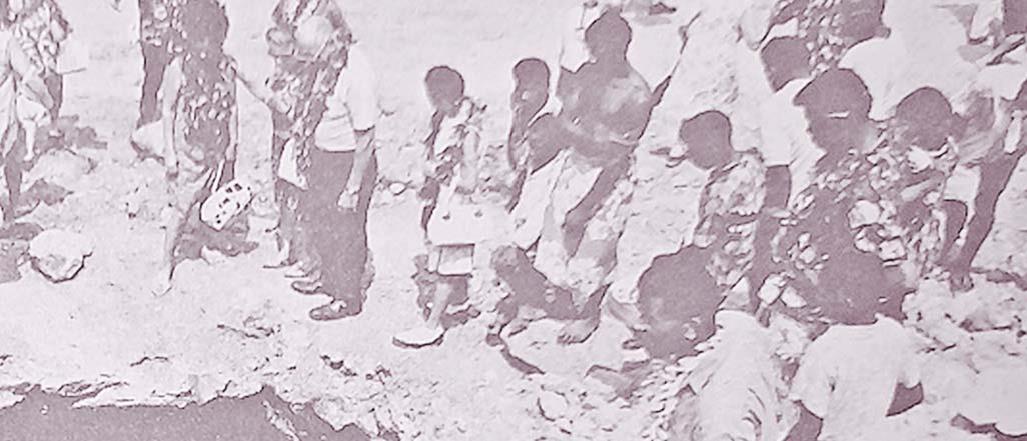
Before a hole believed to be the mythical Fijian seagod Dakuwaqa’s home was uncovered in 1971, the hole was already mentioned in the words of a chant for a meke (a traditional iTaukei dance) composed many years earlier.
The hole which was uncovered in Rukua Village, Beqa was claimed by the villagers to be the sea god’s home when it was uncovered by a bulldozer working at the site.
It had become a tourist attraction.
An article about the hole being uncovered was published in this newspaper on Wednesday, February 10, 1971.
Although not seen before by villagers until the discovery, the hole was already wellknown among villagers through a 20-year-old meke chant.
The site was later inspected by an engineer, R.J Britton and the Minister for Works and Tourism, C.A Stinson.
Public Works Department engineer R.J Britton inspected a tunnel that led to the hole in relation to work being done there by PWD bulldozers and he decided the hole would not affect the work.
Mr Britton described the hole as a subterranean tunnel, about 400yds long, 30ft wide and 12ft high for about 40 yards which extended from the coast to the hole.
The hole was about 9ft deep and contained fresh water.
Mr Peceli Vitukalawa, in a radio-telephone interview with The Fiji Times in 1971,
“The water did not appear to be running,” he said.
The director of Fiji Museum, Bruce Palmer, said the mystery hole might have some archaeological significance.
“I will have to make an on-the-spot investigation before I can be sure,” Mr Palmer told this newspaper.
Fiji Visitors Bureau photographer Nitin Lal had taken a picture when the pleasure vessel Coral See called at Beqa.
According to an article later published on Saturday, February 13, 1971 evacuation work was to be carried out on the site of the cavern.
The decision was made when the Minister for Communications, Works and Tourism, C.A Stinson, went to Beqa to inspect the waterfilled cave himself.
Mr Stinson had discussions with the villagers at Rukua where the cave was discovered earlier.
“There had been a suggestion that the cavern might be retained and used as a tourist attraction,” he said.
“The conclusion we reached was that the work should carry on.
“There is still some more land to be cleared from the place where the hole was discovered.”
Mr Stinson said attempts would be made not to damage the cavern.
“If this cannot be done we will consider either filling it in or leaving it as a small open lake,” he said.
He said there appeared to be a danger of cave-ins in the cavern.
He said the water in the cavern was brackish and murky.
The Public Works Department cut away a headland and used the material to reclaim land in front of the village.

