
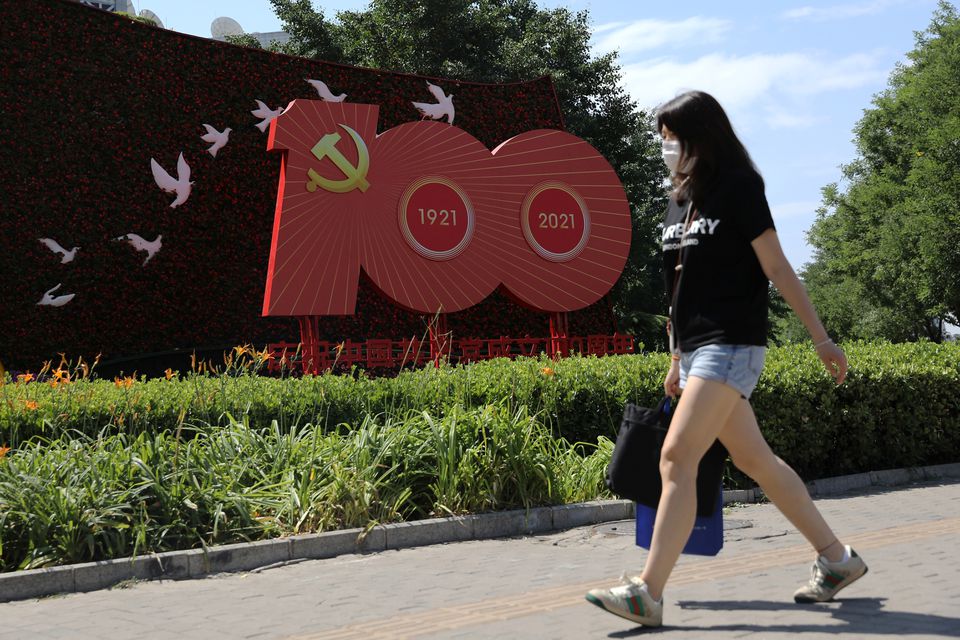
BEIJING, June 30 (Reuters) – China will mark the centenary of the founding of its ruling Communist Party on Thursday with pomp, spectacle, and what state media described as an “important” speech by President Xi Jinping in Beijing’s Tiananmen Square.
Xi, China’s most powerful leader since Mao Zedong, and the party are riding high as the country recovers briskly from the COVID-19 outbreak and takes a more assertive stand on the global stage.
State media has revealed little about the event amid heightened security and secrecy in the Chinese capital, but a flyby of fighter jets and helicopters is expected. Party elders and retired leaders typically appear on major occasions.
Over the past 100 years, the party has “written a splendid chapter in the history of the Chinese nation’s development and that of humanity’s progress”, Xi said on Tuesday in a ceremony honouring exemplary party members.
Since coming to power as general secretary of the party in late 2012 and president in March 2013, Xi has cracked down on corruption that eroded the party’s moral authority, and cemented himself as China’s most powerful leader since Mao with the abolition of presidential term limits.
The party’s ranks swelled by 2.43 million members in 2020, the biggest annual increase since Xi became president, and now has 95.15 million members, data released on Wednesday showed.
While the party initially recruited peasants and workers, it has evolved to embrace markets and entrepreneurship under what is known as “socialism with Chinese characteristics”, while retaining a Leninist model of authoritarianism.
As the party has strengthened under Xi and the room for public dissent has narrowed, public discourse has become increasingly nationalistic, with many Chinese expressing pride in the country’s achievements, crediting the leadership of Xi and the party
To be sure, China faces challenges, including backlash from the West over its actions in Hong Kong, Xinjiang and the South China Sea and its pressure on Taiwan, as well as a worsening domestic demographic outlook that threatens its economic growth.
Beijing also remains under global pressure over a lack of transparency in its early handling of the COVID-19 outbreak, first detected in the central city of Wuhan.
Fu Yangen, a Beijing resident, gave a resounding “Yes!” when asked if she would like the party to stay in power for another 100 years.
“It has enabled us ordinary people to achieve happiness in our lives,” said Fu, 27, as she posed for photos in front of large anniversary-themed flower arrangements along Changan Avenue, the city’s main thoroughfare.

