
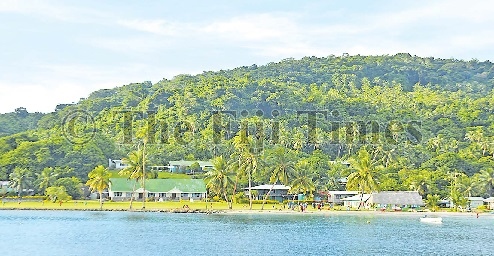
Spanning across the length of Buca Bay, Cakaudrove, Kioa’s only village of Salia cannot be seen from main land Vanua Levu if one stands from Tukavesi in Buca Bay where the Government station sits.
The village sits opposite the bay, facing the island of Taveuni which looms majestically across the span of sea known as the Somosomo strait.
Bordered by white sandy beaches and dotted by smart homes belonging to the people of Vaitupu who have called the island home for the past 73 years.
The island is a true image of a tropical paradise. Its inhabitants are fluent in the Cakaudrove dialect known as the ‘gato’ and are well versed in the traditional customs of their hosts.
However, they have freely practised the customs and traditions of their ancestors from Vaitupu on the island of Tuvalu where they originate from.
Salia Village elder and former chairman of the island’s council, Lotomau Fiafi a, explains that through the span of 73 years their people have intermarried with neighboring villagers in Cakaudrove and adopted their ways of living.
“However, this does not mean that we have lost our culture, we still hold them dearly and practise them,” said Mr Fiafia.
“We have in a way become a’i Ca’audrove (natives of Cakaudrove) even though our origins lie in Tuvalu.
“Even though we consider ourselves a’i Ca’audrove we still acknowledge our origins and that fact cannot be changed.” According to stories passed down them, Mr Fiafi a says their elders were never forced to leave, but were consulted as is their customs.
“Our Vaitupuan community gathered in their maneapa (community hall), a mat was placed in the centre, and an ofo (challenge) was made to the community for able-bodied volunteers,” he explained.
“Those who wished to go were asked to come forward and sit on the mat and once the surface of the mat had been filled with people, no one else would be able to join the first group.
“A total of 35 people mostly men, volunteered; among them were community leaders, teachers, administrators, accountants and medicallytrained personnel, the people needed to create a community.
“On their journey to Kioa the fi rst settlers travelled on board the Awahou, a trading boat that regularly made the trip between Kiribati, Tuvalu and Fiji and only one child, a two-year old girl, were among the group.”
The contingent arrived on the shores of Kioa on Sunday, October 26, 1947, at 2pm. After unloading their luggage, they gathered together and gave thanks to God for their safe passage across the vast ocean.
Today a plaque, unveiled in 1997 to commemorate the 50th anniversary of the arrival, stands near the church positioned directly inland from where the first settlers landed listing the names of the 35 setllers.
Mr Fiafi a shared that a Vaitupuan prophecy predicted that one day the Vaitupuan people would leave their homeland and go to Vai siku lagi, ‘the land beyond the horizon’ (literal translation as water, land, sky).
According to the present-day Kioans, the prophecy was fulfilled in 1947. Seperate groups of Vaitupuans arrived over the next few years and a final collection of 41 names was submitted for relocation in 1956, when it was estimated that there were 200 Vaitupuans in Fiji. The relocation was traumatic for the fi rst Vaitupuans who moved and once news of the diffi culties reached those back in Vaitupu, there was reluctance among the islanders to volunteer for subsequent trips.
According to Tavita Taulia, the island was bought in 1946 by the people of Vaitupu, an island in the nation of Tuvalu, with money earned from American Armed Forces during WWII. The Tuvaluans brought with them their culture, religion, and lifestyle which they have preserved and is still practised today.
The lifestyle of this group of people is overseen by the island’s council. It had sailed all the way from Vaitupu, carrying expectant passengers who were looking forward to start a new life on the island. A great silence befell all those on board as the tired and weary Polynesian islanders scrambled into life boats to complete the last leg of the journey.
As they set foot on solid ground, there was no one to welcome them. Only the strange sounds uttered by birds on this uninhabited island were the only greetings offered to these lone travellers. As the ship heaved its anchor and sailed away, the settlers who had sailed about 10,000 kilometres to get to their new home finally realised they were now left alone in a foreign country far away from their homeland.
The constant memories of their home country were the only realities that linked them to the past.
What awaited them were difficulties encountered in the early years of relocation accompanied by hope for a better future. Mr Fiafi a said to this day they still celebrated and recognised the efforts and insight of their forefathers who chose to abandon their home of Vaitupu, the largest of the eight Islands that made up the nation of Tuvalu (formerly known as the Ellice Islands).
“Our elders heard that three islands in Fiji were on sale and this were the islands of Rabi, Wakaya and Kioa.
“In 1946 after collecting the money to purchase the island they would later call home, the council of elders chose the island of Kioa.
“To this day we have not regretted that decision our elders made because our children now have access to better education and our people have an opportunity to make a living for their families.
“In the later 1980s, the people of Kioa were recognised and accepted by the Tui Cakau, the sovereign high chief of Cakaudrove, Ratu Tuikilakila Golea, who made us as part of his own clan.”
During the reign of Ratu Glenville Lalabalavu he enforced this decision reassuring the people of Kioa that we were part of his clan of Valelevu.
“For this recognition we are grateful as a people and we are proud to be a’i Ca’audrove.
“Staying in Fiji after all these years has not made us forget our beginnings as we still maintain contact with our people back in Tuvalu, especially those on the island of Vaitupu because we are still very much a part of them and they us.
“This is evident in the Tuvalu Government delegation that attended our anniversarial celebrations in 2017 on the island commemorating our elder’s arrival to the island.”
In 2005, the Fijian Government officially recognised the people of Kioa as Fijians.

