
ZURICH (Reuters) – Joern Schneemann thought he would be helping manage logistics for the Tokyo 2020 Olympics this year. Then, the COVID-19 crisis intervened, pushing the event back to 2021.
Instead, the head of Swiss logistics company Kuehne + Nagel’s European Expo & Events unit has been setting up vaccination centres in convention and sporting venues in Germany’s North Rhine-Westphalia state, the nation’s most-populous with 18 million residents.
Schneemann’s pandemic pivot illustrates how logistics firms like Kuehne + Nagel, Germany’s Deutsche Post DHL, Denmark’s DSV Panalpina and Spain’s Grupo Logista have turned COVID-19 disruption into opportunity, grabbing a share of the burgeoning “vaccine economy” while managing record demand in traditional businesses.
“Because of the pandemic, things turned out quite differently than we had planned,” Schneemann told Reuters from his German offices. “And it turned out well.”
Neither North Rhine-Westphalia, which kicks off its vaccination programme in nursing homes on Sunday in line with the rest of Germany, nor Kuehne + Nagel disclosed the contract’s value.
The company, which has secured other, undisclosed government contracts, will manage the rollout of millions of vaccines including Pfizer and German partner BioNTech’s, which won European approval on Monday.
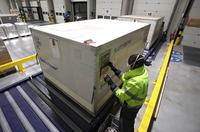
It must coordinate deliveries to halls filled with refrigerated containers that can handle the vaccine’s minus 70 degrees Celsius storage requirement at 53 sites around the state.
Europe is due to get 12.5 million doses of the Pfizer/BioNTech vaccine by Dec. 31, with Germany expecting up to 4 million doses through January, enough to inoculate 2 million people with the two-shot treatment.
“The temperature will also be electronically monitored and recorded during transport,” said Axel Birkenkaemper, a spokesman for North Rhine-Westphalia’s health ministry.
Rival Deutsche Post DHL has secured similar contracts in Lower Saxony and Baden-Wuerttemberg states to store and deliver part of the first tranche of the 300 million potential doses Germany has ordered.
“It’s more urgent and complex, certainly,” said John Pearson, chief executive officer of DHL Express. “But we’re accustomed to handling these kind of deliveries. We do this everyday.”

