
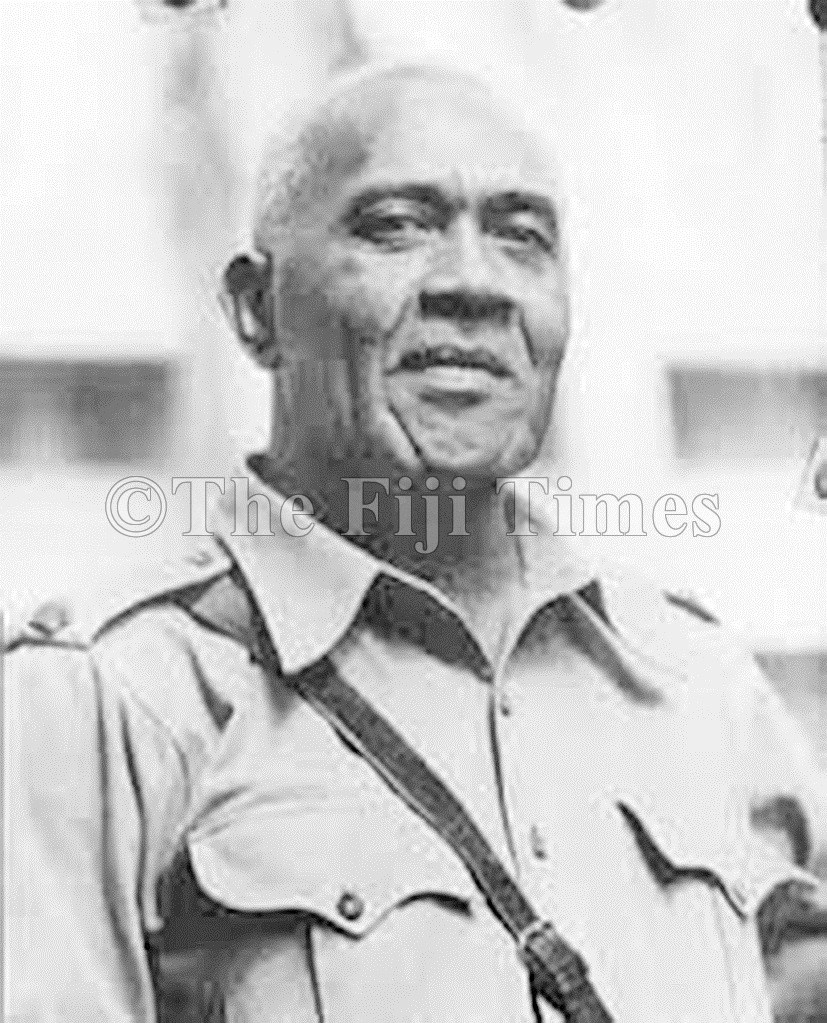
Part 2: This article is based on a radio program delivered by Sir Len Usher through the Fiji Broadcasting Commission in the 1950s where he talks about his visit with Ratu Sir Lala Sukuna to Yacata Island, Cakaudrove in 1944 to tell villagers about the awarding of the Victoria Cross to Corporal Sefanaia Sukanaivalu.
Altogether in the 25 years or more for which I enjoyed the privilege of Ratu Sir Lala Sukuna’s friendship, and it was a privilege which I still treasure, I travelled with him by sea within the Fiji Group well over 1000 miles.
But this trip was of special significance – one of the many occasions throughout Ratu Sir Lala’s life which have become part of the history of his homeland.
As it happened, we were not the first with the news. A boat had called on the island a few days after the announcement had been broadcast and the captain had told the people of Suka’s village about the award.
However, this did not mean very much. Very few of the people had heard of the Victoria Cross, or if they had done so, it did not create an impression in any way comparable to that which would have been created in, say, the United Kingdom or Australia or New Zealand.
The visit to tell the people of Yacata about the award was of deep consequence to Ratu Sukuna. It had been predominantly at his call that Corporal Sukanaivalu and other young men of Yacata and of towns and islands throughout Fiji had become soldiers and gone to the Solomons to fight.
His deep awareness of the history of his own people and the history of the people of Britain, into whose hands the chiefs of Fiji had confidently placed their destinies seventy years before, his pride in the achievements of the young men of his race during the war, his sense of historical significance, his place as the appointed leader of the Fijian people, all these things combined to give his going to Yacata on that particular occasion special meaning.
We took with us a portable 16-millimetre cinema projector and generator and before the last light of day faded the projector was set up on the rara.
The people, who were just coming in from their gardens or from fishing or who were preparing the evening meal, were told to gather in an hour’s time and then, when darkness fully arrived, the pictures began.
There were some British Ministry of Information shots about the war in Europe and then we showed three films which had come from New Zealand. They were all weekly reviews of the National Film Unit.
One dated from the time when the first Fijian commandos went to the Solomons, on the association of New Zealand and Fiji on the field of battle began.
Then there was the Film Unit’s fine record of the 1st Battalion to Fiji.
Of the hundred or so people sitting on mats or the grass that warm, peaceful night, probably not more than a dozen had ever seen moving pictures before.
There had certainly never been pictures on Yacata before.
Few of the people knew very much English and so a commentary was given in Fijian as the screening proceeded.
The audience was made up mainly of women and children and old men. The young men were nearly all in uniform and away, and to those who watched the films, the added reality was given to the letter from these young men and to the stories told by those who had come back on leave.
When the pictures were over there was a pause while everybody talked for a while about what they had seen.
Then Ratu Sukuna took the microphone and spoke to the people of that little village of the remote island of Yacata, the birthplace of Corporal Sefanaia Sukanaivalu, VC.
He spoke very simply. He recalled some of the things they had seen on the screen and said that these would help them understand what he was going to tell them.

