
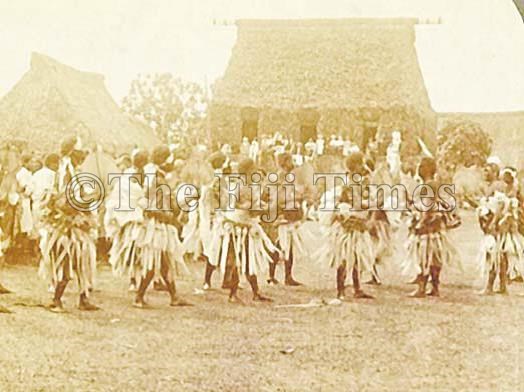
3. Lokaloka ua
This meke likened to the rush of the incoming tide, imitated by 600 dancers. You could hear the moan of the sea, and the reefs growling long before the dancers were in view. Each dancer had a great headdress of white stuff (masi) to imitate the foam, and at length the first line came in a huge human wave, surging across and inundating part of the rara, the second wave did not wait, but came on quivering and threw itself upon the first, the third appeared upon the horizon, white foam, each dancer shaking his headdress, it broke covering the two first, producing an effect of waves which surged and beat against each other. The dance continued for half an hour; it was a fine spectacle. When the dance finished the dancers were so played out that many remained upon the turf for a long time as if dead.
4. Ruasa
The dancers in this are all young people, they come to it as for the meke mada but without clubs. It takes place upon the rara in front of the house of the chief. The lali is carried as is customary in the arms of one of the singers, the orchestra is standing up, and surrounded pell-mell by the dancers who are on foot. After the song has continued for some time, suddenly from the right and left, two young people detach themselves until the number required for the dance is made up. Once the right and left-wing of the dancers deploy the true meke commences. They contort themselves in a way to make one shudder, and it is one of the widest spread and most followed in Fiji. The ruasa commences at evening and does not finish until morning. The young people alone must carry out this dance as one must be both robust and supple to withstand the strain. The subject may be either war, a voyage, girls, or a girl etc. It has been introduced into Fiji by the luve-ni-wai and cannot be very ancient. The luve-ni-wai, literally “children of the war” are supposed to be the souls of still-born infants who in obedience to prayer and sacrifices enter into the bodies of the young boys or girls. Those are suddenly seized with tremblings, and know and teach the ancient dances which are totally forgotten by the present generation; the words of the songs are often sensual but the cadence is perfect.
5. Meke ni yau
(Dances for goods) These are great dances special to fairs or solevu. The writer likens it fairs as they are great influxes of people into a village to exchange goods, mats, pottery, whale’s teeth, canoes, pigs etc. The exchange is made not from individual to individual, but from tribe to tribe. Some will have prepared mats, others will bring whales’ teeth, but to take the mats before the chief of a tribe and invite him to exchange his whales’ teeth for them would seem prosaic. They have invented special dances for the purpose; those are the meke ni yau. The preparations and the execution are the same as for the meke mada or wesi, but the form of action is different. There are a number of meke ni yau, but I will only describe two which I have seen. The Kalou Yalewa (Goddess) was danced after this manner at Rewa, Fiji. After many months devoted to practice the day of the fair or solevu arrives, and on the previous evening two beardless young men had been set aside to whom no food is given, they may have a more languorous air and look more effeminate. On the day of the solevu the crowd sits silently on the rara, awaiting the arrival of the goddesses, the lali or native drum has been beating for several hours at length the crowd opens out, and out two adolescents appear, attired as young girls in fishing costume, nets in hand and the fish basket suspended on the right hip. A silence as of death reigns in an assembly. At the other extremity of the rara, the the crowd also draws back to allow some four hundred dancers to pass, who advance gesticulating in unison in two ranks. They advance quite close to the two goddesses
who remain still as statues. The two ranks of dancers, at about nine yards one from the other, form the banks of a fictitious
river. They stop, and the two fishers commence, they advance with their nets following down each imaginary bank for
about ten yards, and to each dancer a fish jumps into their net, the fish being nothing but a whale’s tooth. The crowd gives
a special cry unique and used only for thisgift of whales’ teeth, which is the most prized of all the riches of a Fijian.
The cry runs: – Ah! Woi! Woi! Hou! The Ah! Woi! Woi! In bass tone and hou! Is given in a very sharp highly raised tone. Two
men follow and gather the whales’ teeth (tabua) into baskets, which they empty at the feet of the chief, who when the fair
is fi nished distributes them in proportion to those who have given more or fewer goods in exchange. The mats are given during the dance called tiqa sau. Tiqa is a national Fijian game. It requires a course about 220 yards long by 7 yards wide. On this occasion only, the alley is laid with mats along which the chiefs throw their tiqa, which in this case will be a whale’s tooth. Those
are their delicate and interesting methods of presenting and exchanging their riches.

