
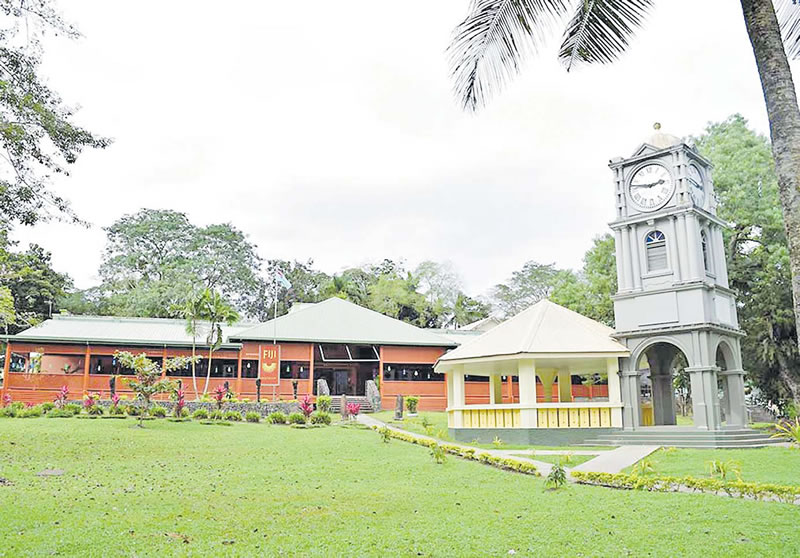
IT’S 2020 and what better way to learn about Fiji’s educational history by paying a visit to the Fiji Museum. Located in the Capital City’s botanical gardens, Thurston Gardens, the museum
boasts a remarkable collection.
It has in its collection, archaeological material dating back 3700 years and cultural objects representing both Fiji’s indigenous inhabitants and the other communities that have settled in the island group over the past 200 years.
According to information provided by the museum, the idea to display and preserve traditional Fijian culture was first discussed in 1904.
Later that year Sir William Allardyce presented his collection to the Suva Town Board, and it was displayed in the Town Hall.
“In 1908 the Fijian Society was formed with the specific aim of researching and preserving the country’s history and culture,” described an information sheet provided by the museum.
The establishment of a museum was included in this aim. In 1910 the government approved an annual grant of £25 to appoint a collection caretaker.
After the passing of the Fiji Museum Ordinance in 1929, the museum was formally recognised as a government statutory body with a board of trustees.
Local residents presented pieces and collections to the Town Board and artifacts were purchased by the trustees.
“These contributed towards a growing collection which filled the Town Hall.
The collection remained on display in the Town Hall until 1919 when a substantial part of the hall was destroyed by fire.
The collection was moved to a variety of venues until the government was persuaded by the trustees to build a National Museum.”
“The current museum was opened in 1955 by the Governor of Fiji, Sir Ronald Garvey.
This building was used to house the displays, reserve collection and provide storage. Today, the building has two adjoining sections, the first constructed in 1972 and the second in 1978.
Together, these buildings provide a history gallery, masi gallery, art gallery, Indo-Fijian gallery, temporary exhibition space, storerooms and gift shop.
The archives, photographic studio, editing suite, library and administration offices are located in what was the Nawela Hostel for women, adjacent to the main museum building. For a long time, the
museum served as a storehouse for cultural items and as a centre for an erudite minority.
The majority of local people did not show much interest. In the 1960s a series of education and craft programs was initiated by the newly appointed director, Bruce Palmer.
Over the years, the museum’s reputation was built up as a research institution by directors such as R.A. Derrick, B. Palmer, and F. Clunie.
Their work along with that of other world-renowned scholars was published by the museum, establishing it as a small centre of academic excellence.”
The museum plans to open an exhibition this year. Titled Our Heritage Sounds: Exploring the past and transition to the present through trends in Fijian musical instruments, the exhibition aims
to show the various musical instruments used by our ancestors.
Director of Fiji Museum, Sipiriano Nemani says the exhibition would soon be opened to the public and interested readers could keep a lookout on their social media pages Facebook, Instagram
and Twitter site.
“We’ve already set up the musical display but (we’re) still working on captions and narratives,” he said.
So if you don’t have anything to do in the weekend, be sure to make a visit to one of our oldest institutions in the country and explore the treasure within.

