
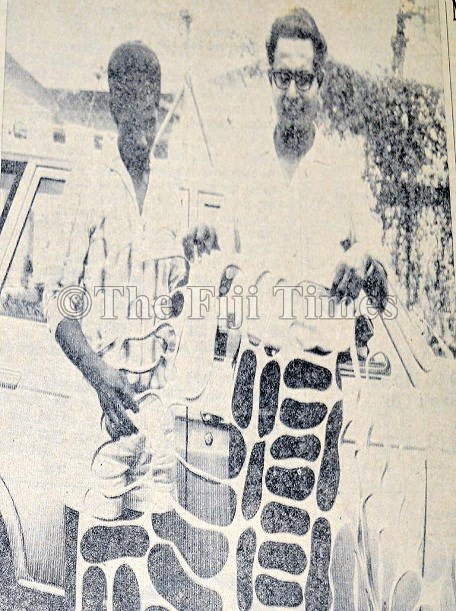
DUE to its popularity in Fiji, the country opened its first flip-flop factory in Nausori in the 1960s to reduce its importation from Asia.
In 1966 alone, the Colony imported about 50,000 pounds worth of flip-flops from countries such as Malaya, Singapore, Hong Kong and Japan.
In February 1967 local company, Japan Industrial Corporation Ltd started experimenting with flip-flop manufacturing machines to check out the viability of the industry.
Company managing director Lall Hathi Ramani, a former Bombay businessman who came to Fiji from Japan, saw the huge demand for the product but noticed there was no factory available to produce it.
Ramani later teamed up with R.N. Mahtani, one of Japan’s leading exporters headquartered at Kobe City, to produce flip-flops here and to make them more accessible to Fijians.
Mahtani, who had flip-flop factories in Japan and Trinidad, came to Fiji in February 1966 to scout opportunities for his textile export business.
“He saw the possibility of starting a factory for rubber beach sandals or flip-flips in the Colony and began negotiating straight away,” said The Fiji Times of February 25, 1967.
The location of Fiji’s first flip-flop factory to keep company costs down and to give an economic boost to Nausori, which became a town in 1931.
“We plan to cater for the Fiji market and later for markets in other Pacific territories,” Ramani was quoted as saying.
Modern flip-flops were influenced by many cultures of the world originating as early as the days of ancient Egyptians.
In the United States, the flip-flops are designed from the Japanese straw sandals, zori, which became popular after soldiers took their many pairs home at the end of World War II.
They became popular unisex summer footwear starting in the 1960s.
Flip-flop is an onomatopoeia that describes the sound made by the sandals when walking in them.
They are called “thongs” in Australia, “jandals” in New Zealand, “visplakkies” in South Africa and Zimbabwe, and “tsinelas” or “step-in” in the Philippines.

