
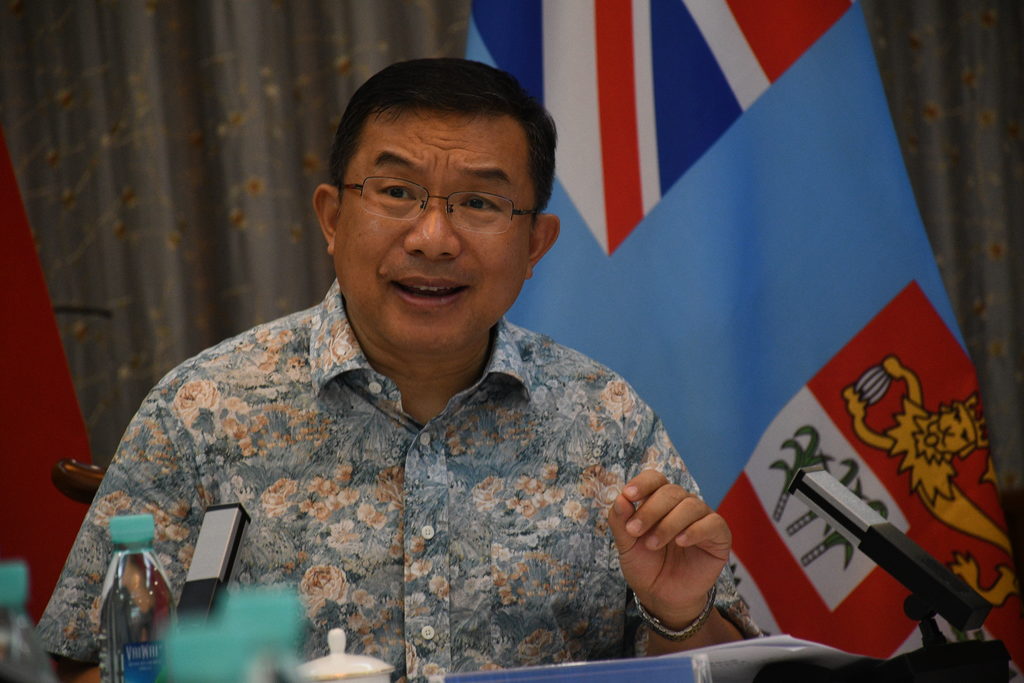
CHINA’S Ambassador to Fiji Zhou Jian held a media briefing at the Chinese Embassy in Suva on Wednesday last week, relaying China’s position on the current US-China trade war, perceived to have been instigated by the United States through President Donald Trump’s tariff imposition on its trading partners early this month, irrespective of size or development status. China, however, has stood out as its main target and according to Ambassador Zhou, China’s position is clear: “our door remains open for talks, but any dialogue must be conducted on the basis of mutual respect and equality”.
“If the US wants to talk, it has to let the people see that it is ready to treat others with dignity, equality and mutual benefit,” he said.
An old Chinese saying, he added, advised that “the person who ties the bell must untie it”, meaning that the one who created a problem should be the one to resolve it.
“If confrontation is the path chosen, China will fight to the end,” Mr Zhou said.
Below is the full text of his speech.
“Today, I’d like to share with you China’s position regarding the US imposition of reckless tariffs on its global trading partners.
Recently, the United States has been levying tariffs on the international community under poor pretexts and absurd methodologies.
First, it slapped a 25 per cent tariff on all steel and aluminum imports.
Then, citing the fentanyl issue, it imposed an additional 10 per cent tariff on China.
Now, under the guise of so-called “being taken advantage of”, it has introduced “reciprocal tariffs”, imposing a 32 per cent tariff on Fiji and raising those on China from 34 per cent to 145 per cent.
The world has witnessed the most reckless and destructive unilateral economic bullying since the end of World War II, a disgrace that will go down in global history.
In response, I’d like to highlight a few key points:
I. Has the United States really been taken advantage of in its trade with China?
The answer is no. The United States has benefited, not lost, in its trade with China. The essence of China-US economic and trade cooperation is mutual benefit and win-win. Over the years, bilateral trade has skyrocketed from less than $US2.5billion ($F5.66b) in 1979 to nearly $US688.3billion ($F1.5trillion) in 2024, a 275-fold increase.
While China has certainly benefited, the US has also reaped enormous profits, far from being the so-called “victim” some politicians claim.
How did I come to this conclusion? You need to look beyond trade deficit in goods to have a fair assessment of China-US trade relations that takes into account trade in services and on-the-ground sales of companies in the host country.
As WTO Director-General Ngozi Okonjo-Iweala highlighted in her recent article “America’s Big Trade Win”, the US is not only a major beneficiary of the global trading system, but also holds a dominant position in the services trade sector, with a service trade surplus of nearly $US300 billion in 2024.
China, in fact, is its largest source of surplus. In key sectors such as travel, intellectual property royalties, and transportation services, the US holds an overwhelming advantage over China.
In 2023 alone, America’s services trade surplus with China stood at $US26.57b ($F60.23b), a clear proof that the “America is ripped off” narrative is utterly wrong. This is the first point.
Second, according to data from the US Department of Commerce, American companies in China generated $US490.52b ($F1.11t) in sales in 2022, far greater than the $US78.64b ($F178.2b) in sales by Chinese firms in the US
This means US businesses earned over six times more in China than their Chinese counterparts did in the US.
If we take all the above into consideration – trade in goods, trade in services and on-the-ground sales of companies in the host country – it’s evident that trade between China and the US is balanced.
Basically, both sides have benefited equally.
I must also emphasise that US exports to China have created massive employment opportunities at home. In 2022, exports to China directly supported 931,000 American jobs, making China the third-largest contributor to US employment, ranking after Canada and Mexico.
China’s contribution even surpassed that of Japan and the Republic of Korea combined.
Furthermore, Chinese goods entering the US market have significantly reduced living costs for American households, particularly boosting the purchasing power of low- and middle-income families.
The Forbes magazine revealed that real wages of Americans have stagnated since the mid-1980s.
Without affordable Chinese products, their standard of living would be far worse, and frankly, they might have started revolutions long ago.
II. Why is it said that the US abuse of tariffs is utterly wrong?
First, US tariff policy is absurd. It is hard to imagine that a tariff policy with such global consequences was derived not through rigorous scientific analysis, but rather a simplistic formula: take the trade deficit that the US runs with a country, divide it by its total exports to the US, and then halve the number, and you get the tariff rate!
For example, if a country exports $US10b ($F22.6b) worth of goods to the US and imports $US4b ($F9b), what the US does is divide the $US6b ($F13.6b) deficit by $US10b ($F22.6b), halve it, and arrive at 30 per cent – the so-called “reciprocal tariff rate.”
This method quickly drew criticism from the international community.
Gary Hufbauer, a senior fellow at the Peterson Institute for International Economics and former US Treasury official, stated that “there is no basis for the claimed tariff-equivalent rates imposed by other countries. This is pure invention.”
Adding to the irony, this flawed tariff policy spares no one – not even penguins in the Antarctica. The US has gone so far as to impose tariffs on places where there are no human beings, let alone international trade.
Another absurd example – take Hong Kong as example. Everybody knows Hong Kong is a free port. It has no tariff policy towards all countries in the world including United States.
If United States resorts to reciprocal tariff policy, it should also be zero per cent.
And Hong Kong has long been the main source for trade surplus of United States.
For the past 10 years, United States have obtained nearly $US300b ($F680b) of trade surplus from Hong Kong.
But it still imposed 145 per cent tariff upon Hong Kong.
My dear friends, what United States want is not tariff.
It wants the life of Hong Kong.
It is pure economic bullying and blackmail.
Second, the US tariff policy is utterly selfish.
Under the guise of pursuing so-called “reciprocity” and “fairness,” the US engages in zero-sum games—its true essence being “America First” and “American exceptionalism.”
It prioritises US interests above the common good of the international community, sacrificing the legitimate interests of nations worldwide to serve America’s hegemonic agenda.
To shift the burden of its domestic economic woes, the US has started trade wars against all countries, including the least developed nations.
Rebeca Grynspan, secretary-general of the United Nations Conference on Trade and Development (UNCTAD), pointedly noted that the 44 Least Developed Countries contribute less than two per cent of the US’s trade deficit, and that higher tariffs would only make their existing debt crisis much worse.
The New York Times also observed that imposing steep tariffs on these nations illustrate “the stupidity and cruelty of Trump’s new trade poliicy”
Take Fiji for example.
In 2024, Fiji’s trade surplus with the US was a mere $F63 million, while 96 per cent of US goods entering Fiji enjoyed ultra-low tariffs of zero to 5 per cent.
Yet, the US repaid this goodwill with hostility, slapping a punitive 32 per cent tariff on all Fijian exports.
In the face of US trade bullying, China – as the world’s second-largest economy and second-largest consumer market – can still rely on its robust industrial chains and diversified markets to withstand pressure.
But for Pacific Island nations like Fiji, whose economies are fragile and dependent on a handful of export industries such as bottled water, kava, fish, and sugar, tariff barriers directly affect people’s livelihoods.
These measures push Fiji into an even more disadvantaged position in the global trade system, stripping it of the basic right to sustainable development.
For small nations like Fiji, this could be a catastrophe. Third, the US tariff policy is disastrous.
America’s actions have severely disrupted the stability of the global economy and supply chains, undermined international trade rules, and backfired on its own economy.
The International Monetary Fund (IMF) warns that the new round of US tariffs will lead to reduced investment and supply chain chaos, posing significant downside risks to the global economy.
It estimates that global economic output will shrink by 0.8 per cent in 2025 and 1.3 per cent in 2026 as a result.
The World Bank cautions that if the US imposes a blanket 10 per cent tariff and trading partners retaliate with counter-tariffs, global economic growth in 2025 could decline by 0.3 per cent.
The US approach blatantly violates WTO members’ commitment to non-discrimination, overturns the negotiation and taxation framework established by the General Agreement on Tariffs and Trade (GATT), and dilutes the principle of Most Favored Nation (MFN) treatment, causing unprecedented damage to international trade.
If the world caves in to US pressure, the rules-based global trade system under the WTO will collapse, and the law of the jungle – where might makes right – will return.
Stephen Walt, a professor at Harvard University, argues that by flouting international rules, the US is attempting to overturn the entire global order, creating a world where authoritarian hegemony thrives and the powerful act with impunity. In doing so, America has transformed from a defender of the international order into an outright “rogue state.”
Since the announcement of the tariff policy, the US has begun to taste the bitter consequences.
As American citizens rush to stockpile goods, protests and demonstrations have erupted across all 50 states, with 600,000 people taking to the streets.
The US stock market plunged, with more than $US6trillion ($F13.6t) in value wiped out in just two trading days.
The combined market capitalisation of the “Magnificent Seven” – Apple, Microsoft, Amazon, Tesla, Meta, Nvidia, and Google – suffered a loss of $US1.8trillion ($F4t).
Lawrence Summers, Harvard economist and former US Treasury Secretary, noted that “we’ll see an extra two million people be unemployed and we’ll see losses in household income of $US5000 ($F11,300) per family or more.”
III. Why does China choose to uphold justice rather than kneel down and surrender?
Faced with America’s unilateralism and economic bullying, there are two possible responses: kneel down and surrender, or fight back. Past experiences has taught us that if you back down, they will only push harder; if you let them call the shots, you will sacrifice your own future of development, and the world will be brought back into the dark age of the law of the jungle. Since the US imposed its tariff measures, countries worldwide have sought negotiations with the US to safeguard their legitimate rights and the well-being of their people. Yet these efforts have not been met with due respect.
The leader of the United States arrogantly dismissed them as “kissing my ass”, while vice President Vance openly called the Chinese people “peasants”, laying bare America’s arrogance and hegemony.
Just like a gangster in a street. Blackmail you today $5, tomorrow $10, next month $100 and then you have to give your house and then you have to give your family, your life.
My dear friends, Chinese people value sincerity and good faith.
We do not provoke trouble, nor are we intimidated by it. Pressuring, threatening, blackmail, intimidation are not the right way in dealing with China. China is a major nation and a responsible member of the international community.
We stand firm against power politics not only to protect our own sovereignty, security and development interests but also to uphold the common interests of all humanity, safeguard international fairness and justice, preserve the multilateral trading system, and prevent the world from regressing into the dark age of the jungle.
We choose not to surrender. We choose to fight back. Not only to protect our own interest, but also to protect the interest of the international community.
To uphold and safeguard international fairness and justice, preserve the multilateral trading system and prevent the world from regressing to the dark ages of the jungles.
We will not sit idly by when the Chinese people’s legitimate rights and interests are denied or when the international trade rules and the multilateral trading regime are undermined, or when the world goes back to the law of the strong preying on the weak.
Based on what I mentioned above, China has taken firm countermeasures, including raising tariffs on US imports to China to 125 per cent, filing a case against the US under the WTO dispute settlement mechanism, adding 12 US entities to the export control list, and placing six US companies on the unreliable entity list.
Let me emphasise this: it is because of China’s firm resistance that the US was forced to backtrack and announce a 90-day suspension of its so-called “reciprocal tariffs” on other countries, while quietly exempting some goods from these tariffs.
China’s firm resistance won the world the suspension. I hope our media friends will report this line. Looking ahead, the 1.4 billion Chinese people have more than enough confidence to withstand tariff bullying.
How things will develop depends on the choices of the US side.
China’s position has long been clear: our door remains open for talks, but any dialogue must be conducted on the basis of mutual respect and equality.
If the US wants to talk, it has to let the people see that it is ready to treat others with dignity, equality and mutual benefit. If confrontation is the path chosen, China will fight to the end.
Intimidation, threat and blackmail are not the right way to engage with China.
There is an old Chinese saying: the person who ties the bell must untie it.
We urge the US to face up to the rational voices of the international community and domestic parties.
And take a significant step in correcting its mistakes, completely cancel the wrong practice of reciprocal tariffs and return to the right path of mutual respect and resolving differences through equal dialogue. Some people ask, where does China’s confidence come from?
Let me tell you: It comes from China’s wise leadership, from the unique strengths of China’s system, from the united will of 1.4 billion Chinese people, from our super-sized market and complete industrial system.
Most importantly, it comes from China’s unwavering stance on the right side of history and the side of fairness and justice.
We believe we stand on the right side of history.
China’s opposition to US economic bullying is a just cause—and just causes will always win the widespread support of people around the world.
IV. China, Fiji, and the international community must stand together on the right side of history
In the face of US tariff bullying, the international community must reflect: Do we choose unilateralism or multilateralism?
Bullying or equal dialogue?
Selfish gains or mutual cooperation?
Upholding the post-World War II international order or regressing to the law of the jungle?
I propose three collective actions we can take:
1. Uphold international rules and reject unilateralism
As key members of the WTO and beneficiaries of the multilateral trading system, China and Fiji must jointly champion an open global economy, defend the WTO-centered multilateral framework, promote universally-beneficial and inclusive economic globalisation, safeguard open and cooperative international environment, stabilise global industrial and supply chains and protect the shared interests of developing nations. We must be the defenders of the rule-based global economic and trade system.
2. Defend fairness and justice, oppose the strong bullying the weak
Development is a universal right, not a privilege for a select few.
Under the UN Charter, all nations – regardless of size or strength – are equal.
Global affairs must be resolved through collective consultation, and the world’s future must be shaped by all.
Imposing one’s will on others is doomed to fail.
The US, by prioritising its own interests over global welfare and sacrificing others to serve its hegemony, acts against the tide of history.
Such unjust practices will only invite stronger opposition and ultimate defeat.
We must unite, deepen cooperation, and resolutely oppose unilateral bullying tactics – such as weaponising tariffs and destabilising global supply chains – to safeguard every nation’s right to development.
3. Expand open cooperation for mutual benefit
As longstanding trade partners, China and Fiji have seen robust growth in economic ties, with bilateral trade reaching $US526m ($F1.1m) in 2023 and $US534m ($F1.2m) in 2024, a 1.52 per cent year-on-year increase, we shouldn’t be satisfied with that. There is still a great potential for our trade.
Building on the momentum of 50th anniversary of diplomatic relations and the outcomes of Hon Prime Minister Rabuka’s visit to China, we must synergise China’s Belt and Road Initiative and Global
Development Initiative with Fiji’s national strategies.
Both sides should promote cooperation in traditional areas such as infrastructure, trade, agriculture and fisheries. Meanwhile, we should also explore new frontiers like poverty alleviation, green development and e-commerce.
China will continue to expand imports of Fijian specialty goods, support Chinese enterprises to invest in Fiji, and encourage tourists to visit Fiji.
China also remains committed to supporting Fiji’s development through projects like Juncao technology and rice planting technology and also the Vanua Levu Road Upgrading Program. Please remember: the US represents just 13 per cent of global trade.
The remaining 87 per cent – over 190 countries – hold vast potential for growth through cooperation.
Strengthening China-Fiji collaboration and fostering shared progress is the strongest rebuttal to US unilateralism and economic coercion. The best answer is to deepen our win-win cooperation.
China is the world’s market and a source of opportunities for every country.
In a world full of uncertainties, China will continue to seek joining hands rather than throwing punches, removing barriers rather than erecting walls, and promoting connectivity rather than decoupling.
We will further expand the trade network, be an even stronger magnet for investment, and provide stability and positive energy to the world economy through high-quality development and high-standard opening up.
My dear friends, let me assure you, the door of China will be open ever wider to the world.
We’ll promote high standard opening up. We will expand the system opening up, institutions opening up in rules, in management, in principles.
And we will promote high quality development. China’s economy is an ocean, not a lake.
External shocks will never change the fundamentals of China’s economy. Nor can it change the positive trend of China’s high quality development.
To sum up, trade wars and protectionism benefit no one.
All countries must adhere to the principles of “extensive consultation, joint cooperation and shared benefits”, address differences
Note: This article was first published on the print version of the Fiji Times dated April 21, 2025

