
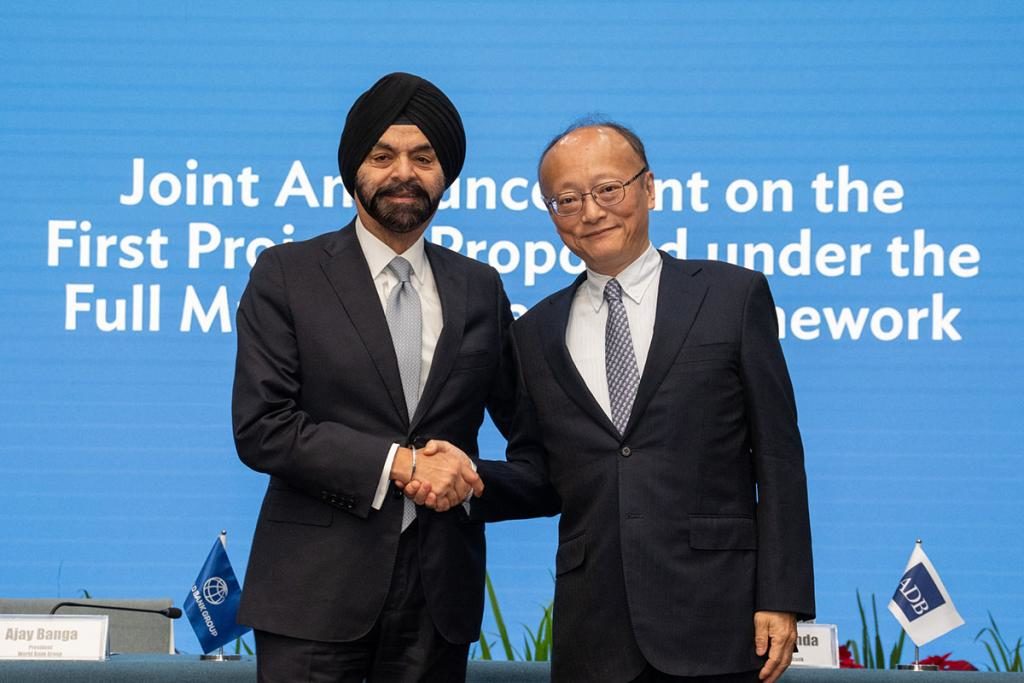
THE World Bank and the Asian Development Bank (ADB) have jointly announced a $US239.5million ($F541.3m) project they will co-finance to fight Non-Communicable Diseases (NCDs) in the Pacific, with Fiji as the centre of operation.
Set to transform Fiji’s health sector and fortify the war against one of the Pacific region’s deadliest killers, the Pacific Healthy Islands Transformation (PHIT) project is one of the first two under the Full Mutual Reliance Framework (FMRF), a new cofinancing model launched by the two multilateral financing agencies early this year.
World Bank president Ajay Banga and ADB president Masato Kanda jointly announced the PHIT project in Manilla last week as one that will “mark the largest single operation of the World Bank Group in the Pacific”, with the World Bank being the lead agency for the project.
PHIT, they said, will “modernise Fiji’s primary health-care networks and support a new, state-of-the-art regional hospital, giving people across the Pacific greater access to treatment for cancer, cardiovascular disease, diabetes, and other major health conditions.”
In a video message following the announcement, Minister for Finance Esrom Immanuel said the PHIT will finance the construction of the new Colonial War Memorial Hospital.
“The PHIT project is designed to strengthen regional health system and enable greater leverage for shared resources to improve access to quality health services with a focus on improving the management of NCDs which remains a major challenge, with rising burden of disease and economic impact,” Mr Immanuel said.
“The project supports both primary and tertiary care level, improving access to and quality of preventative care, while also financing the construction of the new Colonial War Memorial Hospital with climate resilient and gender responsive features.”
Questions have been sent to both institutions on the details of PHIT and how much of it will be spent in Fiji.
In his speech, Mr Banga said through PHIT, “we think we’ll reach two million people…[and] generate 11,000 jobs across Fiji, Tonga, Kiribati and Tuvalu, Nauru, Samoa, Solomon Islands, and Vanuatu.”
The new FMRF, which the two agecncies signed in February this year, will allow countries to work with a single lead lender – either ADB or the World Bank – guiding all aspects of project design, preparation, supervision and evaluation, thereby streamlining processes and reducing duplication between the two institutions and enabling faster project implementation, lower transaction costs and continued adherence to high policy standards for member countries.
The first two projects under the framework are PHIT and an integrated transport, urban and water infrastructure investment in Tonga, with the ADB as lead for the latter.

